




















Bathroom Café Curtains: Privacy-Smart Half-Window Ideas for Every Style (2026)

A bathroom window is the classic privacy-versus-daylight standoff: cover it and the room goes cave-dark; leave it bare and you are on display. Café curtains — also called tier curtains — solve it neatly. They cover only the lower half of the window, blocking sightlines at eye level while daylight keeps pouring in from the clear glass above. That is exactly the balance a bathroom needs, which is why designers now treat café tiers as a smart functional choice, not just a nostalgic cottage detail.
This guide covers everything that actually matters for a bathroom: which fabrics survive the humidity, how high to hang the rod for real privacy, how to style café curtains for coastal, farmhouse, cottage or modern baths, hardware and no-drill options, and how to keep them mold-free. If you already know you want the look, you can browse our café curtains and use the guide to choose well.
Why café curtains beat blinds & frosted film in a bathroom
Because a café curtain covers only the lower sash, it preserves the sky view and daylight through the upper glass — so a small bathroom stays bright and feels larger. Full blinds and roller shades, by contrast, usually black out the entire window when closed, cutting both light and view.
- Frosted film / frosted glass diffuses light across the whole pane permanently. Great for fixed privacy, but it is not adjustable and can flatten the quality of daylight. It pairs beautifully behind a café curtain.
- Roman shades & blinds can be light-filtering, but once lowered for privacy they cover the upper glass too, behaving like a full blind.
- Café curtains keep the top half clear all day, and because the upper window stays open they actually help air circulate and dry the window after a shower.
The quick rule: choose café tiers when a bathroom faces neighbors or the street at eye level and you want privacy with maximum daylight — especially in small or north-facing rooms. (Café curtains shine in kitchens too; for that room see our kitchen café curtain ideas.)
Humidity & mold: the fabrics that actually survive a bathroom
Bathrooms combine steam, temperature swings and weak ventilation, so humidity often sits above 60% and condensation forms on cool glass. If fabric stays damp along a hem for 24–48 hours, mildew can start — especially where dust collects in folds. The fix is part fabric choice, part airflow. Choose fabrics in this order of bathroom-friendliness:
- Polyester & poly blends — the safest pick. Less absorbent than natural fibers, fast-drying, and more mildew-resistant. Many are sold specifically as moisture- or water-resistant for humid rooms.
- Performance / treated synthetics — solution-dyed or antimicrobial-treated fabrics add water repellency and resist fungal growth (the same logic hospitals use for antimicrobial privacy curtains).
- Linen & linen blends — on trend for their organic texture, and linen is naturally somewhat mildew-resistant, but it absorbs water and dries slowly. Best in drier bath zones, or as a blend, or paired with a removable liner.
- Bamboo & natural woven — treated bamboo and composite faux-wood weaves bring warmth and resist warping; a good route for a café-height natural look. Our jute & bamboo woven shades work well where you want texture plus light privacy.
Use with caution near the tub: pure cotton, untreated linen, and heavy blackout fabrics (especially foam- or rubber-backed) trap humid air against the glass, slow drying, and raise the mold risk. Keep those for low-moisture, well-ventilated bathrooms only.
Privacy + daylight: height, lining & frosted glass
Rod height. Mount the café rod roughly halfway up the window for classic proportions, or a little higher — around two-thirds — when you need more privacy while keeping clear glass at the top. The reliable test: have someone stand outside at normal viewing distance while you pin the curtain, then adjust until sightlines to the tub, toilet or vanity are blocked. Street-facing or overlooked windows usually want the higher mount.
To line or not. Unlined linen or semi-sheer polyester is lovely where frosted glass, distance or landscaping already gives partial privacy. Where the window faces a neighbor or sidewalk, add a light lining or backing layer — privacy drops at night with the lights on. Avoid heavy blackout linings in a humid bath: they cut breathability and trap moisture between layers. A great compromise is a semi-sheer café tier over frosted film.
Pair with frosted glass. Treat film or frosted glass as the foundational privacy layer, then hang a café curtain in front for warmth, color and a finished look. The film guarantees obscured views even when the curtain is open — just re-check night-time privacy, since etched glass still shows blurred movement.
Styles: matching café curtains to your bathroom
Café curtains are one of the easiest ways to add softness, texture and pattern to a room dominated by hard tile and glass. A few directions from 2025–2026 trend coverage:
- Coastal & beachy — gauzy white or oat tones in linen-look fabric, or blue/sand ticking stripes; pair with pale tile, chrome or brushed-nickel fixtures and woven baskets. In salty, humid climates lean on linen-look performance synthetics.
- Farmhouse & modern farmhouse — gingham, ticking stripe or small-scale florals on slim black or oil-rubbed-bronze rods; for modern farmhouse, pare back to solid flax-tone linen with a subtle banded edge.
- Cottage & cottagecore — the big driver of the café revival: ditsy florals, embroidered or scalloped hems, soft ruffles. Keep wall tile quiet so the curtain can be the focal point.
- Modern & transitional — flat-front linen or linen-look poly in white, greige or charcoal on slim metal rods; keep fullness modest (1.5×–2×) and match the rod finish to your existing fixtures.
Our Elara linen café curtains come in several muted colorways and suit most of these directions; reserve ornate scallops and ruffles for larger windows so a small bath does not feel crowded.
Hardware, hanging & no-drill options
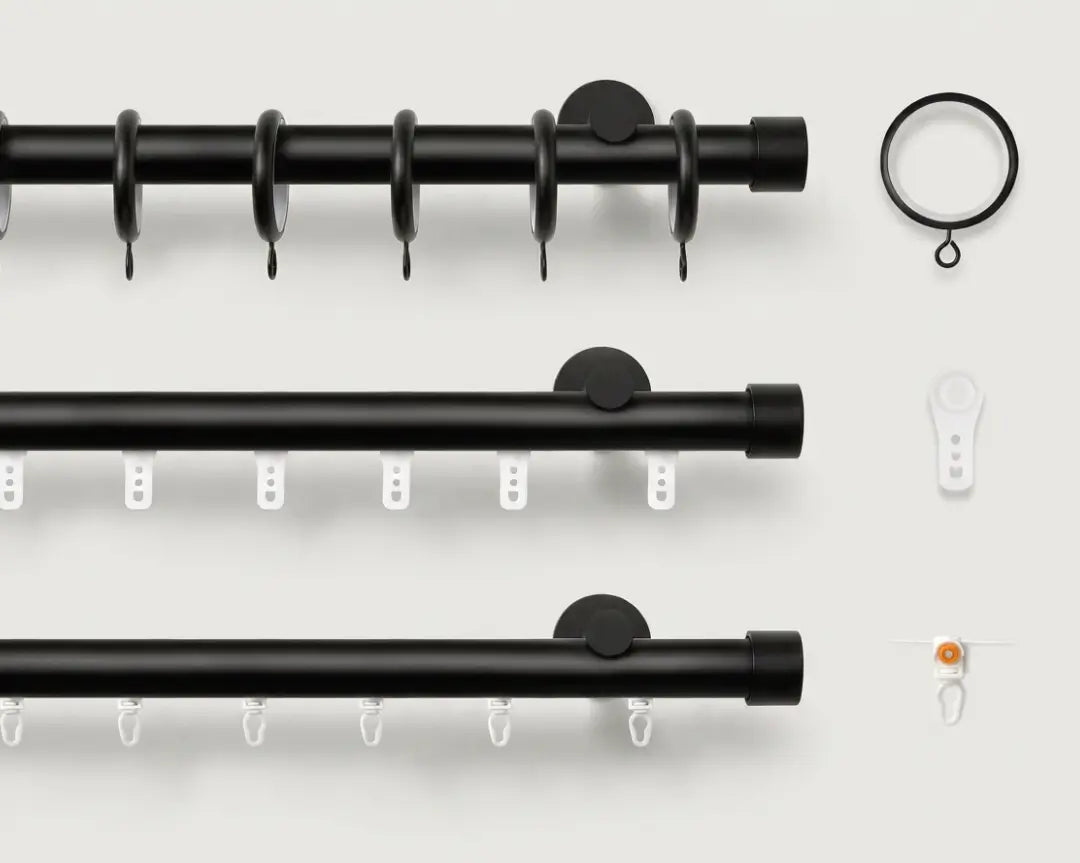
- Tension rods — the renter favorite: no drilling into tile, easy to remove for washing. Best inside a frame with deep enough casing to hold securely.
- Sash rods — thin rods top-and-bottom keep fabric flat against the glass, but they restrict airflow and make laundering harder (less ideal for a steamy bath).
- Standard café rods — inside- or outside-mount on brackets, best for permanent installs. In a bathroom choose rust-resistant hardware (stainless, brass, powder-coated aluminum) with plastic or silicone-coated rings to avoid corrosion streaks.
Inside vs. outside mount: inside looks clean and built-in with deep casings; outside mounting visually enlarges a small window and adds side overlap for better privacy. Measuring: use about 1.5×–2× the window width for fullness (closer to 2× for sheers), and hem the panel to land just above the sill so it does not collect splashes and dust. For inside mounts, measure the width at the exact rod height and use the smallest of the top/middle/bottom readings. No-drill: tension rods, adhesive hooks with a lightweight rod, or clip rings — keep panels light (poly or linen-look) so they do not sag.
Ideas by window location
- Over the tub / shower zone — the wettest spot: use waterproof polyester or a hybrid (glass panel or vinyl liner inside + a decorative café tier outside the splash zone). Mount high so the lower half blocks views and the top vents.
- Next to the toilet — privacy is paramount: semi-opaque fabric, modest fullness, and a slightly higher (two-thirds) mount to guard against angled sightlines. Keep hardware compact in tight spaces.
- Above the vanity — lower moisture here, so linen blends and cotton-poly open up. Subtle stripes or micro-florals frame the mirror and tie into towels; add a faux valance above for cohesion if you like.
- Guest bath vs. primary — guest/powder rooms see less steam but more street exposure, so favor easy-care semi-sheers over film; primary baths take daily steam, so invest in performance linen blends or treated poly and exact sizing.
Custom vs. ready-made for odd bathroom windows
Many bathroom windows are short, wide or high-set and simply do not match mass-market café sizes — leading to awkward gaps or fabric that hits mid-trim. Remember: the window dictates the panel length, not the package. Ready-made tiers are fastest and cheapest and are fine for guest baths and rentals (buy slightly long and hem). For a street-facing primary-bath window, custom is usually worth it: exact sizing, better moisture-smart fabrics (performance poly, OEKO-TEX linen blends) and coordinated rust-proof hardware. A renter-friendly middle path is an oversized ready-made panel hemmed (or fusible-taped) to the right length.
Care & cleaning in a humid bathroom
- Prevent mold: run the exhaust fan during and after showers, open the window for cross-ventilation when you can, and spread the curtain so the folds dry. Keep fabric slightly off the cold glass rather than pressed against it.
- Wash often: bathroom tiers need laundering more than living-room curtains — every 2–3 weeks (monthly at least), in cool-to-warm water with mild detergent. Skip high-heat drying; air-dry over the rod or flat.
- Know when to replace: a persistent musty smell, staining at the hems, or mold that returns soon after washing means it is time. Strong sun can also fade richly dyed fabrics sooner — pair UV-sensitive textiles with a liner or film.
Mistakes to avoid
- Wrong fabric for humidity — heavy blackout or thick cotton at café height in an unvented bath traps moisture and grows mildew. Prioritize moisture-resistant blends in high-splash areas.
- Length & height off — rods that bisect the trim awkwardly, or hems that puddle on the sill collecting damp and dust. Mount at half or two-thirds height and hem just above the sill.
- Over-blocking the light — reaching for full blackout when a half-height tier would give enough privacy with far more daylight. Use semi-sheer or light-filtering fabric and keep the upper glass clear.
- Rust-prone hardware — standard steel rods and screws streak and fail in humidity. Use stainless, brass or powder-coated rods and corrosion-resistant rings.
- Neglecting ventilation — even mold-resistant fabric can't beat persistently stagnant, humid air. Aim to keep bathroom humidity roughly 30–50% and let curtains dry fully between showers.
Frequently asked questions
Can you use café curtains in a bathroom?
Yes — café (tier) curtains are one of the best bathroom window treatments because their half-height design blocks sightlines at eye level while letting daylight in through the clear glass above. Just choose a moisture-resistant fabric and rust-proof hardware.
What is the best fabric for bathroom café curtains?
Polyester and poly blends are the safest — quick-drying and mildew-resistant. Performance or treated synthetics are even more water- and stain-resistant. Linen blends work in drier zones or with a liner; avoid heavy blackout and untreated cotton right next to the tub.
How high should you hang bathroom café curtains?
Mount the rod about halfway up the window for classic proportions, or up to two-thirds for more privacy. Hem the panel to land just above the sill, and test sightlines from outside before you fix the height.
Are café curtains private at night?
Partly. With interior lights on, a single sheer tier may show silhouettes. For street-facing windows add a light lining or pair the café curtain with frosted film or glass, and re-check privacy from outside after dark.
How often should you wash bathroom café curtains?
Every 2–3 weeks (monthly at least) in cool-to-warm water with mild detergent, then air-dry. Frequent washing plus good ventilation is the best defense against mildew.
Ready to dress your bathroom window?
Pick a moisture-smart fabric, set the rod at the right height, and you get privacy and daylight in one tidy half-window. Shop our café curtains — including linen-look and easy-care options sized for tricky bathroom windows — or pair a café tier with frosted film for the most overlooked, street-facing spots.