

















Can You See Through Sheer Curtains? Day vs Night Privacy

Yes — you can see through sheer curtains, but only in one direction at a time, and which direction flips between day and night. During the day, when it is brighter outside, sheers blur the view from the street while you keep a clear view out. At night, once interior lights are on, that reverses: the lit room becomes the bright side, and people outside can see silhouettes and movement through the same fabric. The fix is layering, not a "more private" sheer.
This guide explains the optical principle in plain terms, gives you the openness percentages and fabric weights that actually predict see-through, and lays out exactly how to keep the sheer look while getting real privacy after dark — room by room. If you already want the airy daytime look, you can browse our sheer curtains and use the guide to pair them correctly.
Key takeaways
- Visibility always favors the brighter side of the glass — that is why sheers are private by day and see-through at night.
- Standard sheers offer low nighttime privacy: with lights on, they go nearly transparent and show silhouettes.
- Light-filtering fabrics are denser (frosted-glass effect) and more private than sheers, but their night performance varies widely.
- Only room-darkening (blocks ~70–95% of light) and blackout (95–100%) reliably stop see-through at night.
- To keep the sheer look and get night privacy, layer: blackout/lined drape on a second rod, a cellular shade, double sheers, or frosted film.
Why sheer-curtain privacy reverses at night

Any semi-transparent fabric works like a scrim, and the governing rule is simple: the brighter side is visible to the darker side. A sheer sits right on the boundary between inside and outside, so whichever side has more light "shows through" to the other. This one principle explains the entire day-versus-night privacy puzzle.
During the day, exterior daylight is usually stronger than your indoor light. Outside viewers mostly see daylight reflected on the fabric, so the interior reads as a bright, blurred surface. After dark, you switch the lamps on and the room becomes the bright side while the street is dark. The curtain is now backlit, so passers-by see silhouettes — and sometimes room contents — through the very same weave that looked private at noon.
This is the same reason "one-way" mirror window films lose their privacy at night: they only work while the outside stays brighter than the inside. Once interior light dominates, the effect collapses unless you keep the exterior artificially brighter, which almost no home does.
Can you see through sheer curtains during the day?

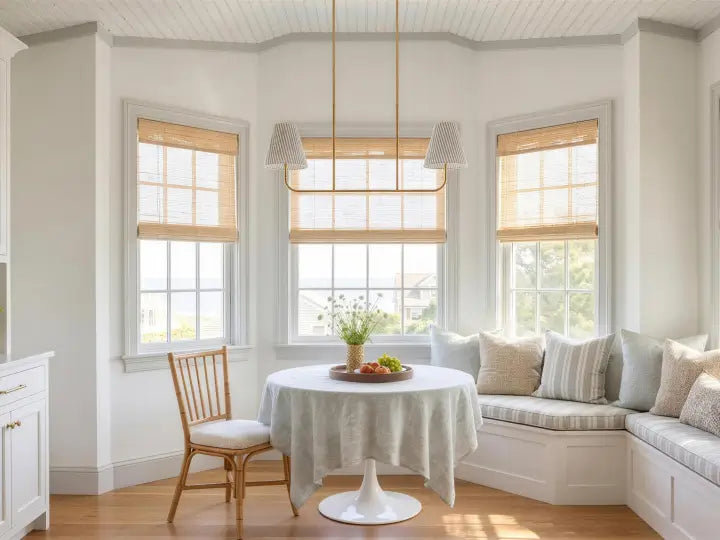
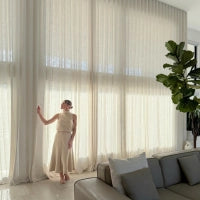
During the day with interior lights off, sheer curtains give you reasonable daytime privacy and a clear view out. From inside, the outside looks softened, like a light haze. From the street, an observer mostly sees a bright surface and, at most, vague shadows if they stand very close to the glass. This is the scenario sheers are designed for.
The privacy is partial, not absolute. Daytime screening from sheers is really just blurring and contrast reduction — it depends on the outside being brighter than the inside. Turn strong interior lights on in daytime and privacy already drops near the window, because the backlighting across the sheer becomes more balanced and silhouettes start to appear. So "private by day" specifically means: daylight outside, lamps off, viewer at a normal distance.
Can you see through sheer curtains at night?

Yes — at night with interior lights on, standard sheer curtains become nearly transparent from outside, and this is the critical failure mode for privacy. Consumer and design sources agree that passers-by can see people and room contents through ordinary sheers at typical urban viewing distances once the room is lit. If your only layer is a true sheer voile, assume you have little to no privacy after dark.
The view runs the other way too. Looking out, a lit room behind sheers turns the fabric into fogged glass — the outside reads as mostly dark with little usable view. With interior lights off at night, you mainly perceive streetlights or lit buildings as vague shapes, and a person near the window can still be a faint silhouette if any ambient light is on inside. In practice, the privacy problems start the moment indoor fixtures come on.
Heavier, darker, tighter-woven sheers reduce how much shows through, but they do not change the underlying reversal. A denser sheer is still a sheer at night. (If you specifically want the natural look of linen, note that sheer linen behaves the same way after dark — it also needs a lined or blackout-backed layer for night privacy.)
Day-vs-night privacy comparison table

This is the at-a-glance summary of how a standard single-layer sheer performs. "Lights off" and "lights on" refer to interior lighting; the brighter side always wins.
| Viewing direction | Daytime (lamps off) | Night, lights OFF | Night, lights ON |
|---|---|---|---|
| From outside looking in | Mostly obscured — bright surface, only blurred shadows up close. Good daytime privacy. | Largely private; a faint silhouette only if some interior ambient light is on. | Poor privacy — nearly transparent; silhouettes and often room contents visible. |
| From inside looking out | Relatively clear; outside softened like a light haze. | Streetlights and lit buildings read as vague shapes. | Like fogged glass — outside mostly dark, little usable view. |
The takeaway from the table: sheers protect you when the sun does the work. The single column that matters for most privacy worries — night, lights on, from outside — is exactly where sheers fail and where a layered solution earns its place.
Are light-filtering and room-darkening curtains see-through?

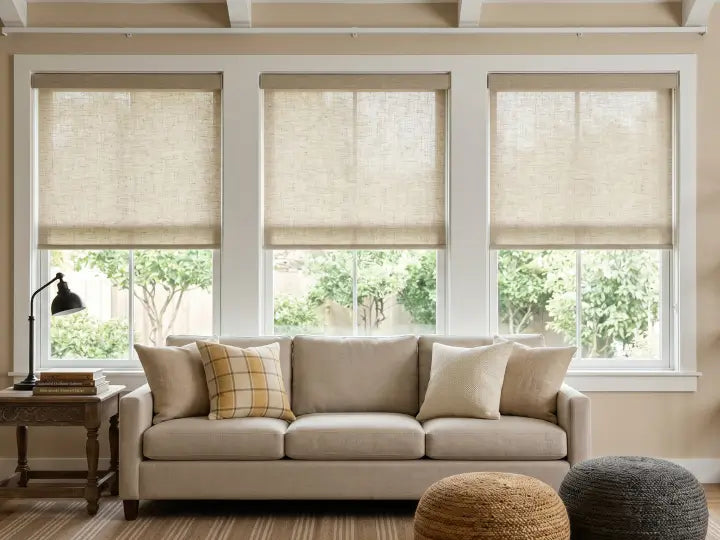
Light-filtering curtains are denser and more opaque than sheers, engineered to diffuse sunlight while obscuring the view — they are often compared to frosted glass. By day they give moderate-to-high privacy, so outside observers see only blurred shapes rather than clear details. At night, though, their performance is genuinely inconsistent: a densely woven light-filtering fabric may show only indistinct shapes with the lights on, while one on the sheer end of the range still reveals silhouettes. Treat "light-filtering" as a spectrum, not a guarantee, and test a sample at night before committing for a bedroom or bath.
Room-darkening curtains are the first category that reliably stops see-through after dark. They use denser fabrics or liners to block roughly 70–95% of incoming light, dimming the room substantially and giving strong privacy both day and night, with only small light leaks at the edges. Retailers generally group room-darkening and blackout together as the only categories that prevent meaningful silhouettes at night. So if someone asks whether room-darkening curtains are see-through, the practical answer is no — a well-fitted room-darkening shade or lined drape blocks the view, unlike a sheer or a thin light-filtering panel. For these heavier functional layers, see our shades & blinds collection.
Sheer vs light-filtering vs room-darkening vs blackout
These four labels are the North American light-control spectrum, running from high openness/low opacity to near-zero transmission. Knowing where a fabric sits tells you its privacy ceiling before you ever hang it.
- Sheer / semi-sheer — lightweight, loosely woven, maximum light. Roughly 60–150 GSM, high weave openness. You can see shapes and sometimes details by day; nearly transparent at night with lights on. Privacy: low.
- Light-filtering — more tightly woven, frosted-glass effect; diffuses light and cuts glare. Denser than a sheer. Daytime privacy moderate-to-high (blurred shapes only); nighttime privacy varies by opacity and weave. Privacy: medium and inconsistent after dark.
- Room-darkening — dense fabric or liner that blocks about 70–95% of light. Strong privacy day and night with only small edge leaks; does not reach total darkness. Privacy: high.
- Blackout — built to block 95–100% of light via triple-weave constructions or opaque backings, typically in the heavier 200–350 GSM band. No view through the fabric, complete privacy day and night when side gaps are managed. Privacy: very high.
Openness %, GSM and the numbers that predict see-through
Two specifications do most of the predicting. Use them instead of vague words like "lightweight" or "heavy."
Openness percentage describes how much of the fabric is open holes rather than yarn — borrowed from solar shades, and the cleanest privacy predictor:
- 1% openness — very tight weave, high privacy, room-darkening feel, blocks about 99% of UV.
- 3% openness — dimly lit interior, strong glare reduction, high privacy.
- 5% openness — balanced light and view, moderate privacy.
- 10–14% openness — bright interior, clearer view out, low privacy (this behaves like a sheer).
GSM (grams per square meter) measures fabric weight, which tracks how airy or substantial a curtain feels — but GSM alone does not equal opacity. Sheers run about 60–150 GSM (60–90 for plain polyester voile, 90–110 for mid-market linen-look day sheers, 110–150 for denser sheers that are still translucent). Blackout and velvet sit around 200–350 GSM, usually with coatings or backings to reach near-zero transmission. Within the sheer range, weave tightness and color matter more for see-through than weight: a heavier 120–150 GSM sheer obscures silhouettes a bit better than an ultra-light voile under 80 GSM, but it is still a sheer at night.
Color and fiber fine-tune the result. Light colors like white and ivory reflect light and read as more translucent, so they reveal more interior shapes when backlit; darker, more saturated colors block the view better at the same openness. Natural-fiber sheers (cotton, linen) carry more visual texture that modestly breaks up silhouettes versus a smooth synthetic yarn — but moving from a true sheer voile to a denser light-filtering weave does far more for privacy than switching fiber alone.
How to get nighttime privacy with sheers
You do not have to give up the airy daytime look to be private after dark. The reliable approach is to keep sheers as your "day" layer and add one opaque "night" layer. Here are the proven options, most-recommended first.
- Layer with a blackout or lined drape on a second rod. This is the most widely recommended fix. Sheers sit nearest the glass for daytime; a heavier lined, room-darkening, or blackout panel on an outer rod is drawn at night for full privacy and light control. It is essentially separate day and night fabrics — maximum flexibility, plus better thermal and acoustic performance. Trade-off: cost and a double-rod or track.
- Double-layer your sheers. Hanging two sheer layers (or buying a double-thickness semi-sheer) roughly halves the effective openness, letting light pass while cutting see-through, and the overlap creates texture that further obscures silhouettes. Best for living rooms and lower-stakes windows; even double sheers may not match a true light-filtering or room-darkening fabric at eye level.
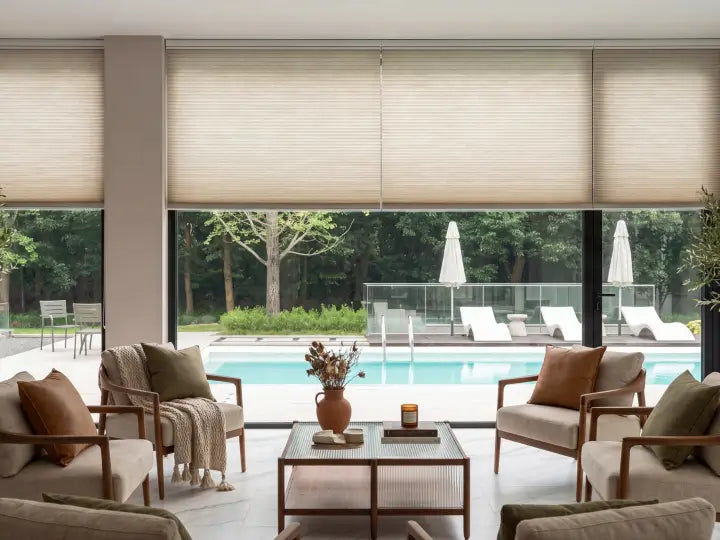
- Pair sheers with a day-night cellular or roller shade. Mount a light-filtering or blackout cellular (honeycomb) or roller shade inside the frame, behind the sheers. Raise it most of the day, lower it at dusk in bedrooms and baths. Day-night cellular products even combine a sheer/light-filtering fabric and a blackout fabric in one headrail so you slide between modes. Browse functional options in our shades & blinds collection.
- Choose a denser, darker light-filtering fabric. If you love the soft look but need more privacy, step up from a true sheer voile to a tighter-woven, deeper-colored semi-sheer or light-filtering panel (a 90–150 GSM weave with a tighter construction). It blocks clearer views at night while keeping soft light. Trade-off: less daytime brightness and view clarity.
- Add frosted or privacy window film. For bathrooms and other high-privacy spots, apply frosted or patterned film to the glass as the baseline privacy layer, then hang sheers in front for warmth and finish. Good film gives no-silhouette privacy while still admitting daylight. Note: most "one-way" films only work while the outside is brighter, so they are a daytime aid — keep curtains or a shade for full nighttime privacy.
Room by room: bedroom, living room, street-facing, bathroom
Bedrooms. Sheers alone are not enough for nighttime privacy, especially on street- or neighbor-facing windows. Pair sheers with a blackout or room-darkening drape on a double rod, or with an inside-mounted blackout cellular/roller shade lowered in the evening. On second-story or less-exposed windows, a light-filtering cellular shade can be acceptable if occasional silhouettes do not bother you. For a master bedroom facing a busy street, lean blackout for both sleep quality and privacy, and treat the sheer purely as a daytime layer. If you specifically want the natural linen aesthetic, read whether linen curtains are worth it before you choose — and use a lined or blackout-backed linen so it stays private with the lights on.
Living rooms and family rooms. These balance daylight and views against moderate privacy, so sheer and semi-sheer panels are popular — just respect the night reversal. Sheers alone are fine on upper floors or where neighbor sightlines are limited (detailed views are unlikely at street distance, even if silhouettes show). On ground-floor urban windows, add a light-filtering shade you lower after dark for a frosted-glass effect, or use double/denser sheers where a private yard matters more than full seclusion. The pro move: stand outside at night with the lights on and check the actual fabric before you decide.
Street-facing and sidewalk-adjacent windows. This is the most sensitive case, and the advice converges: you need a room-darkening or blackout layer, or high-opacity film plus a shade. Effective stacks include an inside-mounted blackout cellular or roller shade behind decorative sheers; frosted film on the lower "privacy band" of the glass with sheers for softness; or a day-night cellular that runs sheer by day and blackout by night without changing the look. Unlined, light-colored sheers alone are discouraged for ground-floor street windows in dense neighborhoods — they are easily seen through after dark.
Bathrooms. Bathrooms demand the highest privacy at eye level, so frosted or opaque film on the glass is the primary solution, with curtains or shades added for style and adjustability. The safest "spa" configuration is frosted film on the glass, a light-filtering or room-darkening shade for night, and a sheer as a soft outer layer — never a sheer as the only privacy layer. For the half-window approach that keeps daylight above eye level, our sheer curtains pair well over film.
Common misconceptions
- "Sheer curtains give privacy at night." They do not, on their own. The technical and design literature consistently rates sheers as minimal-to-no nighttime privacy; many sources state they go almost transparent from outside with interior lights on. Phrases like "soft privacy" usually describe daytime performance only.
- "Light-filtering is always fully private at night." Not reliably. "Light-filtering" spans a wide range of openness and opacity. Some dense versions behave like frosted glass after dark; many still show silhouettes with the lights on. Verify a sample at night rather than trusting the category name.
- "Higher GSM always means more privacy." No — GSM is weight per area, not opacity. Construction (coatings, triple-weave, openness) dominates light-blocking. A decorative uncoated fabric can be heavy yet still transmit light if the weave is open; within the sheer band, weave tightness and color predict see-through better than weight.
- "One-way window film works at night." Most one-way and mirrored films only provide privacy while their side is brighter — i.e., during the day. At night, with the interior brighter, that privacy is lost unless you light the outside more than the inside. Even makers of newer micro-perforated films recommend keeping curtains or blinds for full night privacy.
For the bigger picture beyond privacy, see our full breakdown of 2026 curtain trends — what's in and what's on the way out this year.
Frequently asked questions
Can you see through sheer curtains?
Yes, but directionally. The brighter side is visible to the darker side. By day, with brighter light outside, sheers blur the view in from the street while you see out clearly. At night with interior lights on, the lit room becomes the bright side and people outside can see silhouettes through the fabric.
Are sheer curtains see-through at night?
Yes. With interior lights on, standard sheers become nearly transparent from outside and reveal silhouettes and often room contents at normal viewing distances. For real nighttime privacy, layer them with a blackout or room-darkening drape, a cellular or roller shade, double sheers, or frosted film.
Are light-filtering curtains see-through?
Less than sheers. Light-filtering fabrics are denser, with a frosted-glass effect that gives moderate-to-high daytime privacy (only blurred shapes from outside). At night their performance varies: dense versions may show just indistinct shapes, while thinner ones still reveal silhouettes. Test a sample at night for bedrooms and bathrooms.
Are room-darkening curtains see-through?
No, not in practice. Room-darkening fabrics block roughly 70–95% of light, so a well-fitted panel or shade prevents see-through both day and night, with only small edge leaks. They do not reach total darkness like blackout, but they reliably stop silhouettes when the lights are on.
What are transparent curtains and how private are they?
"Transparent curtains" usually means sheers — lightweight, loosely woven fabrics around 60–150 GSM with high weave openness. They maximize daylight and offer only soft daytime screening. They give little privacy at night with the lights on, so pair them with an opaque layer if privacy matters.
How do I get privacy with sheer curtains at night?
Keep the sheers as a daytime layer and add one opaque night layer. In order of effectiveness: a blackout or lined drape on a second rod; an inside-mounted blackout cellular or roller shade lowered at dusk; double-layered or denser, darker sheers; or frosted window film as the base layer with sheers in front.
Do sheer linen curtains block the view at night?
No — sheer linen diffuses daylight beautifully but still shows silhouettes when interior lights are on, just like other sheers. Natural texture breaks up shapes slightly, but for night privacy use a lined or blackout-backed linen. For more on linen specifically, see our guides on light sheer curtains vs linen drapes and whether linen curtains are worth it.
Get the sheer look — and the privacy
Sheers are a daytime tool: they soften light and add texture, but they are not a nighttime privacy solution by themselves. Pick your sheer for the look, then add one opaque layer — a blackout drape, a cellular shade, or frosted film — for the lights-on hours. Shop our sheer curtains, including extra-long options like the Liana sheers for large windows, and browse shades & blinds for the room-darkening layer that does the night-time work.