






















Curtains for High Ceilings: A Simple Guide to Getting the Perfect Fit

If you have high ceilings, you already know the problem. You find curtains you like, bring them home, hang them up — and they stop somewhere awkwardly above the floor. Like pants that are just a little too short.
Standard curtains usually come in 84 or 96 inches. In a room with 9-foot ceilings, 96-inch panels can work if you mount the rod in just the right spot. But in rooms with 10-foot or 12-foot ceilings? They almost never reach. And when curtains don't reach the floor, the whole room feels unfinished — no matter how nice the fabric is.
The good thing is, once you know a few simple rules, getting the right fit is actually pretty straightforward.
One Simple Rule That Changes Everything
Here's the most useful thing to know about curtains for high ceilings:
Mount the rod close to the ceiling, not just above the window frame.
That's it. Instead of placing the rod 4 to 6 inches above the window trim, bring it up to within a few inches of the ceiling — or mount it directly to the ceiling if that works better for your space. Then measure straight down from the upper edge of the rod to wherever you want the curtains to end.
This one shift does two things. It makes your room look taller, and it gives you a clear measurement to work from. No more guessing whether "standard length" will fit. You have the actual number, and that number tells you exactly what you need.
What Length Should You Actually Buy?
Once you know your rod-to-floor measurement, the rest is easy. Here's what tends to work for different ceiling heights:
9-foot ceilings (108 inches): If you mount the rod near the ceiling, you'll usually need curtains around 96 to 102 inches, leaving gaps at the top for hardware and bottom for floor clearance. Standard 96-inch panels can work here — just double-check your rod placement before buying. (We have a full guide on extra long curtain sizing and installation if you want to dig deeper.) 10-foot ceilings (120 inches): You're looking at 108 to 114 inches. Standard lengths start to fall short at this point, and this is where most people hit the "nothing fits" wall. 12-foot ceilings (144 inches): You'll likely need something in the 132- to 140-inch range, depending on how high you mount the rod and whether you want the fabric to just kiss the floor or pool slightly. Custom length stops being a nice-to-have here — it becomes the only way to get it right.
No matter your ceiling height, you also want to decide how the curtains meet the floor. You have three options:
- Hover: The fabric stops about half an inch above the floor. Clean, practical, easy to live with.
- Kiss: The hem barely touches the floor. Tailored and precise — but you need to measure carefully.
- Puddle: An extra 2 to 4 inches of fabric pools on the floor. Romantic and dramatic, though it does collect dust and isn't ideal if you have pets or small kids.
For most homes, a hover or a light kiss is the safest choice. It looks intentional without being fussy.
Why Linen Works So Well in Tall Rooms
When you are dressing a tall window, the fabric matters more than you might think. Heavy materials like velvet can look stunning, but in a room with high ceilings they can also feel imposing — like the curtains are taking over the space.
Linen is different. It has a natural lightness to it. The texture catches the eye without weighing anything down, and on a long vertical drop, that texture creates a soft, organic look that feels effortless rather than overdone.
This is why we designed the Celina Linen Curtain with high ceilings in mind. It is a 30% linen / 70% polyester blend at 350 GSM — heavy enough to hang beautifully but light enough to keep the room feeling airy. More importantly, Celina is made to order, which means you are not limited to whatever lengths happen to be in stock.

The "Custom" Part (Don't Overthink It)
A lot of people hear "custom curtains" and assume it means complicated, expensive, and slow. It really doesn't have to be.
Here is how it works with Celina: you measure from the upper edge of your rod or the lower edge of the track to the floor, pick your fabric and header style, and we make the curtains to that exact length — anywhere from 84 inches up to 240 inches. If your ceiling height is unusual, or your rod sits at a non-standard position, it doesn't matter. We cut to the inch.
The difference between "close enough" and "made to fit" is one of those things you don't fully appreciate until you see it. Curtains that actually reach the floor look intentional. Curtains that stop a few inches short look like you settled. For a room with high ceilings — where the vertical line is the main event — settling on length defeats the whole point.
Think of it this way: a custom-sized curtain panel and a standard one cost about the same amount of consideration when you are buying. But one of them fits your window. The other one fits someone else's idea of what a window usually looks like.
The Right Hardware Makes All the Difference
One thing people often forget with tall windows: longer curtains weigh more. A lot more. That lightweight rod from the hardware store that works fine for 84-inch panels might struggle with floor-to-ceiling drapes on a 12-foot wall.
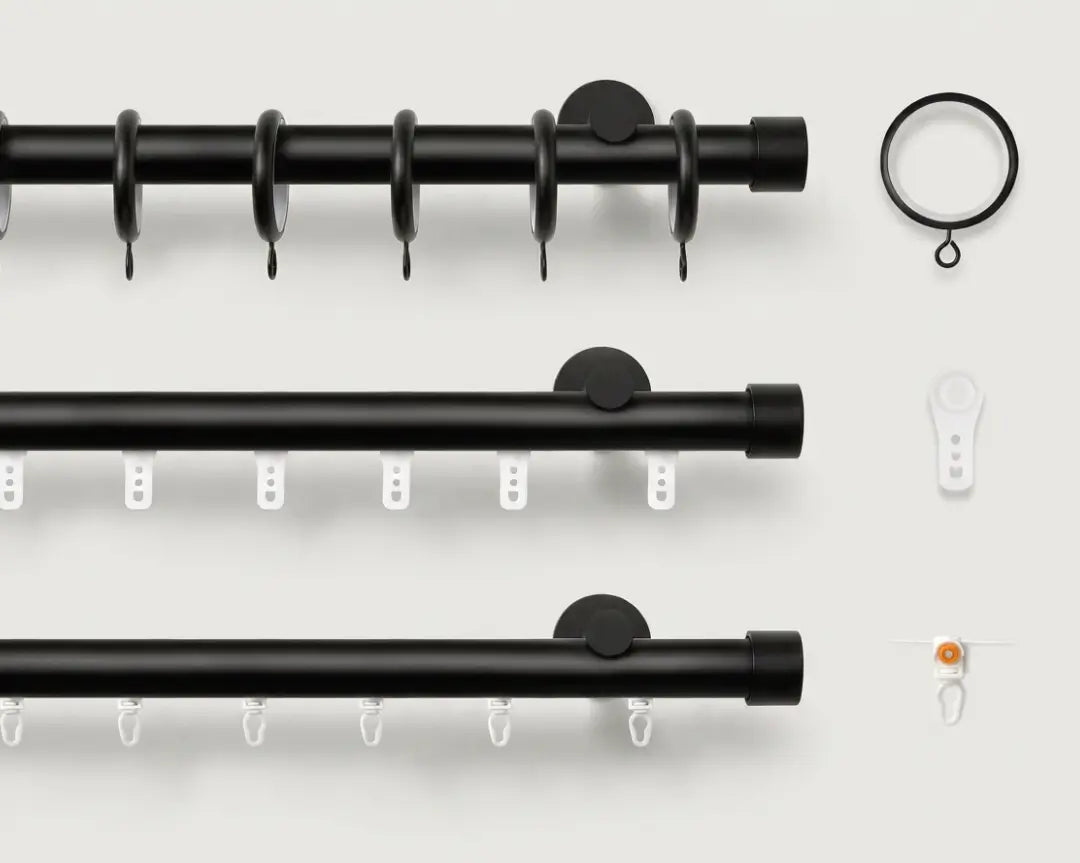
Freshine makes three hardware options that are built for exactly this situation:
Darian Custom Traverse Curtain Rod: This is the heavy-duty choice. Made from aluminum with reinforced brackets, it supports up to 132 pounds and comes with an integrated traverse mechanism — meaning you don't need to tug on the fabric to open and close the curtains. A cord or wand does the work. But what really sets Darian apart is how it handles window layouts that standard rods can't touch: straight runs, L-shaped corner windows, and bay window configurations. Each rod is custom-built to your exact measurements and layout, so the hardware follows the architecture instead of forcing the architecture to adapt to the hardware. Available in five finishes. Arden Adjustable Ripple Fold Track: If you want a cleaner, more modern look, the Arden track is built for ripple fold — the curtain header style that creates soft, uniform S-curve waves from top to bottom. Ripple fold waves are set by a tape system sewn into the header, so they hold their shape permanently. Ceiling-mounted against a tall wall, Arden practically disappears — all you see is a continuous sweep of evenly spaced waves falling from ceiling to floor. It is made from 6063-T5 aluminum alloy with an electrostatic powder-coated finish that resists rust, and the telescopic design adjusts to fit your window width. In a contemporary living room or open-plan space with high ceilings, this combination — ripple fold on a ceiling track — is hard to beat. Riven Adjustable Curtain Track: The versatile middle ground. Riven is compatible with pinch pleat (double and triple), euro pleat (double and triple), and flat panel headers — so you are not locked into a single curtain style. Its telescopic design covers 16 different size ranges, from a compact 33 inches collapsed all the way to 236 inches extended, and the aluminum alloy construction with anti-rust coating handles the weight of floor-to-ceiling panels without complaint. Both ceiling and wall mounting are supported. If you want the flexibility to change header styles down the road, or you are still deciding between pinch pleat and flat panel, Riven keeps your options open.
Pair any of these with Celina Linen curtains and you get the same thing every time: fabric that reaches exactly where it should, on hardware that can actually carry it.
A Quick Word on Ripple Fold and Floor-to-Ceiling
If you are going floor-to-ceiling — which, in a room with high ceilings, is almost always the right move — ripple fold deserves a serious look.
Here is why. With conventional header styles, the fabric bunches and stacks in a way that can feel heavy or uneven on a long drop. Ripple fold solves this. The waves are set by a tape sewn into the header at the factory, so the spacing is mathematically consistent from top to bottom. Every wave is the same depth, same width, same rhythm. When you draw the curtains open, they stack into a tight, compact column instead of a bulky mass. When they are closed, the fabric flows in a single, uninterrupted line.
Ceiling-mounted on an Arden track, ripple fold curtains create exactly the kind of clean vertical sweep that makes a tall room feel intentionally designed rather than just furnished. It is a small detail that changes the whole proportion of the space.
Celina Linen in ripple fold, floor-to-ceiling on an Arden track — that is the setup we would recommend for most living rooms with ceilings over 10 feet.

A Few Small Things Worth Getting Right
Width matters more than you think. For a full, generous look, your total curtain width should be about double the width of your window. With tall windows, skimping on width makes the panels look stretched and thin — the opposite of what you want. Aim for 2x the coverage width, and if you are using pinch pleat triple or euro pleat triple, go for 2.5x. Measure in three places. Floors and ceilings are rarely perfectly level. Measure from upper edge of your rod to the floor at the left, center, and right of the window. Use the measurement that matches your preferred floor finish — for a hover, use the shortest measurement so nothing drags. If you want a step-by-step walkthrough, our measuring guide covers everything from rod placement to final length. Lighter colors keep tall rooms airy. Whites, warm beiges, and soft greys enhance the natural light that tall windows bring in. Darker tones can work — they add drama and coziness — but they also make a room with high ceilings feel more enclosed. If you want the space to feel open and breezy, stick with lighter neutrals.
Frequently Asked Questions
Can I use ready-made curtains for high ceilings?
Sometimes. If your ceilings are 9 feet and you mount the rod close to the ceiling, 96-inch panels can work. But once you pass 10 feet, ready-made options become very limited. Most stores top out at 108 inches, and those are often hard to find in the style and color you want. For ceilings 10 feet and above, custom is almost always the better path unless you are willing to compromise on fit.
What's the best fabric for tall windows?
It depends on the room. Linen and linen blends work beautifully in living rooms and open-plan spaces — they are light, textured, and don't dominate the room. Velvet and heavier weaves are better for bedrooms or media rooms where you want more light control and a cozier feel. Sheers are great for layering: use them alone for soft filtered light during the day, and pair them with heavier panels for privacy at night.
How much do custom extra-long curtains cost?
It varies by fabric, lining, and size, but custom does not automatically mean expensive. Celina Linen curtains start at $32.99 per panel, and because they are made to order, you pay for the exact size you need — not a premium "custom" markup. Compared to buying a standard length, hemming it, and still not getting the right fullness, custom often ends up being the more practical choice.