

















Curtains vs. Blinds vs. Shades: Which One Your Room Actually Needs
Most guides to this question are written by someone who only sells one of the three. We sell all three, so here is the version with the trade-offs left in — including the one where curtains lose.
The short answer
Blinds are the cheapest way to cover a window and the best at aiming light — tilt the slats and you keep the view while killing the glare. Shades are one piece of material that rolls, folds or stacks; the cellular kind is far and away the best insulator of the three. Curtains are fabric on a rod or track: the softest look, the longest life, and the only one that also does something for sound and for the proportions of a room.
If you want one line: buy blinds when budget and glare control rule, shades when the window is cold or awkward, curtains when the room needs to look finished. In most rooms worth doing properly, the real answer is a shade and a curtain.
In this guide
- The 30-second decision
- What each one actually is
- Cost: what they run in 2026
- Energy: the part where curtains lose
- Light and privacy: what none of them fix
- How long each one lasts
- Room by room
- Why the real answer is usually both
- Glossary
- FAQ
The 30-second decision
Start from what the room is failing at, not from what the window looks like.
| If the problem is… | Reach for | Why |
|---|---|---|
| The budget, across many windows | Blinds | Lowest entry price per window and the fastest to install |
| Glare on a screen, but you want the view | Blinds | Tilting slats redirect light without closing the window off |
| A cold, draughty window or a big energy bill | Cellular shades | The trapped air in the honeycomb outperforms everything else here |
| A small, shallow or wet window | Shades | Mount inside the frame and take up no wall |
| The room looking unfinished | Curtains | Height, softness and colour; the only option that changes proportions |
| Echo, or a room that feels hard | Curtains | Fabric mass is the only one of the three that absorbs sound |
| Sleep — genuine darkness | Both, plus hardware | No single treatment blocks the gaps; see the light section below |
What each one actually is
The words get used loosely in shops and listings, which is most of why this comparison feels confusing. The distinction is mechanical, not decorative.
Blinds have slats. Horizontal or vertical strips — wood, faux wood, aluminium, vinyl — that both raise and tilt. The tilt is the whole point and the one trick neither of the others can do: you can drop the glare out of a west-facing room at 5pm and still see the garden.
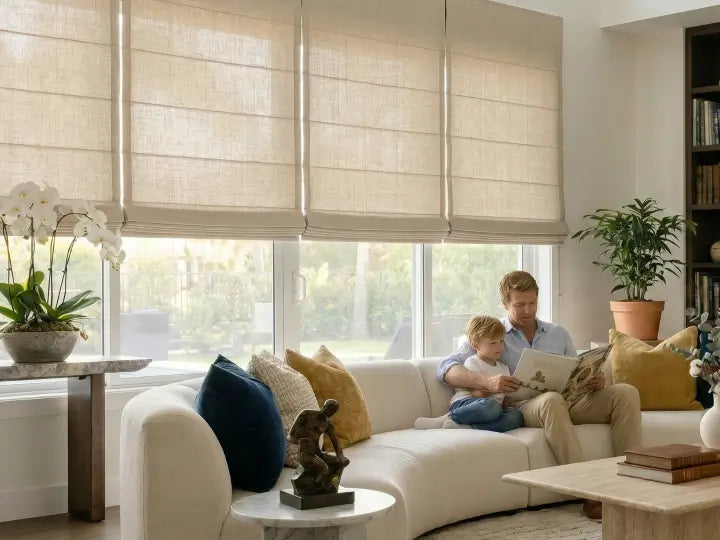
Shades are one continuous piece. No slats, so no tilt: a shade is either up, down, or somewhere between. That single sheet is what lets a shade be engineered — a cellular shade folds into honeycomb cells that hold still air, a woven wood shade filters light through natural fibre, a Roman shade stacks into soft horizontal folds and reads much more like fabric than like hardware.
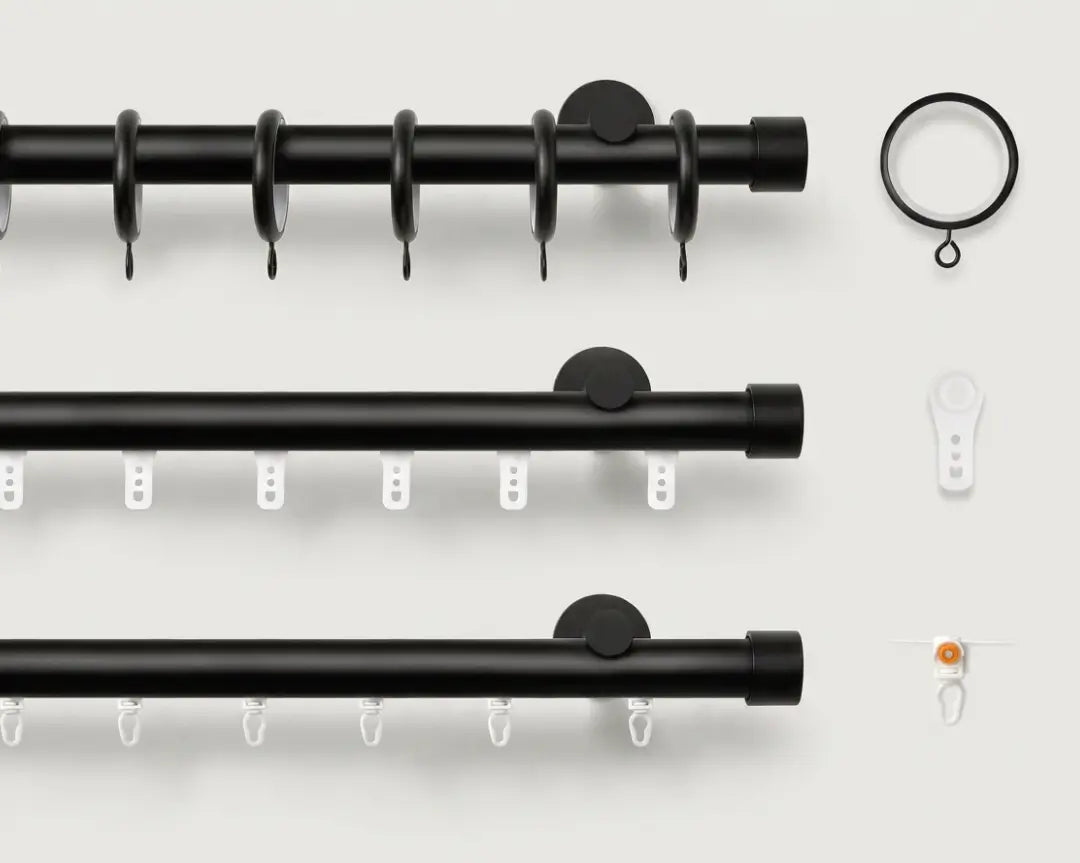
Curtains are loose fabric that travels sideways. Hung from a rod or a track, they stack at the sides rather than the top, which means they need wall — and give back height, softness, colour and acoustic mass in exchange. "Drapes" usually just means heavier, lined, floor-length curtains; there is no industry line between the two words worth arguing about.
One consequence is worth holding on to: blinds and shades cover the glass, curtains dress the wall. That is why the two categories stack so well together, and why so many rooms that look "not quite done" have one but not the other.
Cost: what they run in 2026
Ranges rather than a single number, because window size and custom-versus-stock move the price more than the category does.
| Type | Per window, installed (US, 2026) | What moves the number |
|---|---|---|
| Blinds | roughly $30–$200 for basic slat styles; up to about $600 custom | Vinyl at the bottom, real wood at the top; labour is only ~15–30 min per window |
| Shades | roughly $60–$600 standard; $350–$1,000 motorised | Roller at the bottom, Roman and cellular higher; motors add $150–$400 |
| Curtains | roughly $50–$500; custom drapery from about $300 into four figures | Fabric quantity, lining, and an install that takes an hour or more |
Ranges synthesised from 2026 US cost surveys published by Angi, HomeGuide and HomeAdvisor. Treat them as planning brackets, not quotes.
Two things those brackets hide. First, curtains scale with width and blinds scale with count — a wide picture window can double the fabric bill while barely changing a blind's price, which is its own piece of arithmetic in our guide to curtains for wide windows. Second, the running cost differs: slats and vinyl need dusting, while fabric panels may want periodic cleaning, commonly quoted around $30–$100 per window a year if you send them out.
Energy: the part where curtains lose
This is the section a curtain shop usually skips, and it is the clearest verdict in the whole comparison.
The US Department of Energy's own numbers:
Conventional draperies, drawn in cold weather, reduce heat loss from a warm room by up to about 10%.
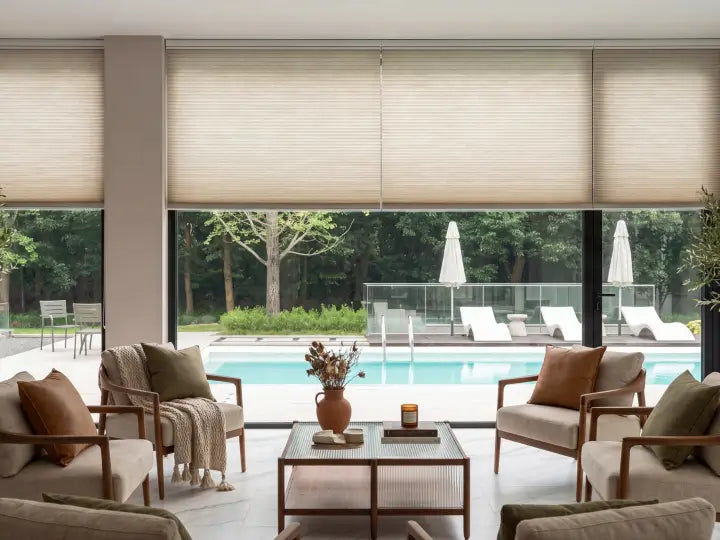
Insulated cellular shades are credited with roughly 10–34% annual HVAC savings, and DOE names them specifically for windows that still feel draughty after weatherising.
That gap is structural, not a matter of quality. A cellular shade's honeycomb traps still air in a sealed pocket against the glass; a curtain hangs loose, so room air circulates behind it and carries the heat back to the window. It matters because windows are a large share of the problem — DOE puts heat lost through windows at roughly 30% of a home's heating energy, and notes that about 76% of the sunlight falling on a standard double-pane window comes in as heat.
Curtains are not useless here, and DOE is specific about how to claw the difference back: hang them close to the window, run them down to the sill or floor, cap the top with a cornice, seal the sides and overlap the panels in the middle. Layer two and you get a tighter air pocket than one. Medium-coloured draperies with white plastic backings are credited with cutting heat gain by about 33% — so on the summer side, fabric holds its own.
Read that list again and you will notice every item is about closing gaps, which is the same fight described in our ripple fold light-gap section. If insulation is the actual goal rather than a bonus, start with a cellular shade — the Avenia cordless cellular shades are the honeycomb build in this range — and treat a curtain over it as the second layer. For the narrower head-to-head between honeycomb and a thermal-lined curtain, we ran that comparison separately in honeycomb shades vs thermal curtains.

Light and privacy: what none of them fix
Every category is sold with a "blackout" option, and every one of them has the same blind spot.
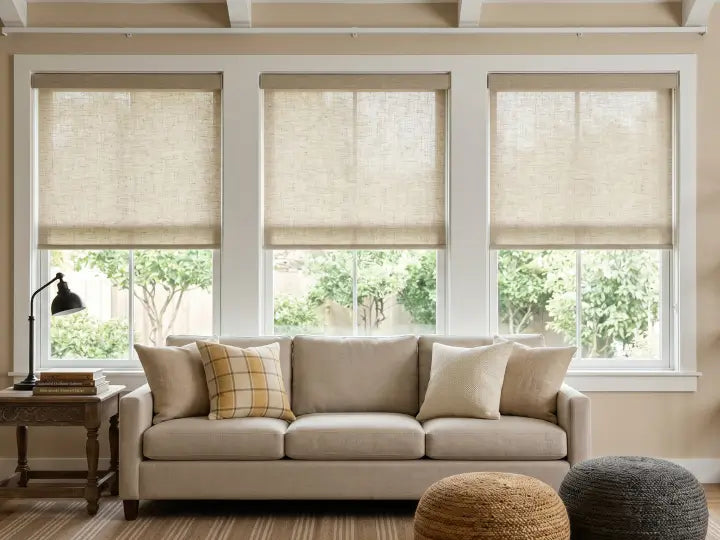
Blackout is a property of the material, and darkness is a property of the installation. A blackout roller shade mounted inside the frame leaves a light channel down both sides. A blackout-lined curtain on a bare rod leaves light over the top and through the centre split. Neither is defective; both are hanging in a gap. The fixes are hardware — mount outside and above the frame, return the edges to the wall, overlap the middle, cap the top — and they apply equally to all three categories.
Where they genuinely differ is in the kind of control:
- Blinds give you angle. Nothing else lets you keep the view and lose the glare in the same movement.
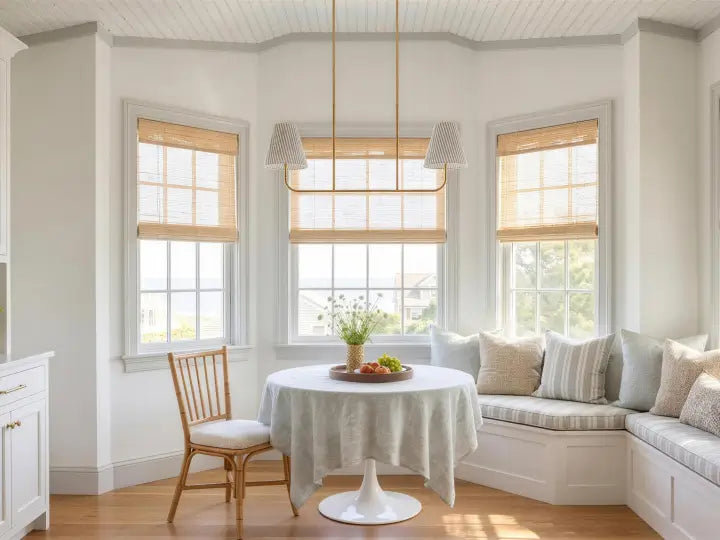
- Shades give you a clean on/off, plus whatever the material does — a woven wood like the Seris jute-bamboo shade throws a warm, filtered light no fabric panel reproduces.
- Curtains give you layers. A sheer by day and an opaque panel by night is the most flexible arrangement available, which is why it keeps turning up in trend reports.
Which lining does what is its own decision, laid out in curtain lining explained; how dark a given room actually needs to be is mapped in blackout vs room darkening vs sheer. On the shade side, the equivalent question is covered in light filtering vs blackout shades.
How long each one lasts
Published lifespans from the trade cluster into a fairly consistent picture, with one caveat worth stating first: the spread within a category is wider than the gap between categories.
| Treatment | Commonly quoted life | What kills it first |
|---|---|---|
| Lined curtains | about 10–15 years | UV on the face fabric; seams stressed by pulling the cloth instead of a wand |
| Sheer / unlined curtains | about 3–5 years | Direct sun, with no lining to take the hit |
| Roman & cellular shades | about 5–7 years typical, longer if well made | Cords and rings — often replaceable without replacing the shade |
| Roller shades | about 8–10 years | The spring mechanism, and fabric edges fraying |
| Venetian / vertical blinds | about 12–18 years | A single snapped slat, which usually is not worth replacing alone |
| Cheap vinyl blinds | about 3–5 years | Warping and yellowing in sun and heat |
So "do blinds outlast curtains?" has no category-level answer. A venetian blind will outlive a sheer curtain by a decade; a lined curtain will outlive a vinyl blind by the same margin. Lining is the single biggest lever on the fabric side — it takes the UV so the face fabric does not. And a point the trade makes that the numbers do not: with curtains, the style usually expires before the cloth does.
Room by room
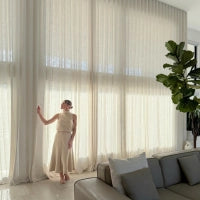
Living room. Curtains, usually floor-length, because this is the room where proportion and softness pay. Add a shade behind them if the window faces afternoon sun or a street. A floor-to-ceiling linen drape plus a woven wood shade is the most repeated combination in interior photography for a reason.
Bedroom. Both, and pick the hardware deliberately — this is the room where the gaps matter. Blackout-lined curtains mounted outside and above the frame, over a shade that handles daytime privacy. Blackout linen curtains keep the room side reading as fabric rather than equipment.
Kitchen. Shades or blinds. Steam, splatter and worktops argue against long fabric near the sink; something that mounts inside the frame and wipes clean wins. A café-length curtain is the exception when the window is well away from the wet zone.
Bathroom. Faux wood or vinyl blinds, or a shade rated for humidity. Real wood warps; unlined fabric holds damp.
Home office. Blinds, for the tilt. Screen glare is an angle problem, and angle is the one thing only slats solve.
Sliding doors and window walls. Curtains on a track, or a vertical blind. This is a traffic problem as much as a light one — the treatment has to stack somewhere that does not block the door, which is the whole subject of our sliding glass door guide. Hardware choice does real work here; rods versus tracks covers it.
Small or shallow windows. Shades. There is often no wall to stack a curtain onto, and an inside-mounted shade keeps the frame visible.

Why the real answer is usually both
Framing this as a three-way contest is the mistake most buyers make, because the categories are not substitutes — they fail in different places. A shade covers glass efficiently and stops at the frame. A curtain dresses the wall and leaks at the edges. Put them together and each one covers the other's weakness: the shade handles insulation and daytime privacy at the glass, the curtain handles darkness, softness, sound and height at the wall.
It is also the cheapest way to get a good result, which is not obvious. A mid-range shade under a mid-range curtain outperforms a single expensive treatment of either type on almost every axis that matters, because you are buying two different mechanisms instead of paying a premium for one to do a job it is not built for.
The practical order: decide the shade first — it is the layer doing the physical work, and its mount depth constrains everything after it. Then choose the curtain for the look, and mount its hardware wide and high enough to clear both. If you only ever buy one layer, buy the one that fixes your actual complaint, and let the room's appearance be the tiebreaker rather than the brief.
Where to start
For the glass layer, browse shades & blinds — cellular if the window is cold, woven wood if you want warmth and texture, Roman if you want it to read as fabric. For the wall layer, linen curtains for daylight rooms and blackout curtains where sleep is the job.
Glossary
- Blind — a covering made of slats that both raise and tilt. The tilt is what separates it from a shade.
- Shade — a covering made from one continuous piece of material that raises and lowers without tilting.
- Cellular (honeycomb) shade — a shade pleated into hollow cells that trap still air; the best insulator of the common options.
- Inside vs outside mount — fitted within the window frame, or fixed to the wall above and beyond it. Outside mount is what closes the side light gaps.
- Return — the short section where a curtain turns back to touch the wall, sealing the side edge.
- Stack-back — the wall or window width a treatment occupies when fully open.
FAQ
Are curtains or blinds better?
Neither is better in general; they fail in different places. Blinds cost less per window, install faster, and are the only option that tilts to redirect glare while keeping the view. Curtains last longer in like-for-like quality, absorb sound, and change how tall a room reads. Choose blinds for budget and glare control, curtains for comfort and appearance — and both where sleep or insulation matters.
What is the difference between blinds and shades?
Slats. A blind is built from horizontal or vertical strips that raise and tilt, so you can angle light without opening the window up. A shade is one continuous piece of material that only raises and lowers. That single sheet is why shades can be engineered for a job — cellular shades trap air for insulation, woven wood filters light, Roman shades fold to read like fabric.
Are blinds cheaper than curtains?
Usually yes at the entry level. In 2026 US pricing, basic slat blinds land around $30–$200 per window installed against roughly $50–$500 for curtains, and a blind takes about 15–30 minutes to fit versus an hour or more for a curtain. The gap narrows or reverses at the top: real wood or motorised blinds can cost more than simple ready-made curtains.
Which is better for insulation, curtains or shades?
Cellular shades, clearly. The US Department of Energy credits conventional draperies with reducing heat loss by up to about 10% when drawn, while insulated cellular shades are associated with roughly 10–34% annual HVAC savings. The honeycomb traps still air against the glass; a loose curtain lets room air circulate behind it. Curtains close some of that gap when hung tight to the window, floor-length, with a cornice and sealed sides.
Can you have blinds and curtains on the same window?
Yes, and for most rooms it is the better answer. The shade or blind sits at the glass and does the physical work — insulation, daytime privacy, glare — while the curtain sits on the wall and supplies darkness, softness, sound absorption and height. Decide the inner layer first, since its mount depth constrains the hardware, then mount the curtain wide and high enough to clear it.
Do blinds or curtains last longer?
It depends far more on which blind and which curtain than on the category. Commonly quoted ranges put lined curtains at about 10–15 years and venetian or vertical blinds at about 12–18, while sheer curtains and cheap vinyl blinds both fail early at roughly 3–5 years. Lining is the biggest single lever on fabric life because it takes the UV instead of the face cloth.
Which is best for a bedroom?
Both, with the hardware chosen deliberately. No blackout material blocks the gap it hangs in, so a blackout-lined curtain mounted outside and above the frame, over a shade that handles daytime privacy, beats any single treatment. Extend the rod past the glass, overlap the panels at the centre and cap the top if you want genuine darkness.
Still deciding between fabrics once you have picked a category? Start with the linen curtain collection, or see how the year's window treatments are trending in our 2026 curtain trends rundown.