





















Curtain Rods vs. Tracks: Which Is Right for Your Window?
The Short Answer
Curtain rods are visible hardware — they frame the window, anchor the room, and act as a design element in their own right. Curtain tracks are the opposite: discreet, often ceiling-mounted, engineered to disappear so the fabric does the talking.
If your priority is decorative presence and you want the hardware to contribute to the room's character, go with a rod. If you want clean lines, smooth operation, and a modern, architectural feel, a track is the better fit.
But there's a third category worth knowing about: the traverse rod. It looks like a decorative rod but has a track mechanism built inside — the best of both worlds, and the right answer for a surprising number of windows.
Which one belongs in your space depends on three things: your curtain's header style, your window's shape, and how you want the room to feel. Let's walk through each option.

Curtain Rods at a Glance
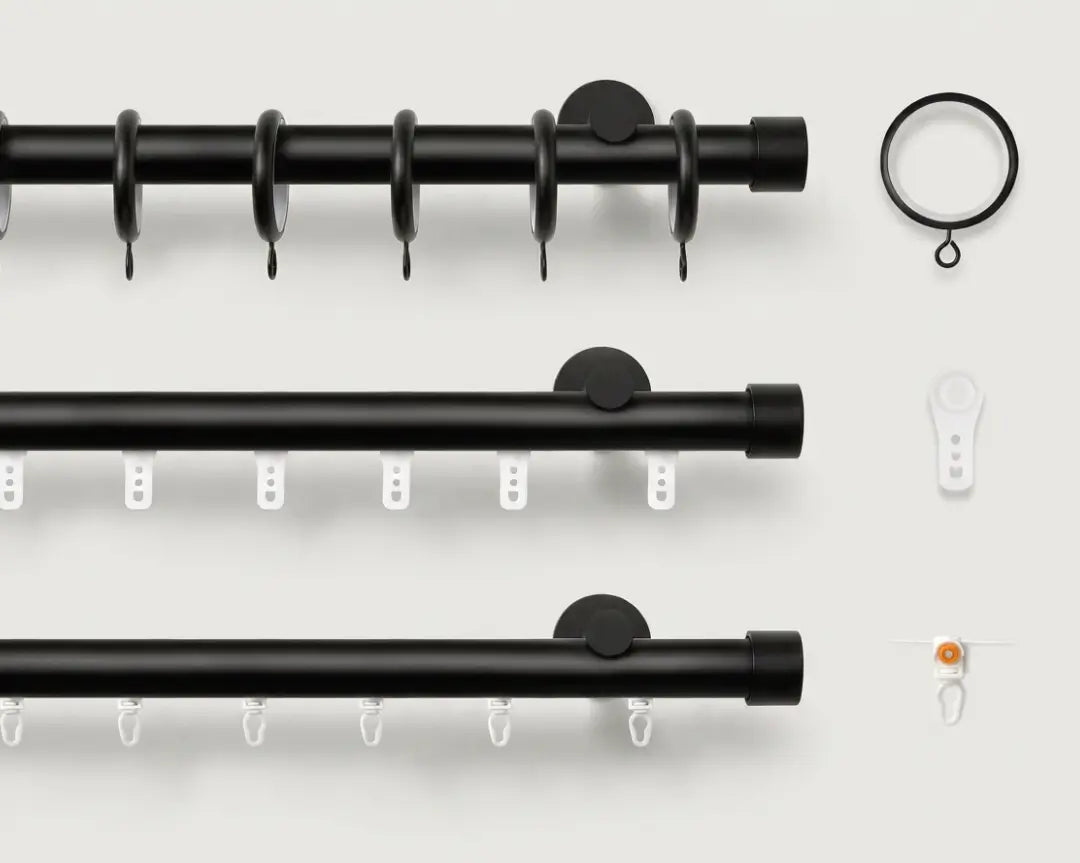
A curtain rod is exactly what it sounds like: a horizontal bar — typically aluminum, alloy or wood — mounted on brackets above the window. The rod is visible. So are the finials on each end. That's the point.
Header styles that work with rods: Grommet, Rod Pocket, Pinch Pleat (double and triple), Euro Pleat, Flat Panel, and Back Tab. In other words, almost everything except Ripple Fold.
Rods come into their own in spaces where the hardware is part of the design conversation. A black metal rod with clean cylindrical finials reads contemporary. A brass rod with turned finials leans traditional. In a living room or dining room — rooms meant to feel considered — the rod contributes as much as the fabric.
They're also the more DIY-friendly option. A few brackets, a rod, and a drill. Installation is straightforward — though if you're starting from scratch, you'll want to measure carefully before ordering anything. For standard rectangular windows, a rod rarely creates complications.
Freshine's take: The Collins Decorative Rod is built for exactly this role — custom-cut to your width, available in four finishes, with eight finial styles to match the room's vocabulary. It's made from aluminum (light enough to handle, strong enough to support up to 132 lbs across the span), and it ships with silent-glide rings every four inches.
Curtain Tracks at a Glance
A curtain track is a slim aluminum channel — typically ceiling-mounted — with internal gliders that carry the curtain. When installed, the track itself is nearly invisible. Ideally, the curtain header covers it. All you see is fabric.
Header styles that work with standard tracks: Pinch Pleat, Euro Pleat, and Flat Panel. Grommet, Rod Pocket, and Back Tab curtains need a rod — they have no way to attach to a track's internal gliders.
Tracks excel in three scenarios. First, modern and minimalist interiors, where visible hardware would distract from the architecture. Second, wide spans and floor-to-ceiling installations — ceiling-mounted tracks create an uninterrupted line that rods with center brackets cannot match. Third, rooms where curtains open and close frequently — gliders slide more smoothly than rings on a rod, especially with heavier fabrics like blackout or velvet.
Freshine's take: The Riven Adjustable Track is our standard option — 16 telescopic sizes, aluminum alloy construction with an anti-rust powder-coated finish, and a Lifetime warranty. It mounts to the ceiling or wall and pairs with Pinch Pleat, Euro Pleat, or Flat Panel curtains.
For a more specific aesthetic, the Arden Ripple Fold Track is purpose-built for Ripple Fold headers — the S-shaped wave pattern that holds its form and reads like a luxury hotel. Same Lifetime warranty, 19 telescopic sizes, and compatible with motorization for smart-home setups.
The Third Option: Traverse Rods
A traverse rod looks like a decorative rod from the front — visible finials, matching finish, brackets — but inside, it houses a built-in track mechanism. Curtains attach to runners, and those runners glide through the rod itself. A cord or hand-draw operates the system.
This solves a real dilemma. You want the decorative presence of a rod, but you also want the smooth, friction-free movement of a track — perhaps because your curtains are heavy, or the window is wide, or you open and close them multiple times a day. A traverse rod gives you both.
It's also the only rod-based system that handles corner windows and bay windows cleanly. Because the internal runners can navigate bends, you get continuous coverage without the gaps that standard rods create at corners.
Freshine's take: The Darian Traverse Rod is the most versatile piece of hardware we make. It supports every header style — including Ripple Fold — and comes in five finishes. Each bracket holds 22 lbs, and the reinforced structure handles heavier drapes with less deflection than a standard round rod. For bay windows, corner windows, or any situation where you want a rod's appearance with a track's performance, Darian is the answer.

Header Style Compatibility Matrix
Not every curtain works with every hardware type. If you already know your header style — or you're still deciding — this table eliminates the guesswork.
| Header Style | Rods (Collins) | Traverse Rod (Darian) | Standard Track (Riven) | Ripple Track (Arden) |
|---|---|---|---|---|
| Grommet | ✓ | ✓ | ✗ | ✗ |
| Rod Pocket | ✓ | ✓ | ✗ | ✗ |
| Back Tab | ✓ | ✓ | ✗ | ✗ |
| Pinch Pleat | ✓ | ✓ | ✓ | ✗ |
| Euro Pleat | ✓ | ✓ | ✓ | ✗ |
| Flat Panel | ✓ | ✓ | ✓ | ✗ |
| Ripple Fold | ✗ | ✓ | ✗ | ✓ |
A few things to note. Grommet, Rod Pocket, and Back Tab curtains all require a physical bar to thread through or hang from — they have no mechanism for attaching to internal gliders, which is why tracks are ruled out. Pinch Pleat and Euro Pleat sit in the middle: versatile enough for rods or tracks, depending on your room. Ripple Fold is the specialist — it needs a dedicated Ripple Fold track (Arden) or a traverse rod (Darian). A standard decorative rod won't produce the defined S-wave that makes Ripple Fold worth choosing in the first place.
How to Decide: Five Questions
If you're still on the fence, answer these in order.
1. Do I want the hardware to show?
Yes → Rod or traverse rod.
No → Track.
This is the aesthetic fork in the road, and it usually makes the rest of the decision fast. If the thought of visible hardware feels heavy or dated in your space, skip straight to tracks.
2. What curtain header style am I using?
Check the matrix above. If you've already chosen Grommet, Rod Pocket, or Back Tab curtains, you need a rod. If you're set on Ripple Fold, you need a Ripple Fold track or a traverse rod. If you're using Pinch Pleat, Euro Pleat, or Flat Panel, both rods and tracks are on the table — keep going.
3. What shape is my window?
Standard rectangle → Any option works.
Bay window, corner window, or angled wall → Traverse rod or flexible track. Standard rods can't bend.
Extra-wide span (over 150 inches) → Track or traverse rod. The continuous internal glide avoids the visual interruption of center brackets.
4. How heavy are my curtains?
Light to medium weight (sheers, linen, standard cotton) → Any option.
Heavy weight (blackout-lined, velvet, thermal) → Track or traverse rod. The distributed support of a track handles weight better than rings on a rod, especially across wide spans.
5. How often do I open and close them?
Rarely (fixed decorative panels) → Rod is fine.
Daily or multiple times a day → Track or traverse rod. Gliders and runners move more smoothly and wear more evenly than rings on a pole.
Room-by-Room Recommendations
Here's how these decisions tend to play out in real rooms.
Living Room. These are the rooms people furnish with intention — the sofa, the rug, the art. The hardware should participate in that conversation. A decorative rod — something with presence — anchors the window as a designed element. The Collins Rod in gold or black pairs well with linen or velvet panels. If your living room has a bay window, upgrade to the Darian Traverse Rod for continuous coverage. Bedroom. Function leads here. Light control and smooth operation matter more than decorative hardware. A ceiling-mounted track lets blackout curtains close tightly against the wall, reducing light leaks at the edges. The Riven Track paired with Pinch Pleat blackout panels is a clean, effective setup. If the room leans traditional and you want a rod, the Darian gives you the look without sacrificing the glide. Dining Room. Similar logic to the living room — this is a space for entertaining, and the details count. A decorative rod in a finish that echoes your light fixtures or cabinet hardware brings cohesion. Collins in gold or brass, paired with floor-length linen or velvet, creates a polished frame. Home Office / Modern Interiors. Tracks. The cleanest possible line, nothing competing with the architecture. Riven for a minimalist look; Arden if you want the sculptural rhythm of Ripple Fold waves across a wide window. Nursery / Kids' Room. Cordless operation is non-negotiable for child safety. A hand-draw track — Riven or Arden — eliminates cords entirely while still allowing easy daily use.

One Last Thing
Hardware and curtains are a system. They work best when chosen together, not as separate afterthoughts. Custom-made curtains are cut to your exact window dimensions — specifying your hardware type at the same time ensures the header style, fullness ratio, and mounting method all align from the start. It's a small thing that makes the difference between curtains that look fine and curtains that look intentional.
Not sure where to begin? Select fabric samples to narrow down your material, then pair your fabric with the right hardware for the room. If you'd rather talk it through, our design team is available — no charge, no pressure.
FAQ
Can I use grommet curtains with a track?
No. Grommet curtains are designed to thread onto a rod. They have no hooks or attachment points for the internal gliders inside a track. If you have grommet curtains, you need a rod or a traverse rod.
What is a traverse rod, and when should I choose one?
A traverse rod combines the decorative look of a curtain rod with the internal track mechanism of a curtain track. Choose one when you want the visible presence of a rod but also need smooth operation — especially for heavy curtains, bay or corner windows, or curtains you open and close daily.
Which is better for blackout curtains — rods or tracks?
Tracks tend to perform better with blackout curtains. A ceiling-mounted track allows the curtain to sit closer to the wall and ceiling, reducing light gaps at the top and sides. A traverse rod is a close second, combining this functional advantage with a more decorative appearance.
Do curtain tracks work for bay windows?
Yes — but not all of them. Flexible tracks and traverse rods with internal runners can follow the angles of a bay window. Standard decorative rods cannot bend and will leave gaps at the corners.
Which hardware type is easier to install?
Both curtain rods and tracks are straightforward to fit, with minor differences in installation workflow. Curtain rods are simple to mount: you only need two or three support brackets, a level and a drill to finish the job. While standard tracks demand slightly more careful alignment—particularly ceiling-mounted ones, as gliders rely on a flawlessly straight channel for seamless sliding—telescopic options such as the Riven streamline the process greatly by eliminating accurate cutting work entirely.