

















Layering Curtains: Sheer + Blackout Combinations for Light, Privacy & Style

A layered curtain system is exactly what it sounds like: two independent panels on one window. An inner sheer layer. An outer blackout layer. Each one does a job the other can't.
The sheer curtain — usually lightweight linen, polyester voile, or a semi-sheer blend — sits closest to the glass. It filters daylight into a soft glow, gives you daytime privacy (shapes blur to color blocks from the street), and keeps the room feeling open and bright.
The blackout curtain — a heavier, sometimes lined panel — hangs on the outer rod. During the day, it's pulled to the sides. When the sun sets or the movie starts, you close it. Total darkness. Actual privacy. A room that feels finished.
A single curtain layer asks you to choose. Sheers alone are see-through at night with the lights on — that's physics, not a product flaw. Blackout curtains alone turn the room into a cave at 2 p.m. One layer gives you light or privacy. Two layers give you both.
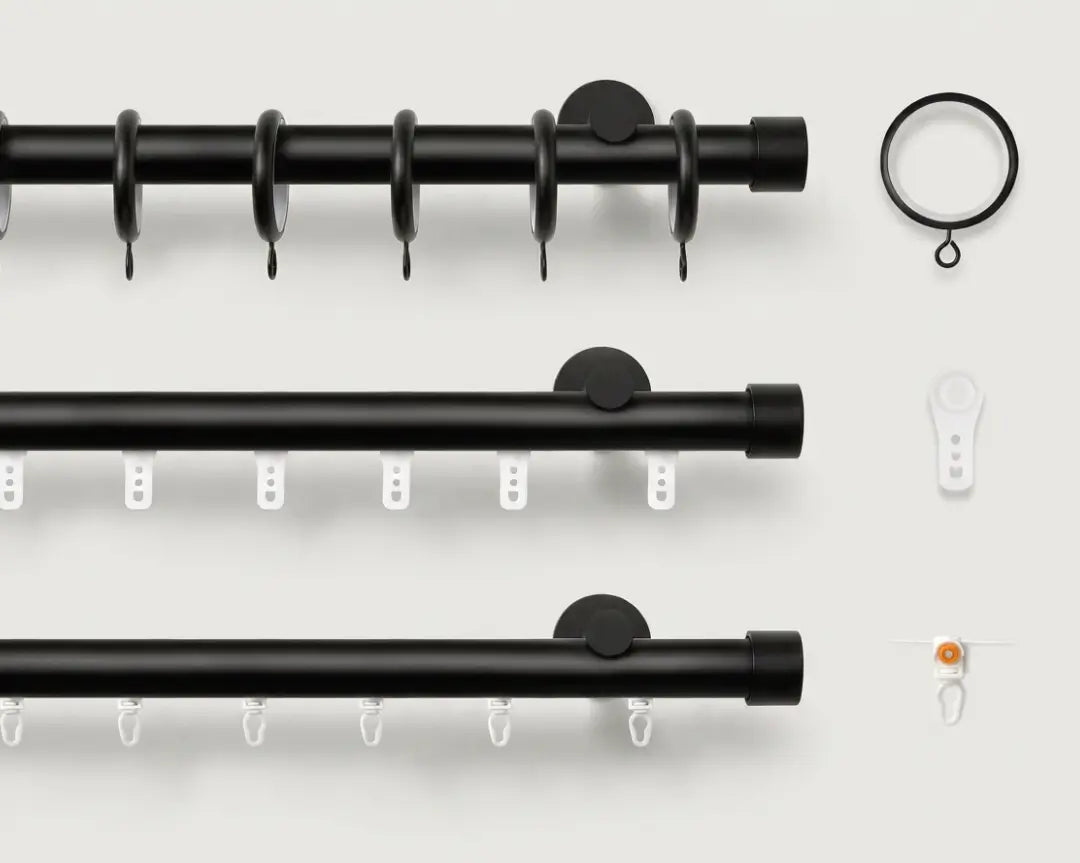
The hardware matters too. You need a double rod or a dual ceiling track. Cramming both layers onto a single rod defeats the purpose — they can't move independently, and opening and closing becomes a daily frustration.
1. Five Reasons to Layer Your Curtains

Layered curtains aren't a decorative flourish. They solve five practical problems that single-layer curtains can't touch.
Light Control & Sleep
This is the core promise. The outer blackout layer blocks 85–100% of incoming light. The inner sheer layer lets you have daylight without sacrificing privacy.
Here's how the day actually works. Morning: open the blackout panels, keep the sheers closed. The bedroom glows with soft, diffused light. From outside, nobody can see you making coffee. Night: close the blackout panels. The room goes dark. No streetlight creeping through the edges, no 6 a.m. sun waking you up on a Saturday.
For bedrooms where sleep quality is non-negotiable — shift workers, light sleepers, nurseries — pairing Arlise 100% Blackout Chenille (256 GSM, thermal lining) on the outer rod with Liana Sheer Curtains on the inner rod gives you total light suppression at night and a bright, airy room during the day.
Thermal Insulation
Two fabric layers with an air gap between them create a natural insulation barrier. It's the same principle as double glazing — trapped air resists heat transfer.
The blackout layer does the heavy lifting. Chenille (Arlise, 256 GSM) and velvet (Marina, 400 GSM) add real thermal mass. In summer, keep both layers closed during peak sun hours to block heat gain. In winter, close them at dusk to trap warm air against the window. The sheer layer adds a secondary air pocket without visual weight.
Iris Blackout Linen Curtains, at 390 GSM, bring substantial thermal density without reading as a "thermal product." The linen-look face fabric keeps the room looking designed, not utilitarian.
Noise Reduction
Dense fabrics absorb sound. Two dense layers absorb more. This matters if your windows face a street, a school, or a neighbor's driveway.
The physics is straightforward: heavier fabric = more sound dampening. Arlise chenille (256 GSM) and Marina velvet (400 GSM) as outer layers offer the most acoustic benefit. The sheer inner layer contributes a modest additional buffer, but the blackout panel carries the noise-reduction weight. It won't soundproof your room — no curtain does — but it takes the edge off traffic hum and street noise.
Privacy Protection
This is the high-frequency, everyday use case.
During daylight, the sheer inner layer works. The sun outside is brighter than your interior lights. Light pushes inward through the fabric. From the street, someone sees a soft, uniform surface — ivory, linen, white — but not your sofa, not your face, not what's on your TV.
At night, the equation reverses. Interior lights on, outside dark. Light pushes outward. Any sheer becomes see-through. This isn't a bad product. It's how light works. The fix is the second layer: close the blackout panel after sunset.
For street-facing living rooms, the best combination is Luciana Semi-Sheer Curtains on the inner rod and Iris Blackout Linen on the outer. Luciana's pleated construction has more visual body than flat sheers — it obscures interior shapes more effectively during the day. (For a deeper look at how semi-sheer fabric handles privacy across different times of day, see our semi-sheer curtains guide.) Iris's linen texture means the blackout layer looks like a design choice, not a security measure.
Dust, UV & Furniture Preservation
The outer blackout panel takes the environmental hit. Dust settles on it first. UV rays hit it before they reach your furniture, floors, and art. The inner sheer stays cleaner, longer.
Iris (390 GSM, 85–95% blackout) blocks most UV before it enters the room. For south-facing and west-facing windows — the ones that bleach hardwood and fade upholstery — the difference is measurable over years.
2. Room-by-Room Pairings
The right combination depends on how you use the room. A bedroom wants total darkness. A living room wants the blackout layer to not look like a blackout layer. A dining room wants atmosphere. Here are four complete pairings — sheer, blackout, and hardware — for four different rooms.
Bedroom: Miravel + Arlise
The bedroom's primary job is sleep. That means maximum light suppression at night, plus soft morning light when you want it.

Sheer: Miravel Linen Blend Semi-Sheer Curtains. Miravel is a new arrival — 20% linen, 80% polyester, 180 GSM. The linen content gives it more drape and body than a standard sheer. At 180 GSM, it hangs in cleaner vertical lines. During the day, it diffuses light without making the room feel dark. The open-weave texture adds dimension without pattern. Blackout: Arlise 100% Blackout Chenille Drapes. 256 GSM, 100% light suppression, thermal-lined. The chenille face has a soft, dimensional texture — it doesn't look like a product designed purely for function. It also dampens sound and insulates. For anyone who works nights, has a newborn, or simply can't sleep with a sliver of light, Arlise is the answer. Hardware: Collins Double Decorative Custom Curtain Rod. The double-rod configuration keeps both layers independent. Available in Black, Silver, Gold, and Brass — match it to your bedroom hardware or keep it simple with black.
Living Room: Luciana + Iris
The living room is the hardest room to dress. It needs to be bright during the day, glare-free for TV, and private at night. The blackout layer has to look like furniture, not function.
Sheer: Luciana Custom Semi-Sheer Curtains. Luciana is semi-sheer with a pleated construction — more visual weight than flat sheers, more structure than voile. At 170 GSM and 100% polyester, it's wrinkle-resistant and holds its shape. The white option reads clean and tailored, exactly what a living room needs during daylight hours. Blackout: Iris Blackout Linen Curtains. This is the critical choice. Iris blocks 85–95% of light, but its face fabric is a textured linen look — matte, neutral, with visible slub. It reads as a curtain that happens to block light, not a blackout product that happens to be a curtain. The grey undertone keeps it neutral without reading cold. At 390 GSM, it's substantial enough to insulate and dampen sound, but it doesn't feel heavy. Hardware: Darian Double Custom Traverse Curtain Rod. The Darian looks like a decorative rod but has an internal track mechanism. Curtains glide on runners — smoother than rings on a pole, especially with heavier fabrics. The traverse mechanism handles daily open/close without wear. Five finish options: Matte Black, Matte White, Antique Bronze, Satin Nickel, Brushed Brass.
If you're still deciding between rod and track hardware for your space, our curtain rods vs. tracks comparison walks through the decision framework.
Dining Room: Corenya + Marina
The dining room doesn't need total darkness. It needs atmosphere. The curtains are part of the entertaining environment — they should contribute to the room's character.

Sheer: Corenya Linen Blend Textured Sheer Curtain. Corenya is a new textured sheer — 20% linen, 80% polyester, 130 GSM. The vertical weave pattern catches light differently than flat sheers. When candlelight or a chandelier hits it, the texture creates subtle variation. It's a step up from basic polyester voile without going formal. Blackout: Marina Floor-to-Ceiling Soft Blackout Velvet Curtains. Marina blocks 70–75% of light — not total blackout, but for a dining room that's the right amount. The velvet face has a directional sheen that shifts as you move past. At 400 GSM, it drapes with real presence. The soft hand reads as warm, not stiff. Hardware: Collins Double Rod in Brass or Gold. Match the rod finish to your dining room's light fixture or cabinet hardware. The visible rod becomes a design element, not just a support.
Kids' Room: Liana + Iris
Kids' rooms have specific constraints: nap-time darkness, cordless operation for safety, machine-washable fabrics, and materials that don't off-gas.
Sheer: Liana Sheer Curtains. Liana is Freshine's best-selling sheer — 100 GSM, lightweight, universally versatile. It's the default sheer for a reason: it works with everything, it's easy to clean, and at 100% polyester it's durable enough for daily kid chaos. If you're unsure which sheer to choose, Liana is the answer. Blackout: Iris Blackout Linen Curtains. Iris again — because the OEKO-TEX Standard 100 certification matters where children sleep and play. The 85–95% blackout handles nap time. The linen-look face keeps the room from feeling clinical. Hardware: Riven Adjustable Curtain Track, ceiling-mounted. This is the safety decision. Ceiling-mounted tracks eliminate dangling cords entirely. Install two Riven tracks side by side — one for sheers, one for blackout. The track is nearly invisible once installed. The child can't reach it, can't pull on it, and there's nothing to get tangled in.
3. The Product Lineup
You don't need to memorize every spec. You need to know which product solves which problem.
Sheer Layer

Liana — the best-seller. 100 GSM, lightweight, pure polyester. If you're unsure where to start, start here. It pairs with any blackout panel, any room, any style. The safe, proven choice. Miravel — new. 180 GSM, 20% linen blend. The added weight means better drape. The open-weave texture gives it more character than Liana. Choose Miravel when you want the sheer to have presence, not just transparency. Corenya — new. 130 GSM, 20% linen blend, textured vertical weave. The most visually interesting of the four. The weave catches and scatters light in a way flat sheers don't. Best for rooms where the sheer layer is visible and you want it to contribute to the room's character. Luciana — semi-sheer with pleated construction. 170 GSM, 100% polyester, wrinkle-resistant. White, clean, structured. The pleats give it a tailored look that flat sheers can't match. The best choice for living rooms and modern interiors where "crisp" matters.
Blackout Layer

Arlise — 100% blackout chenille. 256 GSM, thermal-lined. If total darkness is the goal, this is the product. The chenille face has a soft, upholstery-grade texture. It dampens sound, insulates, and seals light completely. Bedrooms, media rooms, nurseries. Iris — 85–95% blackout linen-look. 390 GSM, thermal. The one that doesn't look like a blackout curtain. Linen-textured face, matte surface, neutral grey undertone. For living rooms, dining rooms, and anywhere the curtain needs to read as design first. Marina — 70–75% light-blocking velvet. 400 GSM. Soft directional sheen. Not total blackout — and for formal spaces, that's the right call. For dining rooms, formal living rooms, and spaces where atmosphere outweighs absolute light control.
Hardware
Collins Double Rod — classic double rod. Four finishes, eight finial styles. Wall or ceiling mount. When the hardware is meant to be visible, Collins is the standard. Darian Double Traverse — six finishes including Antique Bronze and Brushed Brass. Decorative rod with internal track. Curtains glide on runners. Compatible with Ripple Fold. For wide windows, heavy drapes, and daily-use curtains. Riven Track — telescopic aluminum track. Clean, minimal, nearly invisible after install. Ceiling-mount two side-by-side for a dual-layer system. Compatible with Pinch Pleat, Euro Pleat, and Flat Panel headers. Arden Ripple Fold Track — dedicated Ripple Fold track. Creates uniform S-waves. Ceiling-mount two for a dual-layer ripple system. The most contemporary, hotel-like option.
Quick-Reference: Sheer + Blackout Pairings at a Glance
| Sheer | Type | GSM | Best Blackout Pair | Best Room |
|---|---|---|---|---|
| Liana | Sheer | 100 | Arlise or Iris | Kids' room, any room |
| Miravel | Semi-Sheer | 180 | Arlise | Bedroom |
| Corenya | Textured Sheer | 130 | Marina or Iris | Dining room, living room |
| Luciana | Semi-Sheer Pleated | 170 | Iris | Living room, modern spaces |
| Blackout | Light Blocking | GSM | Face Fabric | Best Room |
|---|---|---|---|---|
| Arlise | 100% | 256 | Chenille | Bedroom, media room, nursery |
| Iris | 85–95% | 390 | Linen-look | Living room, kids' room, dining room |
| Marina | 70–75% | 400 | Velvet | Dining room, formal living room |
4. Color Pairings for Every Interior Style

The sheer layer is almost always neutral — white, ivory, or cream. The creative decision is the blackout color. Here's how that decision maps to six popular interior styles.
Cream / Warm Minimal
Sheer: Warm white or ivory (Liana White, Luciana White) Blackout: Oatmeal, milk-tea, or warm beige linen (Iris Beige) Logic: Same color family, one shade deeper. Texture distinguishes the layers — the sheer is smooth, the blackout has linen slub. No contrast, just depth. The room reads as calm, not boring.
Japandi / Organic Modern
Sheer: Natural white (Corenya Natural Ivory) Blackout: Raw linen, terracotta-taupe (Iris in a warm neutral) Logic: The sheer echoes wood trim and pale walls. The blackout picks up the flooring tone or the dominant wood finish. Nothing fights. The curtains feel like they grew out of the room.
Quiet Luxury / Light Luxury
Sheer: Ivory (Liana or Luciana) Blackout: Deep grey, charcoal, or navy velvet (Marina in a dark tone) Hardware: Gold, brass, or brushed brass Logic: The dark velvet outer layer makes the statement. The hardware finish elevates everything. The ivory sheer keeps the room from feeling heavy. This is the formula for a room that reads as expensive without trying.
Minimalist
Sheer: Pure white (Liana White, Luciana White) Blackout: Light grey or greige (Iris in a pale neutral) Hardware: Riven or Arden track, ceiling-mounted Logic: Zero color contrast. Zero visible hardware. The two layers are distinguished by texture alone — smooth sheer against linen-textured blackout. Ripple Fold (Arden) or clean track (Riven). No finials, no rings, no distractions.
French / Parisian
Sheer: Cream or soft white (Liana, Luciana) Blackout: Dusty rose, soft blush, or warm cream velvet (Marina in a warm light tone) Hardware: Gold, antique bronze, or brushed brass Logic: Warmth and subtle shimmer. Marina's velvet sheen reads romantic without being saccharine. The sheer keeps the room light during the day. The velvet warms it at night.
Vintage / Moody
Sheer: Ivory (Liana, Luciana) Blackout: Deep brown, burgundy, or forest green velvet (Marina) Hardware: Antique bronze or matte black Logic: The heavy outer layer anchors the window. The ivory sheer prevents the room from feeling like a tomb. This is the highest-contrast pairing — and when it works, it's the most dramatic.
Three Color Rules That Never Fail
Tonal layering. Same color, two depths. White sheer + oatmeal blackout. Ivory sheer + taupe blackout. The safest, most versatile approach. Works in every room. Low-saturation clash. Two muted colors from opposite sides of the wheel. Sage green drapes over cream sheers. Dusty blue over warm white. Enough contrast to be intentional, not enough to be loud. The no-fail default. White or ivory sheer + any neutral blackout. White sheers go with everything. If you're unsure, start here. You can't get it wrong.
One practical note on wall and furniture coordination: match the blackout color to the room's second-most dominant color — the rug, the sofa, an accent wall — not the wall paint. Matching curtains to walls makes the room feel smaller. Matching them to furniture ties the room together.
5. Header Style & the Light It Creates
The way a curtain hangs at the top changes how both layers read — and how light moves through the room.

Pinch Pleat is the structured choice. Deep, even folds that hold their shape. Best for traditional and transitional spaces. When both layers are pinch-pleated, the window reads as formally composed. Pinch pleat on the outer blackout layer with a softer inner sheer header creates a gentle tension between tailored and relaxed. Euro Pleat is the modern compromise. Pinched at the top edge, cleaner than traditional pinch pleat. It reads as tailored without being formal. Works well in contemporary living rooms and bedrooms. Ripple Fold (S-fold) is the architectural option. Continuous soft waves with no gathering at the top. Best on a ceiling track (Arden). It's the hotel look — clean, uniform, intentionally composed. Ripple Fold sheers on the inner track with Ripple Fold blackout on the outer track creates the most contemporary dual-layer setup. Grommet is the relaxed option. Exposed rings, casual rhythm. Works with decorative rods where the hardware is meant to be visible. Less formal than pleated styles, but not sloppy. Good for kids' rooms, casual living spaces, and anyone who wants curtains that feel lived-in rather than staged.
The Light You Can't Buy
The best thing about sheers isn't the fabric. It's what happens to sunlight when it passes through.
Late afternoon sun through a textured sheer — Corenya's vertical weave, Miravel's open weave — creates a light pattern on your floor that a flat polyester voile can't produce. It's the difference between "window has curtains" and "this room feels designed."
Backlit sheers in the morning turn the window into a softbox. The white Liana against direct light reads clean and editorial. This is why layered windows photograph well — the depth of two fabrics at different distances from the glass creates dimension a single layer can't fake.
A practical tip: mount the outer rod 3–4 inches wider and 2–3 inches higher than the inner rod. The blackout panels frame the sheers instead of crowding them. When both layers are open, you see the full window, not a wall of stacked fabric.
6. FAQ: What Nobody Tells You About Layering Curtains
Can I hang both layers on a single rod?
No. A single rod means both layers share the same track. They can't move independently. You'll be wrestling with fabric every time you want to close the blackout layer. Double rod (Collins Double, Darian Double Traverse) or dual ceiling tracks (two Riven or two Arden) is non-negotiable.
Do sheer curtains give me privacy at night?
No. When interior lights are on and it's dark outside, any sheer — regardless of GSM, weave, or color — becomes transparent. This is light physics, not a product limitation. The fix is the second layer. Close the blackout panel after sunset.
Is layering more expensive than buying one good curtain?
Yes. You're buying two sets of panels and a double rod or dual track. The alternative is choosing between daylight and privacy every single day. Most people who invest in custom curtains for their primary living spaces find the second layer pays for itself in daily usability.
Does layering work on small or narrow windows?
Yes, with one adjustment. Mount the rod 6–10 inches wider than the window on each side. The stacked panels sit on the wall, not the glass. For very narrow windows, a ceiling-mounted dual track (two Riven or two Arden) takes up less visual space than a double rod with finials.
Which layer needs more maintenance?
The sheer layer catches dust faster and should be washed every 3–4 months. Most polyester sheers (Liana, Luciana) are machine-washable on cold/gentle. Blackout panels with linings or coatings may need dry cleaning — check the individual care label. Arlise and Iris are machine-washable on gentle; Marina velvet should be dry-cleaned or steamed in place.
Can I mix header styles between the two layers?
Yes. A common approach: Ripple Fold sheers on the inner track (Arden) with Pinch Pleat blackout on the outer rod. The sheers disappear into clean waves. The blackout makes a structured statement. Just make sure the hardware is compatible — Ripple Fold requires a dedicated track or a Darian Traverse rod with Ripple Fold runners.
A layered curtain system isn't for every window in the house. But for the rooms where you spend your waking hours and the rooms where you sleep, it solves the single-layer compromise once and for all. Light when you want it. Darkness when you need it. Privacy day and night. A window that looks finished, not just covered. Browse Sheer Curtains · Shop Blackout Curtains · Explore Hardware