
















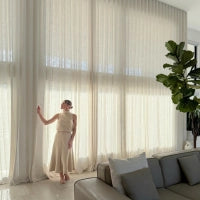


Semi-Sheer Curtains: The Privacy-and-Light Balance Every Room Needs
 Semi-sheer curtains sit in the useful space between two extremes. They're not as transparent as traditional sheers — someone on the sidewalk won't see you drinking coffee in your living room — and they're nowhere near as dark as blackout panels. What you get is filtered daylight that softens a room without turning it into a cave, plus enough fabric density to blur interior shapes into indistinct colors during the day.
At night, the equation changes. When your lights are on and it's dark outside, semi-sheer fabric becomes more transparent — you'll be visible as a silhouette, though not in sharp detail. The fix isn't to abandon semi-sheers. It's to pair them with a second layer you close after sunset.
If you want a single number: semi-sheer curtains typically filter out about 30-50% of incoming light. Enough to cut glare on a laptop screen. Enough to keep the room from feeling exposed. Not enough to sleep past sunrise.
Semi-Sheer vs. Sheer vs. Light Filtering: What's the Actual Difference?
These three terms get used interchangeably, and that's part of why the category feels confusing. Here's how they actually relate.
| Sheer | Semi-Sheer | Light Filtering | |
|---|---|---|---|
| Weave density | Open, gauzy | Tighter, more yarn | Varies — category, not a weave |
| Light transmission | ~80-90% | ~50-70% | Any fabric that softens light |
| Daytime privacy | Low — silhouettes visible | High — shapes blurred to color blocks | Depends on the specific fabric |
| Nighttime privacy | None — fully see-through with lights on | Low-moderate — diffused silhouettes | Varies |
| Best for | Layering under drapes, private backyard rooms | Street-facing living rooms, dining rooms, home offices | Rooms where you want soft light but don't need specific privacy |
A note on "light filtering": it's an umbrella term, not a distinct weave. A linen curtain with no lining is light filtering. A semi-sheer polyester panel is light filtering. What matters is the actual fabric — its weight, its weave, its opacity. When you're shopping, look past the label and check what the fabric actually does.
Semi-sheer is the narrowest, most useful category of the three. It means the fabric has enough body to provide meaningful privacy during daylight hours while still letting the room feel bright. At Freshine, products tagged semi-sheer — like the Orinda Semi Sheer Curtains and the Amara Linen Curtains — use linen blends and textured weaves that strike exactly this balance.
Day vs. Night: The Privacy Reality
Semi-sheer curtains behave differently depending on which side the light is coming from. This isn't a defect — it's physics. Understanding it means you can plan around it.
During the day: The sun outside is brighter than your interior lights. Light pushes inward through the fabric. From the street, someone sees a soft, uniform surface — maybe a wash of oatmeal or ivory — but not the shape of your sofa, and definitely not your face. If you're six feet back from the window, you're invisible. If you're standing right against the glass, someone might make out a vague outline. This is why semi-sheers work so well for living rooms and dining rooms — spaces you use during daylight. At night: The dynamic reverses. Your interior lights are now the brightest source. Light pushes outward through the fabric. From outside, someone can see that the room is lit, and they can probably tell if someone is moving around. Details stay soft — they won't read your book title from the sidewalk — but privacy drops significantly compared to daytime.
The practical takeaway: semi-sheers are a daytime privacy solution. For nighttime, you need a plan. Which brings us to the most reliable strategy in window treatments.
The Layer Strategy: Day Softness, Night Privacy
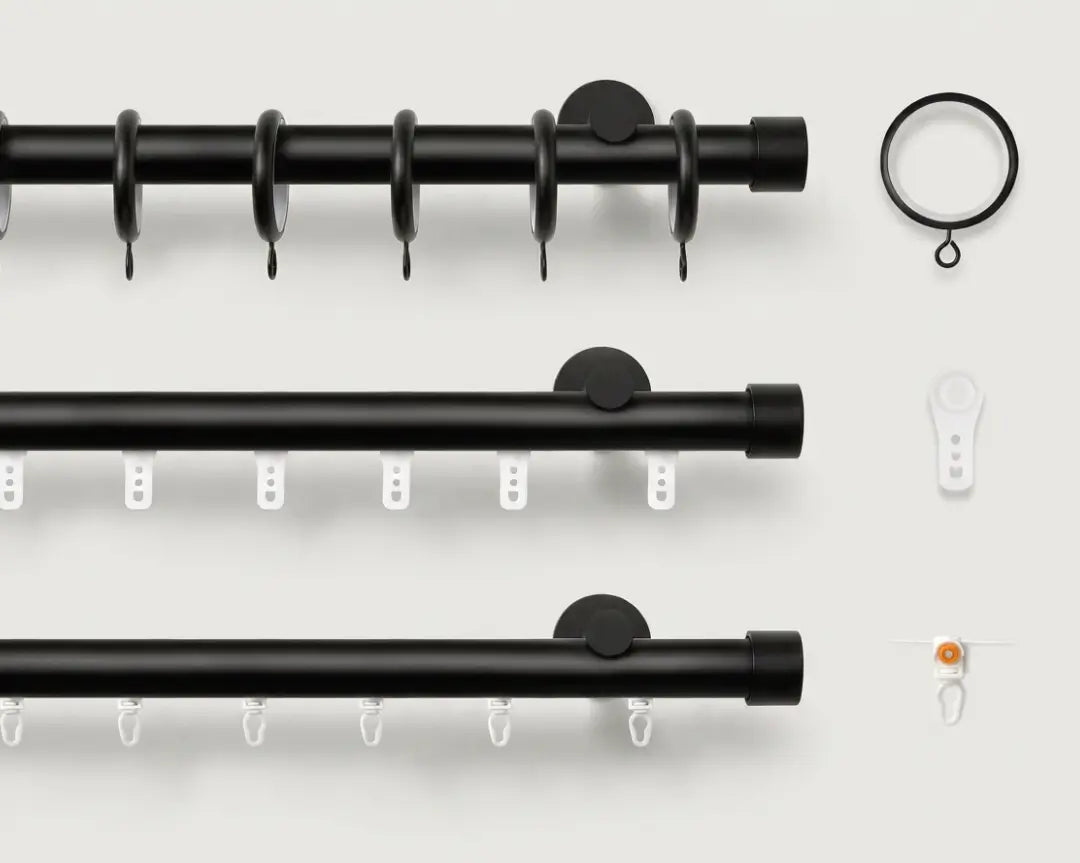
A double curtain rod or dual-track system lets you run two layers of curtains independently. The inner layer (closest to the glass) is your semi-sheer. The outer layer is a lined or blackout curtain. Here's how the day plays out:

Morning to sunset: Blackout layer pulled open, stacked to the sides. Semi-sheer layer closed. The room glows. You have privacy. It feels open and light. After dark: Semi-sheer layer stays in place. Blackout layer drawn closed. The room goes dark, private, and quiet. Total control with a single motion.
This setup costs more than a single rod, but it's the only configuration that gives you both daytime ambiance and nighttime privacy in the same window. It also insulates better — the trapped air between two fabric layers helps with both heat and sound.
Which semi-sheer product you choose for the inner layer depends on the room. For living rooms, a linen semi-sheer like Amara brings texture and warmth. For dining rooms, Elara in a neutral tone adds formality without heaviness. The outer blackout layer can be something like Iris Blackout Linen for near-total darkness, or a lined linen panel for moderate dimming with a softer look.
If a double rod feels like too much hardware for your space, a simpler option is to choose a semi-sheer with a built-in second layer — Nova Semi-Sheer Double-Layer Curtains combine two fabric tiers in a single panel. It's less adjustable than a double rod, but it gives you a similar visual effect with one set of brackets.
Where Semi-Sheer Curtains Work Best (and Where They Don't)
 Living Room — The natural home for semi-sheer. This is the room you use during daylight. You want it bright, you want it to feel open, and you don't want delivery drivers watching you eat lunch. Semi-sheers deliver all three. Choose a textured fabric — a linen blend, something with slub — to give the light something to play against. (For a deeper look at living room curtain choices, see our living room curtain guide.) Dining Room — Similar logic. Entertaining happens in the evening, often with candles and softer lighting. Semi-sheers during the day keep the room from feeling closed off; at night, when the lights are low, the transparency issue matters less. If your dining room faces the street, pull a lined outer layer closed when guests arrive. Home Office — Semi-sheers solve a specific problem here: screen glare. Direct sun on a monitor is unusable. Blackout curtains are overkill — you'd be working in artificial light at 2 p.m. Semi-sheers cut the harshness without darkening the room. If your desk faces the window, this alone can make the space functional. Bedroom — This is where the disclaimer belongs. Semi-sheers alone will not give you the darkness most people need to sleep well. They won't block the neighbor's porch light or the 6 a.m. sun. The right answer for a bedroom is layering: semi-sheer for daytime softness, blackout for night. If you only want one layer, skip semi-sheer and go straight to a lined or blackout curtain. Street-Facing Ground-Floor Windows — Semi-sheers work here, but color matters. White semi-sheers glow like a lantern at night — every passerby sees them lit from within. A warmer neutral — oatmeal, sand, dove gray — absorbs some of that escaping light and keeps the window darker from the outside. The difference is noticeable.
What to Look for When You Order
Fabric makes the difference. Linen and linen-blend semi-sheers have more body than polyester voile. The natural slub texture breaks up the visual line, making it harder to see through. They also drape better — important when the fabric is lightweight. Cotton blends offer a similar effect with a smoother hand. Color changes privacy. The darker the fabric, the less light passes through in either direction. White semi-sheers are the most popular — they brighten a room beautifully — but they're also the most transparent at night. If nighttime privacy is your main concern and you don't want to layer, go a shade or two darker: linen, taupe, soft gray. You'll lose a little brightness and gain a meaningful privacy bump. Header style shapes the look. Pinch pleat on a semi-sheer curtain gives it structure — the pleats create vertical lines that read as intentional rather than flimsy. Euro pleat does something similar with a slightly more modern profile. Rod pocket and grommet headers work too, but they tend to look more casual. For living rooms and dining rooms where the curtain is part of the design, pleated headers are worth the upgrade. Custom sizing closes the gaps. Ready-made semi-sheer curtains come in standard lengths — 84, 96, 108 inches. If your ceiling is 9 feet and you mount the rod near the ceiling, a 96-inch panel stops short. That gap at the bottom lets in light and, more importantly, eyes. Custom curtains cut to your exact measurements eliminate this. The rod extends past the window frame, the fabric reaches precisely to the floor, and the whole setup looks cohesive rather than approximate.
Every Freshine semi-sheer curtain is made to order — you specify the width and length, and the panel is cut and sewn to those dimensions. All fabrics are OEKO-TEX Standard 100 certified, so there's no chemical off-gassing to worry about, especially in nurseries or kids' rooms where fabric safety matters more.

FAQ
Can you see through semi-sheer curtains at night?
Partially. When interior lights are on and it's dark outside, semi-sheer fabric becomes more transparent. Someone close to the window can see silhouettes and movement, though not fine details. For full nighttime privacy, pair semi-sheers with a lined or blackout outer layer on a double rod.
What's the difference between sheer and semi-sheer curtains?
Sheer curtains use an open, gauzy weave — they let in about 80-90% of light and provide almost no privacy during the day. Semi-sheer curtains use a denser weave that filters 50-70% of light and blurs interior shapes into indistinct colors from the outside. Sheer is decorative; semi-sheer is functional. If you're considering traditional sheers instead, see our sheer curtains guide for a different set of tradeoffs.
Are semi-sheer curtains good for bedrooms?
They're a good daytime layer but not sufficient alone for sleep. Semi-sheers won't block morning light or street glow. The right bedroom setup is a double rod: semi-sheer inner layer for daytime softness, blackout outer layer for darkness at night.
Do semi-sheer curtains provide UV protection?
They reduce UV exposure compared to bare windows — the fabric density scatters and absorbs some UV — but they are not a substitute for dedicated UV-blocking window film or lined curtains. For furniture and flooring you want to protect from fading, a lined outer layer is the more reliable solution.
What color semi-sheer curtains give the most privacy?
Darker colors. White semi-sheers are the most transparent at night — they glow when lit from within. Oatmeal, linen, taupe, and gray absorb more escaping light and keep the window darker from the outside. The tradeoff is that darker semi-sheers also let in less daylight, so balance privacy against brightness for your specific room.