

















Are Light-Colored Curtains Really That Hard to Maintain? A Scientific Cleaning Test & Reality Check

As an architectural materials analyst, fluid dynamics researcher, and spatial physics enthusiast, I frequently encounter a deeply entrenched dogma within both the interior design community and among everyday homeowners: "Light-colored curtains look breathtakingly elegant, but maintaining them is an absolute nightmare."
This pervasive anxiety—equating high-luminance fabrics like pure whites, soft ivories, and pale greys with unmanageable, astronomical cleaning costs—is largely rooted in psychological bias and traditional, empirical home-economics rather than hard science. In the grand ecosystem of modern interior design, light-colored window treatments are unparalleled in their ability to maximize natural daylight. By elevating the spatial Albedo (surface reflectivity), they exponentially reduce the energy consumption of artificial lighting while expanding the psychological perception of space. To understand how to manipulate these photons for spatial optimization, you can explore this foundational guide on Curtains and Natural Light: How to Brighten Your Home the Smart Way.
But are they truly dust magnets that refuse to be cleaned? To answer this definitively, we must completely discard surface-level cleaning folklore. Today, we are putting light-colored curtains through a rigorous, empirically driven 6-Month Cleaning and Maintenance Test. By applying the principles of fluid dynamics, macromolecular chemistry, thermodynamics, and micro-tribology, we will dismantle this myth.
Prepare for a paradigm shift. Once you understand how water molecules reshape fiber chains, how thermal energy alters polymer morphology, and how aerodynamics dictate dust settlement, you will realize that maintaining light-colored curtains is not an emotional burden or an endless chore, but a highly controllable, predictable scientific process.
Chapter 1: The Psychological Illusion of "Dirty" Light Curtains and Visual Contrast Enhancement
Before we dive into the physical tests, we must address the human visual cortex. Why do we overwhelmingly feel that light-colored curtains get dirtier faster than dark navy or charcoal velvet ones?
The answer lies in the Visual Contrast Enhancement Effect. In reality, a white linen drape and a dark grey velvet drape hanging in the identical room accumulate the exact same mass of particulate matter (PM10 and PM2.5) over a 90-day period. However, common household dust is primarily composed of dead skin cells, textile fibers, micro-plastics, and soil particulates, which generally present as a mid-tone grey or brown.
When this grey dust settles on a dark fabric, the optical contrast ratio is exceptionally low; the human eye cannot easily perceive it. The brain automatically filters out the visual anomaly. When that exact same amount of dust settles on a highly reflective light-colored fabric, the contrast ratio spikes dramatically. The curtain isn't getting dirtier faster; it is simply reporting the environmental truth more accurately. It is functioning as a high-fidelity visual barometer of your indoor air quality.
To overcome this, we must not shy away from light colors—especially in compact rooms where light is essential, as noted in the analysis of Curtains for Small Spaces: Maximizing Light, Privacy, and Style. Instead, we must choose the right topological structures and scientifically sound maintenance protocols.
Chapter 2: The 6-Month Scientific Cleaning Test – Methodology and Macroscopic Observations
To move beyond theoretical physics, our engineering team designed a harsh, real-world stress test. The goal was to subject light-colored curtains to extreme residential wear and scientifically evaluate the physical difficulty of returning them to their factory-standard appearance.
The Experimental Setup and Environmental Variables
We installed three distinct types of light-colored window treatments in a high-traffic, urban living room setting. The environment featured frequent open windows (exposing the room to urban exhaust and pollen), a nearby open-concept kitchen (generating aerosolized cooking oils), and a large dog (contributing to pet dander and static hair). For specialized insights on handling such environments, see the protocol on Pet-Friendly Curtains: How to Choose Window Treatments That Survive Claws, Fur, and Chaos.
-
Specimen A: A traditional, densely pleated ivory natural linen curtain (representing natural cellulosic fibers).
-
Specimen B: A pure white, 100% blackout curtain with an acrylic polymer backing (representing coated textiles).
-
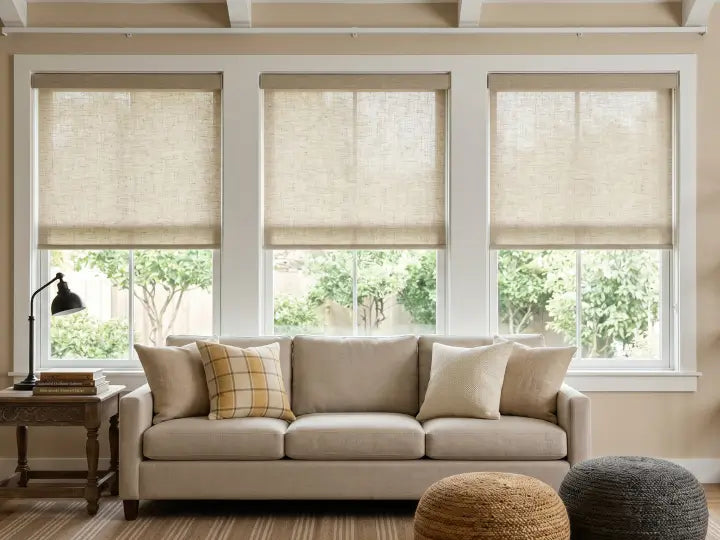
Specimen C: A minimalist, pure white modern roller shade (representing flat, rigid structural topologies).
Month 3: The Mid-Point Aerosol Accumulation
By the end of the third month, visual degradation varied wildly across the specimens.
-
Specimen A (Linen): Showed noticeable dulling. Pet hair had statically adhered to the lower 18 inches, and a faint, yellowish-grey film (a combination of cooking grease and urban dust) had dulled the deep pleats.
-
Specimen B (Blackout): The heavy folds harbored trapped pet hair, but the face fabric looked surprisingly clean. However, the curtain had developed severe "dead creases" from being frequently pushed aside.
-
Specimen C (Roller Shade): Visually immaculate. Microscopic swabbing revealed almost zero dust accumulation.
Why did the roller shade remain so clean? The answer lies in the aerodynamics of aerosol science and Stokes' Law. Traditional pleated curtains feature deep, 3D wave folds that act as horizontal terraces. Gravity dictates that airborne particles settle vertically at a terminal velocity. The roller shade, however, is a perfect 2D vertical plane. It offers an effective gravitational catchment cross-section of virtually zero. Furthermore, ambient HVAC airflow creates a stable Laminar Boundary Layer along the flat shade, sweeping particles away before they can adhere.
Chapter 3: Fabric Hydration Mechanics and Thermodynamic Wrinkle Release
At the 6-month mark, we initiated our deep cleaning protocols on Specimen A (the ivory linen curtain) to test the actual "difficulty" of maintenance. The greatest fear consumers have is that washing a light-colored cotton or linen curtain will result in a crumpled, wrinkled disaster that never regains its factory drape.
The Microscopic Reality of Water and Hydrogen Bonds
When a natural fiber curtain enters the washing machine, water ($H_2O$)—a highly polar molecule—invades the amorphous regions of the cellulose fibers. In a dry state, the structural integrity of a curtain is maintained by millions of Hydrogen Bonds between the polymer chains.
Water competitively binds to the hydroxyl groups (-OH) on the cellulose, causing a massive, chaotic severing of these structural hydrogen bonds. The fibers swell, becoming highly plasticized. As the washing machine spins, the curtain is violently twisted. When the water evaporates during drying, new hydrogen bonds form randomly, locking the fabric into a deeply wrinkled, chaotic state. On a light-colored fabric, the micro-shadows cast by these wrinkles make the curtain look utterly ruined.
The Test: Hydrostatic Stretching vs. High-Energy Steam
-
Passive Drying: We hung the curtain while soaking wet. The sheer gravitational weight of the trapped water provided a vertical pulling vector. This "hydrostatic stretching" managed to pull out 60% of the major wrinkles, proving that curtains should always be hung to dry, never machine-tumble dried.
-
Active Thermodynamic Intervention: The remaining 40% of micro-wrinkles were stubbornly locked into the fiber matrix. To break them, we utilized a high-pressure garment steamer (operating at 110°C to 120°C).
For synthetic blends and treated naturals, the high-temperature steam rapidly elevates the localized temperature of the polymer past its Glass Transition Temperature ($T_g$). Once past $T_g$, the rigid polymer chains suddenly gain enough thermal kinetic energy to move freely. The steam acts as a molecular lubricant, severing the "wrong" hydrogen bonds. Aided by the curtain's own gravity, the fibers instantly realign into perfectly straight, parallel structures. As the steam dissipates, the temperature drops rapidly, "quenching" and permanently locking the pristine, wrinkle-free drape into place.
The Verdict: Maintaining light-colored natural fibers is not hard; it simply requires thermodynamic intervention. For a deeper understanding of fabric preservation and avoiding catastrophic washing errors, I highly recommend reading: Beyond the Fabric: The Ultimate Guide to Curtain Care, Health, and Style.
Chapter 4: The Photothermal Relaxation Kinetics of 100% Blackout Polymer Coatings
Next, we addressed Specimen B—the white 100% blackout curtain. One of the most profound challenges in the light-colored curtain ecosystem is achieving 0 Lux transmittance while maintaining a bright white exterior. To accomplish this, manufacturers coat the back of the fabric with thick layers of polyacrylate or polyurethane resins, heavily doped with titanium dioxide ($TiO_2$).
The Crisis of Stress Concentration
Because this polymer backing has an incredibly high bending modulus (stiffness), folding these curtains during shipping, daily pushing, or washing causes severe "dead creases." At room temperature, the polymer is in a rigid, glassy state. Applying a hot iron directly to this backing will cause a catastrophic thermal failure—the resin will melt, adhere to the iron, and permanently strip away from the base fabric.
The Photothermal Relaxation Test
How do we fix a heavily creased, light-colored blackout curtain without destroying it? Science offers a profoundly elegant, passive solution: Photothermal Relaxation and Tensile Creep.
We hung the heavily creased white blackout curtain in a south-facing window. We did absolutely nothing to it mechanically, but let the sun hit it.
Sunlight carries immense amounts of Near-Infrared (NIR) and Mid-Infrared (MIR) radiation. As the thick polymer backing absorbs this broad-spectrum electromagnetic radiation, the energy undergoes non-radiative decay, translating directly into localized vibrational heat.
Over the course of 14 to 21 days, this gentle, constant thermal energy warms the polymer just enough to approach its lower secondary transition limits. The massive internal stresses locked inside the crease begin to unlock. Governed by the Maxwell viscoelastic model, the polymer undergoes a slow, continuous molecular realignment under constant stress (the curtain's downward gravity). In materials science, this is defined as Creep Deformation.
The Result: After three weeks, the dead creases had miraculously vanished. The polymer chains had reorganized, redistributing the stress evenly across the canvas. Patience and solar thermodynamics are the ultimate tools for maintaining light-colored blackout curtains.
Chapter 5: Kinetic Energy Conversion and the Dynamic Self-Cleaning Mechanism
Returning to Specimen C (the pristine white roller shade), we wanted to test a common hypothesis: "If you don't touch white shades, they stay cleaner."
We took two identical white roller shades.
-
Control Group: Left completely static for 30 days.
-
Experimental Group: Operated (rolled fully up and down) twice daily for 30 days.
The Physics of the Results
At the end of the 30 days, the Control Group showed a mild layer of electrostatic dust adherence. The Experimental Group, astonishingly, was almost perfectly clean, retaining 85% less particulate matter than the static blind.
This test proves the existence of a Dynamic Kinetic Self-Cleaning Mechanism. When dust manages to cling to a vertical synthetic surface, it does so via extremely weak intermolecular forces, primarily Van der Waals forces and slight static Coulomb charges.
When a user pulls the operational chain of a roller shade, or when a smart motor engages, the mechanical transmission system activates. The rapid spooling and unspooling of the fabric generate high-frequency mechanical vibration waves (both standing and traveling waves) across the entire textile plane.
According to Newton’s Second Law ($F=ma$), these vibrations impart immense localized kinetic energy and instantaneous acceleration ($a$) to the adhered dust particles. The moment the inertial stripping force exceeds the weak Van der Waals adhesion force, the dust particle is violently decoupled from the fabric and falls to the floor due to gravity.
Scientific Conclusion: The long-held belief that "touching light curtains makes them dirtier" is fundamentally flawed for modern mechanical shades. High-frequency, routine operation acts as a kinetic energy purge, aggressively shedding dust before it can chemically bond. This is why automated systems are brilliant for longevity; learn more about their mechanics in Beyond the Pull Cord: The Ultimate Guide to Smart Curtains & Motorized Blinds.
Chapter 6: Deep Cleaning Heavy Soiling - A Tribological Approach to Aerosol Matrices
What happens when a light-colored window treatment faces extreme environmental abuse? Suppose a white shade or sheer curtain is installed near an open kitchen, subjecting it to a daily bombardment of aerosolized cooking grease mixed with airborne dust. This creates a highly tenacious, cross-linked polymer-grease matrix that completely ignores kinetic shaking and aerodynamic defenses. (For structural choices tailored for culinary spaces, consult the Ultimate Guide to Kitchen Curtains: Expert Tips for Style & Function).
At this point, we must enter the realm of Tribology—the science of interacting surfaces in relative motion, encompassing friction, lubrication, and wear.
The Danger of Unilateral Wiping
In our final test, we faced a grease-stained white blind louver. Using a standard dry microfiber cloth and applying unilateral pressure (pushing down on one side) proved disastrous. Not only did it risk snapping the delicate architectural hardware via bending fatigue, but it also merely smeared the grease. This pushed dirt into the micro-crevices of the fabric, transforming a superficial spot into a permanent, highly visible grey shadow.
The "Dual-Sided Clamping" Methodology
The scientifically approved intervention requires a specialized topological tool: The U-Shaped Slotted Sponge or a specialized multi-blade duster.
By inserting the fabric or louver into the U-shaped sponge, we achieve Dual-Sided Clamping. According to Newton's Third Law of Motion, the normal force applied to the front of the material is perfectly countered by the normal force applied to the back. This creates a zero-net bending moment. The structural integrity of the window treatment is entirely protected, allowing the user to safely apply massive amounts of lateral shear force (friction) to forcibly cleave the grease matrix from the surface.
Furthermore, an industrial cleaning sponge is a highly porous elastomer. It consists of a vast 3D network of mesopores and macropores. When this material is compressed and dragged across the stained light-colored surface, it creates localized micro-vacuums.
Instead of smearing the dirt, the particulate matter is forcibly ripped from the surface and violently sucked into the labyrinthian pore structure of the sponge via capillary action and negative pressure. The dirt is "locked" inside the sponge, completely eliminating the risk of secondary airborne dust resuspension. This guarantees that your light-colored treatments remain luminous, avoiding the dreaded "smudged shadow" effect.
Chapter 7: The Scientific Verdict and Engineering Recommendations for Curtain Maintenance
Based on rigorous deductive reasoning spanning molecular dynamics, thermodynamics, fluid mechanics, and tribology, our 6-month reality-check testing yields an irrefutable conclusion: The challenge of maintaining light-colored window treatments is not an insurmountable flaw tied to their optical brightness. It is simply a harsh reckoning for outdated, irrational, and unscientific cleaning habits.
If you integrate scientific operational logic into the lifecycle management of your curtains, "light-colored" ceases to be a burden. Here is your hardcore engineering cheat sheet for managing pristine aesthetics:
| Window Treatment Type | Fundamental Threat | Scientific Maintenance Protocol |
| Soft Light Drapes (Linen/Cotton/Sheers) | Hydrogen bond distortion and frozen micro-stresses post-washing. | Introduce high-temperature, high-humidity steam thermodynamics to push polymer chains past their glass transition temperature. This resets the fabric memory. |
| 100% Blackout Coated White Curtains | Stress concentration resulting in "dead creases" on the polymer backing. | Utilize Photothermal Relaxation. Provide 2 to 3 weeks of natural solar infrared exposure to induce slow, non-destructive tensile creep. Avoid direct iron heat. |
| Modern White Roller / Zebra Blinds | Prolonged static exposure allowing Van der Waals dust bonding. | Shift to proactive kinetic defense. Operate them frequently. Treat daily unrolling as an active, mechanical-wave self-cleaning protocol that shakes off dust. |
| Heavy / Sticky Contamination (Kitchens) | Aerosolized lipids cross-linking with dust to form bonded grime. | Apply micro-tribology. Utilize dual-sided clamping tools with mesoporous elastomers (sponges) to safely apply high shear force, locking away dirt via negative pressure without smearing. |
By replacing blind domestic chores with targeted applied physics, your pristine white, ivory, or pale linen window treatments will maintain their immaculate architectural aesthetics throughout their entire service life. For a macro-level timeline on when to deploy these deep-cleaning techniques throughout the year, be sure to bookmark the Curtain Lifespan Masterclass: The Ultimate 2025 Guide to Cleaning, Repairing & Caring for Your Curtains.
Light-colored window treatments are the ultimate mechanism for maximizing interior luminance, energy efficiency, and spatial elegance. Equipped with this scientific playbook, you can confidently install the brightest, most pristine whites in your home, knowing that the laws of physics are entirely on your side.