


















The Jewelry of the Room: 2026’s Hottest Curtain Hardware Trends to Elevate Your Home

In the world of interior design, we often talk about the "big" things—the velvet sofa you spent months picking out, the hand-knotted rug, or the perfect shade of "greige" for the walls. But as any seasoned designer in the US will tell you, a room isn't truly finished until you’ve addressed the windows. And I’m not just talking about the fabric.
If the curtains are the outfit, the curtain hardware is the jewelry.
As we move into 2026, the shift in window aesthetics has moved away from purely functional “sticks” to sculptural, high-tech, and statement-making hardware. Homeowners from New York to Los Angeles are realizing that a sagging, generic rod can ruin a high-end look, while the right hardware can make even affordable drapes look like a million bucks.
Whether you’re leaning into the "Quiet Luxury" movement or the bold "Maximalist" resurgence, here is everything you need to know about the curtain hardware trends dominating 2026.
1. Sculptural Finials: Art for Your Windows
For years, the finial (the decorative end cap on a curtain rod) was an afterthought—usually a simple ball or a small cap. In 2026, finials are stepping into the spotlight as miniature works of art.
We are seeing a massive surge in organic and sculptural shapes. Think hand-carved stone end caps, hammered metal textures, and even asymmetrical glass designs. These pieces act as a focal point, drawing the eye upward and adding a layer of architectural interest to the room.
-
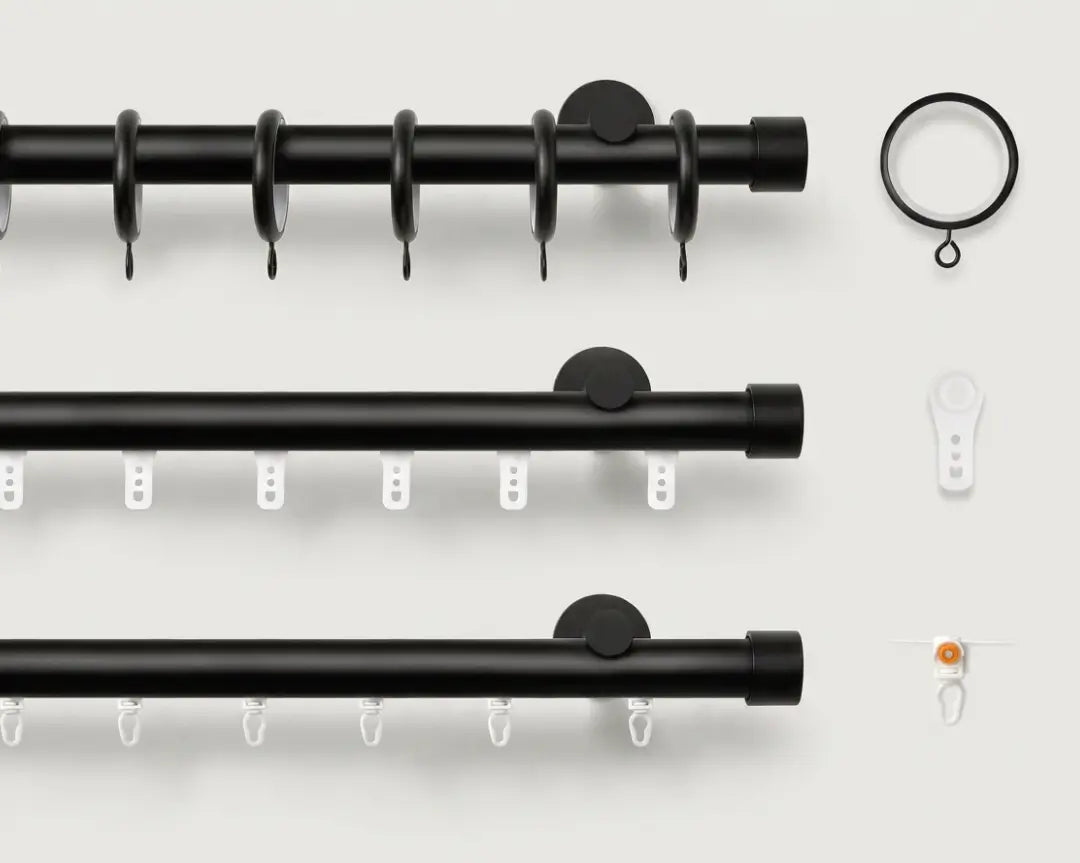
The Look: Matte black angles for a modern edge, or brushed brass arches for a touch of "Neo-Art Deco."
-
Pro Tip: If your room is fairly neutral, use a bold finial to inject personality without overcommitting to a vibrant curtain fabric.
2. The Rise of "Invisible" Tracks & Architectural Minimalism
On the opposite end of the spectrum from bold finials is the move toward seamless integration. For those who love the "Japandi" or "Modern Minimalist" aesthetic, the hardware shouldn't be seen at all.
Architectural tracks are being recessed into ceilings or hidden behind sleek valances to create a "floating" effect. This trend is particularly popular in luxury condos and modern builds where floor-to-ceiling windows are the star of the show.
-
The Hardware: The Arden Adjustable Ripple Fold Curtain Track is a perfect example. It offers that sleek, "hotel-style" wave that looks incredibly polished without the bulk of a traditional rod.
-
Why it works: It creates clean, vertical lines that make your ceilings feel 10 feet taller.
There is also a middle path between a bare track and a decorative pole: the modern traverse rod. From the floor it reads as an ordinary wood or metal rod, but the carriers run inside a hidden channel, so heavy drapes open on a cord or wand instead of being dragged along the pole by hand. You keep the warmth of a visible rod and get the action of a track, with far less wear on the leading edge of the fabric.
3. Mixed Metals and Warm Finishes
Say goodbye to the cold, industrial feel of stainless steel. 2026 is the year of Warm Metallics. We are seeing a huge preference for:
-
Brushed Gold and Honey Brass: Adds a soft, sunny glow to the room.
-
Oil-Rubbed Bronze: Perfect for the "Modern Farmhouse" or "Old World" aesthetic.
-
Matte Black: Still a staple, but now often paired with wood or stone accents for a more "organic" feel.
The "mixed metal" rule is also being thrown out the window. It is perfectly acceptable—and actually encouraged—to have brass curtain rods even if your door handles are matte black. It creates a "collected over time" look that feels authentic.
Two more finishes are worth knowing about. Unlacquered brass is left unsealed, so instead of holding one shine forever it develops a living patina that darkens at the brackets and stays bright where hands touch it. And acrylic or lucite is not a metal at all: a clear rod occupies almost no visual space, which makes it a quiet trick in a small room where a heavy pole would push the walls in. Clear rods look best with brass brackets and finials rather than alone.
One guardrail on all this mixing, though: hold a single room to about two distinct metal finishes. Two reads as collected. Four reads as an accident.
4. Smart Hardware: The New Standard
Technology is no longer a luxury "add-on"; in 2026, it's an expectation. Motorized curtain tracks have become remarkably quiet and affordable. Imagine waking up and having your drapes glide open with a voice command or a scheduled timer to let in the morning sun.
Beyond just the "cool factor," smart hardware like the Kaelen Custom Motorized Curtain Track serves a practical purpose. It protects your privacy, helps regulate home temperature by closing during the heat of the day, and—most importantly—is 100% child-safe since there are no hazardous cords.
Expert Insight: According to the U.S. Department of Energy, smart window treatments can significantly reduce heat gain in the summer, saving you a bundle on cooling costs.
5. Layering with Double Rods
Layering isn't just for your bed or your winter outfits. The most sophisticated window treatments in 2026 involve a dual-layer approach.
By using a Double Decorative Custom Curtain Rod, you can hang a light-filtering sheer on the back rod for daytime privacy and a heavy, textured drape (like velvet or linen) on the front rod for nighttime coziness and light blocking.
-
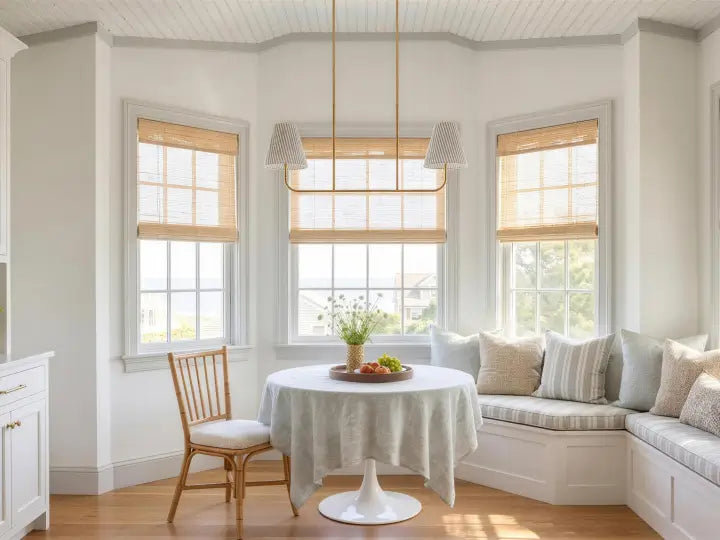
The Trend: Pairing a natural woven wood shade with a sheer linen curtain on a double rod. It creates an "Artisanal" look that is very popular in coastal and suburban homes right now.
6. Heavy-Duty Hardware for Grand Openings
As the trend for "extra-wide" windows and open-concept living continues, we need hardware that can actually handle the weight. There is nothing that kills a vibe faster than a "sad smile"—that's designer-speak for a curtain rod that bows in the middle.
In 2026, we are seeing a return to substantial diameters. A 1-inch rod is the standard, but for large living room windows, designers are opting for 1.25-inch or even 1.5-inch rods like the Eleanor Custom Rod. These offer the structural integrity needed for heavy blackout or velvet drapes.
Diameter is only half of the strength question. The other half is how the rod is built. Most big-box rods are telescoping, one pole sliding inside another, which leaves a visible bump at the overlap, and that bump is exactly what your rings catch on every time you draw the curtains. A spliced rod is joined internally into one continuous line: no snag point, and far more load.
The numbers are worth knowing before you buy. A standard 1-inch telescoping rod usually holds somewhere around 15 to 20 pounds, and that rating falls as you extend it toward its maximum length. A spliced rod is in a different class entirely: our Collins Single Decorative Custom Curtain Rods are aluminum and rated to 132 lbs when installed with proper anchors. That sounds like overkill until you remember you are not only holding up static fabric. You are absorbing the force of someone yanking the curtains open twice a day for years.
Technical Table: Choosing the Right Hardware for Your Header
| Header Style | Recommended Hardware | 2026 Trend Rating |
| Pinch Pleat | Rod with Rings or Traverse Track | ⭐⭐⭐⭐⭐ (The "Gold Standard") |
| Ripple Fold | Dedicated Track System | ⭐⭐⭐⭐⭐ (The Modern Favorite) |
| Grommet | Single Decorative Rod | ⭐⭐⭐ (Great for Casual Spaces) |
| Euro Pleat | Decorative Rod with Leo Adjustable Hooks | ⭐⭐⭐⭐ (Tailored & Timeless) |
Wood or Metal? Choosing the Rod Itself
Finish gets all the attention, but the material underneath changes how a rod behaves as much as how it looks.
| Metal Rods | Wood Rods | |
| Strengths | Highest load capacity, slimmest profile for the strength it gives, widest range of finishes | Warm and architectural, can be painted or stained to match trim, near silent when wood rings ride on a wood pole |
| Trade-offs | Metal rings on a metal pole can be noisy unless the rings are nylon lined | Can warp in a humid room, and the thicker diameters can read as dated in a very modern space |
| Best for | Modern, industrial, transitional and glam rooms | Traditional, farmhouse, coastal and bohemian rooms |
If you are hanging something genuinely heavy, such as lined velvet or a long silk panel, favor metal and do not drop below roughly 1 3/8 inches in diameter. Wood is the better call when you want the hardware to feel like furniture, or when silence matters, as in a bedroom.
How to Install Like a Pro (The "High and Wide" Rule)
To truly capitalize on these trends, the installation is just as important as the hardware itself. If you want that "designer look" seen in magazines like Architectural Digest, follow the High and Wide rule:
-
Go High: Mount your rod 4 to 6 inches above the window frame, or even halfway between the frame and the ceiling. This draws the eye up and creates an illusion of height.
-
Go Wide: Extend the rod 8 to 12 inches past the window frame on each side. This allows the curtains to "stack" on the wall when open, making the window appear much larger and letting in maximum natural light.
-
The Center Support: If your window is wider than 60 inches, you must use a center bracket. Our Noah Custom Rod comes with reinforced brackets to ensure your setup stays level for years to come.
Before you start, gather: a steel tape measure (a fabric tape sags and will cost you half an inch), a pencil, a spirit level, a drill and bits, wall anchors, and a stepladder.
Two steps people skip and then regret. First, level independently. Do not measure down from the ceiling or up from the window frame. Houses settle and frames go crooked, and a rod hung parallel to a crooked frame looks wrong in a way nobody can quite name. Mark both brackets, then check the marks against a level rather than against the trim.
Second, anchor properly. Only a fraction of bracket screws happen to land in a stud; the rest go into plain drywall, and heavy drapes will pull an unanchored screw straight out of it. Drill a pilot hole, seat the anchor, then drive the screw into the anchor. Where you cannot find a stud, toggle bolts are the stronger option.
One last trick when you thread the rings on: leave one ring outside each bracket, between the bracket and the finial, and pin the outer edge of the panel to it. That locks the leading edge to the wall, so when you draw the curtain closed the whole panel does not creep toward the middle of the window.
Why Hardware Quality Matters More Than You Think
It’s tempting to grab the cheapest rod at a big-box store, but consider this: curtain hardware is a moving part. You pull on it every single day.
-
Gliding Ease: High-quality tracks use ball-bearing carriers so your curtains glide like silk, rather than catching and jerking.
-
Finish Durability: Cheap finishes flake and peel over time due to the friction of rings sliding back and forth. Freshine’s custom rods are finished with high-durability coatings designed to withstand daily use.
-
Adjustment: Small details, like using Leo Adjustable Pin Hooks, allow you to tweak the height of your curtains by up to 3 inches after they are hung. This is a lifesaver if your floors aren't perfectly level (and let's be honest, whose are?).
Bay Windows, Corners and Other Awkward Openings
Not every window is a tidy rectangle on a flat wall. Bay windows especially used to mean commissioning a metalworker to bend a rod to your exact angles, at a price that persuaded most people to give up and hang three separate panels instead.
Elbow connectors ended that. They are hinged joints that seat into the ends of two rods and let a run turn a corner at whatever angle your bay actually is, rather than the tidy 90 degrees a catalog assumes. Our Collins rods take corner connectors, which turns a bay or a corner window into a normal order instead of a custom fabrication job.
Hardware Safety With Children and Pets
Two things outrank style if there are small children or animals in the house.
-
Anchor every bracket. A toddler who grabs a curtain and leans back can bring a poorly fixed rod down on top of themselves. This is the strongest argument there is for wall anchors over bare screws.
-
Eliminate dangling cords. The long operating cords on older traverse systems are a genuine strangulation hazard. Wand-drawn tracks and motorized systems remove the cord altogether, which is why a motorized track earns its place on safety grounds and not only as a luxury.
Troubleshooting the Usual Hardware Problems
The curtains snag when I slide them. Almost always a telescoping rod: the rings are catching on the ridge where the two poles overlap. Move to a spliced or single-piece rod, or switch to a track with ball-bearing carriers. Wax or silicone spray on the pole is a stopgap, not a fix.
The rod spins when I open the curtains. Most brackets have a small set screw underneath or on the side that clamps the rod into the bracket cup. It has usually just worked loose.
There is a band of light along the top of the curtains. Common with grommet and ring-top panels, where the fabric hangs below the rod by design. Mount the rod closer to the ceiling so the gap sits above eye level, or hide it behind a valance or cornice. If the leak is down the sides rather than along the top, what you actually want is a wraparound rod.
FAQ: Your Curtain Hardware Questions Answered
Q: Can I mix different hardware styles in the same house?
A: Absolutely! While you want a sense of "flow," you don't need every room to be identical. You might use a sleek Arden Track in a modern living room and a more traditional Collins Double Rod in a cozy bedroom.
Q: How do I know what diameter rod I need?
A: For most standard windows, a 1-inch diameter is perfect. For very large windows (over 100 inches wide) or very heavy drapes (like velvet), go with a 1.25-inch or 1.5-inch rod to prevent sagging and maintain the proper visual scale.
Q: Are motorized tracks hard to install?
A: Not at all! Most modern motorized tracks, like our Kaelen series, are designed for DIY installation. They often plug into a standard outlet or are battery-powered, requiring no complex hardwiring.
Q: What is the best hardware for blackout curtains?
A: To get a "true" blackout experience, we recommend a Wraparound (or Return) Rod. This allows the curtain to curve back to the wall, sealing the gap where light usually leaks in through the sides.
Q: Do I need rings or can I just use the rod pocket?
A: While rod pockets are a classic look, they are the hardest to slide open and closed. For 2026, we recommend using Curtain Rings with Hooks. They offer a much smoother "glide" and a more tailored, high-end appearance.
Q: Should I buy the curtains or the rod first?
A: Choose the curtains first, because their weight and heading style decide what the hardware has to do. But install the rod before you order made-to-measure lengths. The only measurement that matters is the drop from the installed rod to the floor, and you cannot know it until the rod is on the wall.
Q: Can I use a tension rod for living room drapes?
A: Generally no. Tension rods hold by spring pressure alone and suit very light sheers inside a window frame, cafe-curtain style. Lined or custom living room panels will bring one down. Use wall-mounted brackets.
Q: Can I mount curtain rods on the ceiling?
A: Yes, and it buys you the maximum possible illusion of height. Ceiling mounting is the standard approach for floor-to-ceiling glass and for room dividers. Our tracks are designed for it, and many rod brackets can be rotated to mount overhead.
Q: What is the difference between a traverse rod and a regular rod?
A: On a regular rod you move the fabric by hand. A traverse rod has carriers running inside a hidden channel, worked by a cord or a wand, so the drapes open and close without you touching them. Traverse systems are the better choice for heavy curtains you open every day.
Q: My window is over 100 inches wide. What changes?
A: Two things. Use a spliced rod or a connector system rather than a single telescoping rod, which will sag at that span whatever it is rated for. And plan on at least one center support bracket, possibly two.
Q: How do I clean curtain hardware?
A: A soft dry cloth, regularly. Avoid chemical cleaners and anything abrasive, which will strip the finish. Brass and nickel are especially unforgiving about this.
Final Thoughts
Your windows are the "eyes" of your home, and the hardware you choose provides the structure and soul for your interior design. Whether you’re going for the bold statement of a brass rod or the quiet efficiency of a motorized track, investing in quality hardware is the secret to a space that feels expensive, functional, and uniquely yours.
Ready to give your windows the "jewelry" they deserve? Browse our full Freshine Hardware Collection to find the perfect match for your style.