
















Are Valances Back in Style for 2026? An Honest Verdict
Type "valance" into a search bar and the results split into two different decades: scalloped floral swags photographed in 1994, and crisp upholstered boxes photographed in 2026 show houses. Both are called valances. Only one of them is coming back — and the comeback has as much to do with how modern curtains hang as with how they look.
The short answer
The ruffled, swagged, scallop-edged valance of the 1990s is not coming back — fussy, festooned window tops still read dated, and trend editors have not changed their minds about that. What is back for 2026 is the tailored top treatment: clean upholstered cornices, box-pleat valances and faux-Roman-shade valances, in modern-classic and farmhouse-modern rooms. And there is one strictly practical reason to consider one even in a minimalist home: a cornice closes the light gap above a track-hung curtain — the one gap the curtain itself can never close.

In this guide
- Are valances out of style?
- Valance, cornice, pelmet, swag — which one do you mean?
- Why tailored top treatments are back
- The light-gap job nothing else does
- The faux-Roman-shade valance
- What size should a valance be?
- The honest downsides
- The bottom line
- FAQ
Are valances out of style?
One kind is. One kind is not — and 2026 is the year the two finally separated in the trend coverage.
The version most Americans picture — the puffy balloon valance, the scarf swag looped over a pole, the scalloped ruffle in a floral that matched the bedspread — belongs to the ensemble decorating of the late 1980s and 1990s, and it is staying there. Nothing in current designer commentary points to a revival. When our own Roman shade verdict named bulky swags and stiff valances as the things that genuinely read dated, that was the version it meant.
The tailored version is a different story. The straight-bottomed upholstered cornice, the box-pleat valance in plain linen, the neat little skirt over a kitchen window: these never left high-end work, and this year they are visibly back in trend roundups and real projects. So the useful question is not "valances: yes or no." It is which valance — and whether the one practical job a top treatment performs is a job your window actually needs.
Valance, cornice, pelmet, swag — which one do you mean?
Part of the confusion is vocabulary. Four different objects share the word, and the style verdict is different for each of them.
| Term | What it actually is | 2026 status |
|---|---|---|
| Valance | A soft fabric top treatment — gathered, pleated or flat — hung from a rod or mounted on a board. Fabric only, no rigid frame. | In, if tailored: box pleats, flat panels, plain fabrics. |
| Cornice | A rigid box — wood, usually padded and upholstered — fixed to the wall above the window. Holds a crisp architectural line. | In. The strongest of the four, and the most functional. |
| Pelmet | The British word for a cornice. A "modern curtain pelmet" is what the US market calls a modern upholstered cornice. | Same verdict as the cornice — it is the same object. |
| Swag | A draped semicircle of loose fabric, often with cascading tails at each side. The 1990s look, by name. | Out, and not on the way back. |
American usage has drifted into treating "valance" as an umbrella for all four — which is exactly why the style question gets such contradictory answers. Everything below uses the words precisely.
Why tailored top treatments are back
The clearest published signal: Livingetc's 2026 curtain-trend coverage lists valances among the classic details making a return, and it is not alone — across this year's shelter-title roundups, finished window tops keep resurfacing as part of the broader modern-classic and farmhouse-modern direction. Trend editors are careful with the wording, and it is worth being careful with it here too: what they are calling back is the upholstered cornice with a straight or lightly shaped edge and the tailored valance in quiet fabric — not the swag.
Underneath the coverage there are two more durable reasons. The first is the pendulum. After a decade of bare minimalism — naked windows, exposed poles, rooms stripped of trim — interiors are re-adding finished edges: skirted furniture, banded lampshades, dressed windows. A tailored top treatment is that instinct applied at the window, usually in the same plain, heavy linens the curtains beneath it have moved to — the greige, putty and clay tones you will find across our linen curtain collection.
The second reason is the one that makes the comeback likely to stick: the way curtains are installed has changed underneath the trend. The modern install is increasingly a track — ceiling-line, wall-to-wall, often motorized — and a track is a functional object with no decorative ambition. A cornice hides it completely, brackets and all. The 1990s valance decorated a rod. The 2026 cornice conceals a track. Same category of object, completely different job — and you can see where it slots into the wider year in our curtain trends 2026 rundown.
The light-gap job nothing else does
This is the section to read if you could not care less about trends.
Hang a curtain on a track and the panel hangs below the hardware — the carriers sit under the channel, so along the top of every track-hung curtain there is a horizontal slot of open air. Close a blackout panel against a bright morning and that slot turns into a stripe of light washing across the ceiling. No fabric choice fixes it, because the gap is above the fabric.
The hotel test: look above the drapery in almost any hotel blackout room and you will find a cornice, soffit or ceiling pocket capping the track. That is not styling — hospitality specifications state plainly that closing the light path above a track takes exactly that: a cornice, a valance or a ceiling pocket.
Our ripple fold guide walks through this gap in detail — on that system it exists by design and cannot be engineered out of the heading itself. And our comparison of blackout versus room-darkening versus sheer covers how much blocking the panel can contribute on its own. The one-line version: the curtain handles the glass; only a cap over the hardware handles the top. The other half of that sentence is the lining: it governs what comes through the glass, while the cornice governs what comes over the hardware — see our guide to curtain lining for the first half. That single fact is why a cornice earns its place even in rooms that want nothing decorative at all.
The honest flip side, since search data shows people asking whether valances help with privacy: essentially, no. A valance occupies the top eight to eighteen inches of the window and covers none of the glass at eye level. If the real goal is privacy at a kitchen or bathroom window, the treatment that covers the lower glass is a café curtain — our bathroom café curtain guide covers that pairing — and a valance is, at most, the finishing line above it. Light control at the top: yes. Privacy: that is a different tool.
One more functional point, for households with young children: a valance or cornice has no operating cords at all, which puts it naturally in line with the cordless direction the CPSC has pushed window coverings toward for homes with kids.
The faux-Roman-shade valance — and when the real thing is smarter
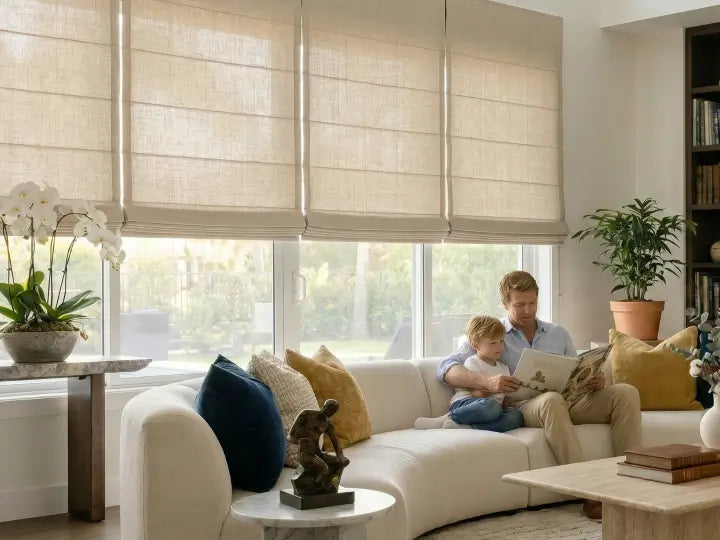
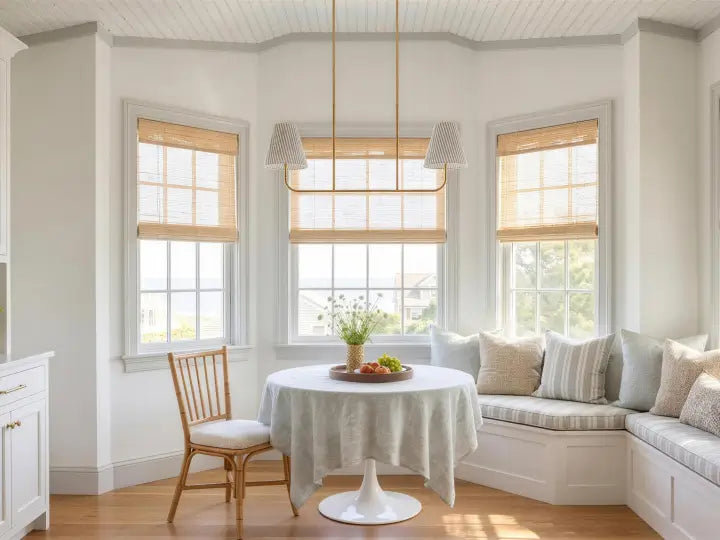
The most-searched valance of the moment is not a gathered one. It is the faux Roman shade: a stationary valance sewn and mounted to look like a real Roman shade sitting at half-raise — flat panel, two or three soft horizontal folds, mounted on a board — with no cords, no lift mechanism, and no function beyond the look. The DIY appeal is obvious: it takes a fraction of the fabric of a working shade and none of the mechanism.

And for the right window, it is genuinely smart. The right window is one you will never operate: the high window over a kitchen sink, a transom, a dormer up out of reach, a breakfast-nook window that faces nothing but your own yard. There, a working mechanism is money spent on movement that will never happen, and a fixed fabric top is the rational buy.
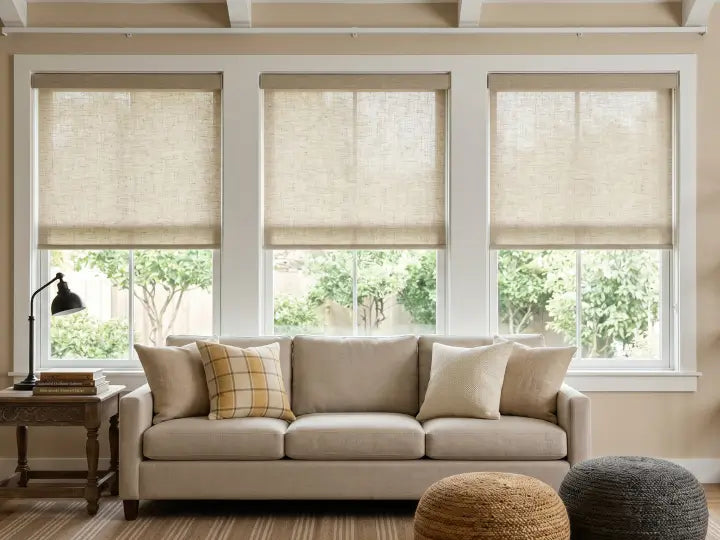
The honest caveat is the flip of the same logic. If the window will ever need to darken or go private — any bedroom, any street-facing glass — a real Roman shade typically costs only modestly more than a well-made faux one, and it actually functions: it raises, it lowers, it covers the glass on demand. Real Romans are also squarely on the 2026 "in" list — the case is laid out in our Roman shade verdict — so you give up nothing stylistically by choosing the working version from our Roman shade collection. Buy the fake for windows you will never touch; buy the real one everywhere else.
What size should a valance be?
The convention — and it is a convention, not a law — is that a valance covers roughly the top fifth of the window. The common workroom rule puts the depth at 1/5 to 1/6 of the window height, which on the taller 84-to-96-inch openings of newer builds lands somewhere around 15 to 18 inches deep.
For the question people actually type — what size valance for a 48-inch window — the direct answer: if 48 inches is the height, the rule gives you a valance roughly 8 to 10 inches deep. If 48 inches is the width, the valance or cornice should run a couple of inches past the frame on each side — call it 52 inches or a touch more — and a gathered style wants 1.5 to 2 times the width in fabric so it does not hang flat. Mounting the board a few inches above the frame makes the window read taller and lets the valance cover the frame rather than the glass. Then trust your eye over the arithmetic: a valance that looks right at eleven inches is right.
The honest downsides
Three of them, none fatal, all worth knowing before you commit.
It is a dust shelf. A cornice has a horizontal top edge, and that ledge collects dust — and, in a kitchen, airborne grease — that a bare window never asks you to clean.
It has visual weight. In a room with 8-foot ceilings, a deep box above the window lowers the whole wall. Low rooms want a shallow treatment mounted high — or none at all. The look depends on having some height to spend.
A bad one dates a room faster than none. This is the real risk. The swag dated its decade so hard that the entire category spent twenty years in exile. The safest 2026 versions are the plainest ones: straight lines, box pleats, quiet fabric that matches the drapery below. If you are hesitating between a fussy valance and no valance, no valance wins.
The bottom line
The 1990s swag stays dead. The tailored top treatment — upholstered cornice, box-pleat valance, faux-Roman valance — is back for 2026, and the cornice in particular has a functional case the trend cycle cannot touch: it is the piece that closes the light gap above a track that no curtain can close by itself.
Worth saying plainly: we do not sell valances or cornices — an upholstered cornice comes from a workroom or a carpenter. What we make is the thing underneath. And if what you actually want is a tailored, finished window top and working light control in a single object, that object already exists: it is a Roman shade, which delivers the flat, structured face of a cornice and then actually operates. That, honestly, is the better first buy for most windows — add the cornice when there is a track worth hiding.
FAQ
Are valances out of style?
The ruffled 1990s version — swags, balloons, scalloped florals — is out and staying out. The tailored version is not: 2026 trend coverage names clean upholstered cornices and box-pleat valances among the classic details returning in modern-classic and farmhouse-modern rooms. Judge by shape and fabric, not by the word.
What is the difference between a valance and a cornice?
A valance is soft — fabric only, gathered, pleated or flat, hung from a rod or board. A cornice is rigid — a wood box, usually padded and upholstered, fixed to the wall above the window. "Pelmet" is the British word for a cornice, and a swag is loosely draped fabric with tails, which is the dated version.
Do valances help with light control?
Yes, in one specific place: the gap above the curtain, where light spills over the top of track-mounted hardware. A deep valance or cornice blocks that stripe, which is why hotel blackout rooms almost always have one over the drapery. They do nothing for light through the glass itself — that part is the curtain's or shade's job.
What size valance for a 48 inch window?
If 48 inches is the window height, the common 1/5-to-1/6 rule gives a valance about 8 to 10 inches deep. If 48 inches is the width, size the valance to extend roughly 2 inches past the frame on each side — about 52 inches — with 1.5 to 2 times that width in fabric for gathered styles. Treat both as conventions and check by eye.
What is a faux Roman shade valance?
A stationary valance sewn to look like a Roman shade at half-raise: a flat panel with a few soft folds, board-mounted, with no cords or lift. It suits windows you never cover — over a kitchen sink, transoms, high dormers. For any window that needs real darkening or privacy, a working Roman shade costs only modestly more and actually operates.
Do modern rooms use valances?
Yes — the current use is tailored and architectural rather than decorative. Modern-classic and farmhouse-modern rooms use straight-lined cornices and box-pleat valances to conceal track hardware and finish the top of the window, most often in plain linen tones that match the drapery rather than contrast with it.