





















Ripple Fold Curtains: What They Are, What They Cost, and Who Should Skip Them
Ripple fold is the heading you have been looking at in every modern interior photograph for the last five years — the one where the curtain reads as a continuous wave with no visible hardware. It is also the heading most likely to go wrong on order, because it is not a way of sewing a curtain at all.
The short answer
Ripple fold is a hardware system, not a pleat. Carriers are corded together inside a track at fixed spacing, and the fabric snaps onto them. The wave lives in the hardware — which is why the panel cannot go on a rod with rings, cannot be adjusted a half-inch on site, and always leaves a small light gap at the top.
Choose it for wide runs, sliders and wall-to-wall glass where you want one uninterrupted rhythm. Skip it if you need true blackout, if your window is small, if the rod is meant to be seen — or if you were hoping to reuse the hardware you already own.
In this guide
- Why it's a system, not a stitch
- Why it has to be a track — and what that rules out
- 60, 80, 100, 120: what those numbers mean
- Stack-back: how much glass you actually lose
- The light gap nobody mentions
- What fabric holds a wave
- What it costs in the US in 2026
- Cords, kids, and the rule that changed in 2024
- Who should buy it — and who should skip it
- Glossary
- FAQ
Why it's a system, not a stitch
Every other heading is defined by sewing. A pinch pleat is fabric folded and stitched into groups. A rod pocket is a channel. Ripple fold is defined by hardware: a strip of snap tape is sewn flat across the top of the panel, and that tape snaps onto carriers that ride inside a track. Those carriers are corded together at fixed spacing, and one of them — the master carrier — acts as the engine that pulls the whole coupled set along.
The cord is the whole trick. It holds the carriers a set distance apart so the fabric between them has nowhere to go but forward and back, in a continuous S. Nothing is pressed, folded or stitched into shape. Take the panel off the track and it is a flat rectangle of cloth.
That also explains the most common complaint. Because the carriers are coupled, one carrier that binds in the channel drags its neighbours, and the wave goes uneven across a whole section rather than in one spot. And if the snap spacing on the tape does not match the carrier spacing on the track, the documented result is uneven waves, a twisted heading, poor movement and a bad centre closure — all at once.
Kirsch's own fabrication guide puts the defining constraint in three words: the treatment "ALWAYS hangs below rod." Remember that line — it comes back in the light-control section, because it is the reason ripple fold behaves the way it does.
You will see three names for the same look. Ripplefold is the original — Kirsch registered it in 1969, and although the trademark lapsed in 2010, it is still what the US trade says. Wave is the British term (Silent Gliss), and S-fold is the Australian and New Zealand one. They describe the same continuous curve, but they are not interchangeable as products: Kirsch uses snap tape, Silent Gliss uses a pocketed tape with hooks, and the carrier spacings differ. Never mix components across brands.
Why it has to be a track — and what that rules out
This is the single most useful thing to know before you fall in love with the look, and almost nobody says it plainly:
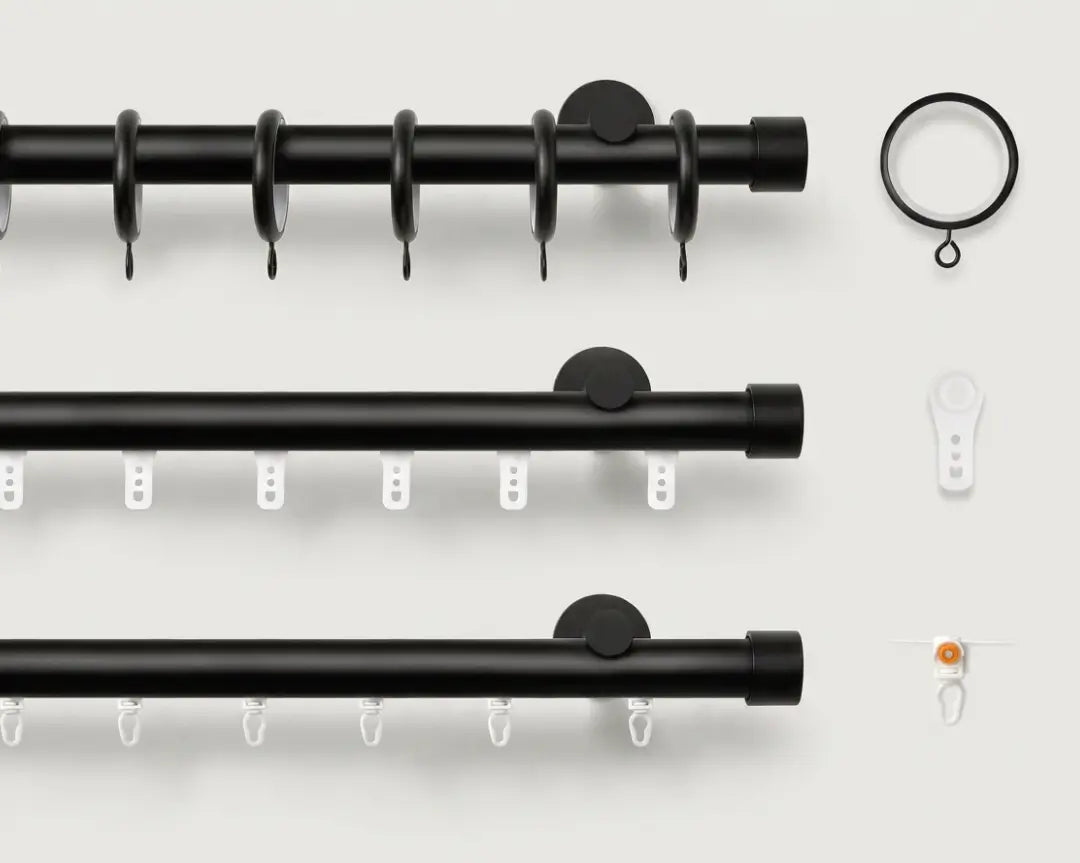
You cannot hang ripple fold on a decorative rod with rings. Rings have nothing to space them and nothing to cord them together, so there is no mechanism to create the wave. It needs a carrier track, or a traverse system built to accept ripple fold carriers.
Three consequences follow, and each one catches people out.
You cannot convert your existing pinch pleat panels cheaply. It means unpicking the pleat stitching, removing the buckram, pressing out creases that are often permanent in linen, velvet or sun-faded cloth, and sewing on snap tape. Worse, the flat width you end up with then dictates how wide a track you can cover — the fabric decides the window, instead of the other way round.
You should not reuse an old ripple fold track for new panels either. The carrier count has to match the snap count. Hardware built for 80% fullness will not line up with a panel made at 100%, and carriers and snaps from different manufacturers frequently will not snap together at all. This is a documented source of drapes falling off the track, not a theoretical risk.
Curves and corners depend on the specific system. Some ripple fold tracks state flatly that their carriers cannot go round a bend; others are made to be curved — Kirsch Architrac can be bent, and Lutron's system curves to a 20-inch minimum radius. Never assume a bay window is possible until the manufacturer says so.
There is one genuine exception worth knowing about, because it rescues the look for anyone who wants visible hardware. A traverse rod — a rod that carries its own internal carriers, rather than a static pole with rings hung on it — can run ripple fold, and several manufacturers build decorative versions specifically so the wave appears to hang from a handsome pole. The catch is consistent across brands: those rod-fronted systems cannot be bent, so they are straight runs only. Our Darian Custom Traverse Rod lists ripple fold among its compatible headings for exactly this reason.
In our own range, the Arden Adjustable Ripple Fold Curtain Track is the one built for this heading and nothing else — its compatible-header list has exactly one entry. The Lior Ceiling-Mount Ultra-Slim Track takes ripple fold as well as pleated headings, on a quarter-inch profile that all but disappears into a ceiling. If you are still deciding between a track and a rod as a general matter — a different question from this one — our guide to curtain rods versus tracks works through it properly, and the full hardware range lives in Rods and Tracks.
60, 80, 100, 120: what those numbers mean
Order ripple fold anywhere and you will be asked to pick a percentage. It is not a fabric quantity in the usual sense — it is which carrier spacing you want, and the fabric follows from that. On the Kirsch system the snap tape spacing is fixed at 4¼ inches, and the carrier spacing changes:
| Nominal fullness | Carrier spacing | Fabric multiplier | Wave character |
|---|---|---|---|
| 60% | 2⅝" | 1.62× | Deepest individual wave — least fabric, tightest stack |
| 80% | 2⅜" | 1.79× | The workroom default |
| 100% | 2⅛" | 2.00× | Tighter, denser rhythm; the other common default |
| 120% | 1⅞" | 2.27× | Most fabric, most carriers, biggest stack |
Practitioners land on 80 to 100% almost every time. One retailer selling at scale states its default as approximately 1.8× — which is exactly the 80% setting, and, as the next section shows, the setting where ripple fold's stack advantage is real.
A small caution if you go comparing charts: the multipliers above are arithmetic from the published carrier spacings, and they do not always match the round numbers printed alongside them. Kirsch's own literature advertises "the appearance of 2.5× fullness" at 120%, but 4¼ divided by 1⅞ is 2.27×, and their own fabric tables confirm it. Figures from 1.6× to 2.5× circulate for the same nominal percentages, so take the multiplier from whoever is actually cutting your fabric. If you want to understand curtain fullness as a general principle rather than as a ripple fold order option, that is a separate subject and we cover it in 1.5× versus 2× fullness.
One number worth holding onto, because it is concrete: ripple fold needs a runner roughly every 6 cm (2.36 inches), against about every 10 cm on a standard track. That is why a ripple fold set has so many more carriers in it — and, as you will see below, why the hardware costs what it does. Our Ethan track runners are sold on exactly that spacing rule.
Stack-back: how much glass you actually lose
Here is where most writing on this subject gets vague, so let's use the manufacturer's own numbers. Stack-back is not really set by how full the curtain is — it is set by how many carriers are sitting in the track, because each carrier body takes up roughly half an inch whether the fabric between them is deep or shallow. Higher fullness means tighter carrier spacing, which means more carriers across the same window, which means a bigger stack.
Worked from Kirsch's published stack-back chart, the rate comes out at 3.00 inches of stack per foot of track at 60% fullness, rising to 4.00 inches per foot at 120%. Applied to real openings, for a one-way draw:
| Fullness | Stack per foot | 60" opening | 100" opening | 144" opening |
|---|---|---|---|---|
| 60% | 3.00" | 15" | 25" | 36" |
| 80% | 3.24" | 16" | 27" | 39" |
| 100% | 3.59" | 18" | 30" | 43" |
| 120% | 4.00" | 20" | 33" | 48" |
Two adjustments to that table. Specifying an overlap master so the panels cross at the centre adds roughly 2 inches to the stack over a butt master. And a two-way draw stacks more in total than a one-way on the same track, because each of the two panels carries its own base stack — it simply splits that total between the two ends, which is usually what you want.
Now the honest part, because "ripple fold stacks tighter than pleats" is repeated everywhere and is only partly true. Published pinch pleat charts run about 3.4 to 4.5 inches per foot. So ripple fold clearly wins at 60 and 80% fullness, is roughly a wash at 100%, and at 120% it is no better at all — one workroom argues it is actually slightly worse, precisely because all those carriers accumulate in the track. The stack advantage is real, but it belongs to the lower fullness settings.
The claim that does hold across the range is fabric: Kirsch states ripple fold uses up to 25% less fabric than a pleated heading for the same window. On expensive cloth, that is where the saving lives.
Read all of this against your wall, not your window. If you do not have roughly a quarter to a third of the opening width in clear wall to stack into, you have three honest options: drop to 60% fullness, split the run into two one-way draws stacking to the jambs, or accept that the stack sits over glass. On a slider, stack toward the fixed panel — never over the leaf that moves or the handle you need to reach.
Depth matters too. A single layer of ripple fold projects about 4¼ to 4½ inches from the wall, and a double-track setup with a sheer behind needs roughly 8½ to 9 inches. Returns to the wall are typically 4 inches, or 6 on a double track. Measure your ceiling clearance before you plan a layered install.
Four sizing conventions the trade uses, which are handy to have before you order: the fabric starts about 1¼ inches below the top of the track, because the panel hangs from carriers rather than over the hardware. Plan roughly ½ inch of floor clearance for a curtain you will actually draw every day, or a deliberate 1 to 6 inch break if you want the softer look — which also conveniently disguises an uneven floor. And extend the track 6 to 12 inches past each side of the window or door so the stack clears the glass. If you are working out drops and widths for the first time, how to choose, measure and install custom drapes walks through the measuring itself.
The other thing the snap-on construction takes away is tolerance. Panels that hang from rings can be nudged a half-inch on site by adjusting the pin hooks. Snap tape cannot. One workroom has documented linen panels that measured 100 inches flat on the table and had grown to 101 inches by the time they were hung, forcing an emergency re-hem. If your measurements are not right, ripple fold has no way to forgive them.
The light gap nobody mentions
Here is the trade-off that retailer copy tends to skip, and it is worth being blunt about because you may have read the opposite elsewhere — including in an older guide of ours.
Ripple fold cannot match a pinch pleat for blackout, by design. The panel hangs from carriers that sit below the track, which leaves a gap along the top edge. On a pinch pleat the top of the fabric can be brought up to overlap the hardware; on ripple fold it cannot.
This is not a fringe opinion. Lutron's own hospitality specification recommends pinch pleat where inside-mount light blocking is the priority, and states that closing the indirect light path takes a cornice, valance or ceiling pocket. Consumer-side coverage says the same thing in plainer terms: because of the gap between the wave and the track, it does not control light completely.
If you want ripple fold and a dark room, you have to build for it: specify an overlap master at the centre so the two panels cross (a butt master leaves a visible crack down the middle), hook the returns to the wall to kill side light, add a ceiling pocket or cornice above the track, and accept that you are engineering around the heading rather than relying on it. The simpler answer for a bedroom is often to put a blackout roller with side channels behind the drapery and let the ripple fold be the beautiful layer. Our comparison of blackout versus room-darkening versus sheer sets out what each level of light control actually delivers.
What fabric holds a wave
The failure mode here is not weight, it is stiffness. A fabric that is too boardy billows outward instead of settling into a curve, because nothing is stitched to make it bend — the cloth has to want to. Anything with a crisp hand or a heavy coating fights the fold. What works is fabric with drape.
It is worth knowing that manufacturers do not specify this by fabric weight at all. You will see "250 to 400 GSM" quoted around the web as the optimal range, but it does not come from any manufacturer document we could find. What the makers actually publish is a weight limit per metre of track — and even that is disputed between brands, with one system rating its wave tape at 2.5 kg per metre and another at 10 kg — plus a hand test. Silent Gliss describes the test simply: hold the fabric at the top and see whether it falls into a soft wave without much effort.
Their published lists are more useful than any number. Normally suitable: voiles, lined cotton, interlined silk, blackout lining. What the soft curves of a wave do not lend themselves to: stiff fabrics, heavy embroidery, irregular vertical stripes, metallic threads. Note that sheers are on the recommended list, not the risky one — this heading is unusually kind to a voile.
One cost consequence worth knowing: because there are no pleats to support, lining is optional here in a way it often isn't elsewhere. Kirsch notes that ripple fold needs only straight hemming, so the extra body from crinoline or buckram is unnecessary. An unlined sheer wave is a legitimate finished treatment, not a shortcut.
For what it's worth, here is where our own cloth sits — verifiable numbers rather than adjectives:
| Fabric | Weight | How it reads in a wave |
|---|---|---|
| Liana Sheer | 100 GSM | The strongest pairing there is — weightless cloth in one continuous ripple. Below the usual weight window, so ask for a chain weight in the hem |
| Luna Premium Velvet | 300 GSM | Deep, self-supporting curves and real light absorption; keep the hem floating rather than breaking |
| Delsia Linen Blend | 315 GSM | Slub texture catching light along each curve — the half-linen composition adds fold memory |
| Celina Linen | 350 GSM | Heavy enough to hold its shape across a wide run; the safe default for long floor-length drops |
A note on pure linen: it is the fabric everyone pictures for a wave, and it does look right, but a linen blend usually performs better here. The polyester content gives the fold a memory, so the wave survives being drawn back and forth every day instead of relaxing out of shape. If you want to think in fibres rather than headings, our 2026 curtain fabric guide compares linen, velvet and polyester on performance; the wider ranges are in Linen Curtains and Sheer Curtains.
One aesthetic rule, since the fold rhythm is the ornament: ripple fold and a large busy print work against each other. A big pattern breaks across the curves unless the snaps are spaced to the repeat. Plain, textured, tonal cloth is what this heading flatters — which happens to sit neatly with where 2026 colour is going, toward warm grounded neutrals, mushroom and red-based taupe, and drapery matched to the wall rather than contrasted against it.
What it costs in the US in 2026
Almost nobody publishes this, so here is the clearest comparison available. The Shade Store lists starting prices for every heading style side by side, which makes it the one genuine apples-to-apples data point:
| Heading | Starting price | Against ripple fold |
|---|---|---|
| Rod pocket | $430 | $115 less |
| Tailored / pinch pleat | $465 | $80 less |
| Ripple fold | $545 | — |
| Grommet | $685 | $140 more |
So ripple fold runs roughly 17% above a pinch pleat and 27% above a rod pocket at the same retailer — but it is meaningfully cheaper than grommet. The common claim that ripple fold is the most expensive heading available does not survive contact with a real price list.
And the premium is not sewing. Snapping flat tape to a panel is less labour than building pleats. The money is in hardware: ripple fold needs a dedicated carrier track, while a pinch pleat will hang from pins on almost any traverse or decorative rod you already like.
Across the wider US market, custom ripple fold with hardware included starts around $357 at the value end and $545 at The Shade Store, while drapery-only suppliers who explicitly do not sell hardware start near $302 — a figure to read carefully, because the track is still to come. Complete manual track sets, including carriers, brackets and a baton, work out at roughly $18 to $23 per foot, falling as the run gets longer.
That per-foot number is worth one more sentence, because it tells you where your money goes. Bare track extrusion sells for about $4 to $4.50 per foot. Everything above that — carriers, brackets, assembly — is 75 to 80% of the cost of a manual set. You are not paying for aluminium; you are paying for the several dozen corded carriers that make the wave.
Two more line items people forget. Installation runs about $50 to $250 per window at general rates; The Shade Store charges 15% of the product price with a $250 minimum trip fee, which is a useful benchmark for what professional fitting is worth on a system with no measurement tolerance. And motorization is expensive here: a transparent US dealer price for a Somfy Glydea-class drapery motor is around $546 for the motor alone, plus the track by length, which computes to roughly $154 per foot on a short 6-foot run and around $55 per foot at 30 feet — five to eight times a manual set, converging as runs lengthen. Independent cost guides put motorized tracks at $300 to $1,000 per opening.
If you are handy, the DIY route is genuinely open: snap tape sells by the yard from around $1.65 to $10, carriers run about 55 to 60 cents each, and hardware for a single 120-inch opening at 100% fullness comes to roughly $110 to $185 excluding fabric and sewing. That is real money saved — against the risk that, as above, ripple fold gives you nothing to adjust if the measurement is off.
Cords, kids, and the rule that changed in 2024
This part is often treated as fine print, and it should not be. A corded-draw ripple fold is a regulated corded window covering, not an exempt "curtain" — the US standard explicitly covers traverse rods and the curtains used with them.
The regulatory picture, briefly: the Consumer Product Safety Commission determined that accessible operating cords longer than 8 inches on custom window coverings pose an unreasonable strangulation risk to children aged 8 and under. The federal rule, 16 CFR 1260, took effect on 30 May 2023, and the industry standard ANSI/WCMA A100.1-2022, effective 1 June 2024, eliminates free-hanging operating cords on made-to-order custom products. Existing installations in your home are not required to be replaced.
In practice this makes the choice simple: specify a cordless baton or motorization. A baton is the cheaper answer and works beautifully on a ceiling track — our Virelle Drapery Pull Wand is a 41-inch wand for exactly this, and it has a second benefit on pale linen, which is that you stop transferring hand oils to the leading edge every time you draw the curtain. The one thing to check before choosing a wand over a motor is access: if a sofa or a bed sits against the glass, nobody will reach the baton, and that is the honest argument for motorizing.
On that subject, one disclosure. Ripple fold is the most motorization-friendly heading there is — it held close to 48% of the automatic curtain market in 2025, and hardware makers sell ripple-fold-specific carrier configurations as priced options. But our own motorized track is currently built for pleated headings rather than ripple fold, so a motorized ripple fold run means a dedicated drapery motor system rather than something we can supply today. If motorization is the priority, our guide to smart curtains and motorized blinds is the better starting point.
Who should buy it — and who should skip it
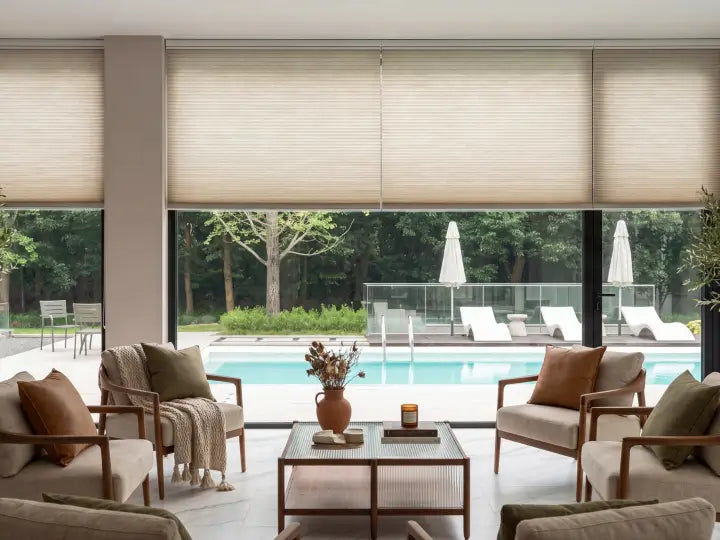
Buy ripple fold if you have a wide run — a slider, a bank of windows, a wall of glass — and you want it read as one continuous surface rather than a decorated window. It is the correct heading for wall-to-wall drapery, which is why designers specifying that look name it explicitly: as Jessica Davis of Nest Studio puts it, a ripple fold "looks much cleaner and works better with this type of application" than a traditional pinch pleat. It suits plain, textured, tonal fabric, it glides with very little effort, and because you handle the cloth less it holds its shape over years. Track painted to match the ceiling, and the hardware effectively vanishes.
Skip it if any of these apply. You need genuine blackout and do not want to build a pocket or cornice to get it. Your window is small, where the wave overpowers the proportion. The rod is meant to be seen — a beautiful finial is a design decision that ripple fold cancels entirely. You have less than a quarter of the opening width in adjacent wall to stack into. You were hoping to reuse hardware or convert existing panels. Or you are renting and may take the curtains with you: these panels are cut to one track, in one system, and they do not travel.
Worth saying plainly, since a lot of writing on this subject implies otherwise: ripple fold is not "better" than a pinch pleat. It is a different trade — hardware precision and a clean line, in exchange for flexibility, light control and the option of a decorative rod. If those are the wrong trades for your room, the pinch pleat guide covers the alternative in the same detail. And if your run happens to be full-height as well as wide, the complete guide to floor-to-ceiling curtains handles the proportion questions that come with height.
Glossary
- Snap tape — flat tape sewn across the top of the panel, with snaps at fixed intervals that clip onto carriers.
- Carrier — the wheeled or gliding part that rides in the track and holds one snap. Carriers are corded together at set spacing.
- Master carrier — the leading carrier you pull, which drags the coupled set. A butt master closes edge to edge; an overlap master makes the panels cross, closing the centre light gap.
- Return — the section of panel that turns back to meet the wall at each end, usually 4 inches, or 6 on a double track.
- Stack-back — the width the gathered panel occupies when fully open.
- Projection — how far the track and drapery sit out from the wall; roughly 4¼–4½ inches single, 8½–9 inches doubled.
- Fold training — setting the S-curve by hand after installation, pushing alternate carriers back and forward. A required install step, not an optional flourish.
FAQ
Do ripple fold curtains need a special track?
Yes, and this is not negotiable. The wave is created by carriers corded together at fixed spacing inside a track, so it needs either a purpose-made ripple fold track or a traverse system that accepts ripple fold carriers. A decorative rod with rings cannot produce the effect.
Can I hang ripple fold on my existing curtain rod?
Almost certainly not. Rings have no way to hold spacing or to couple together, which is what creates the S-curve. The one exception is a traverse rod that carries its own internal carriers — some decorative versions are built to run ripple fold, though they cannot be curved. If what you own is a standard pole with rings, a pinch pleat or a tailored pleat is the heading that will use it.
Are ripple fold curtains more expensive?
Moderately, and less than people assume. At a retailer publishing prices for every heading, ripple fold starts about 17% above a pinch pleat and 27% above a rod pocket — but $140 below grommet. The premium is the carrier track, not the sewing.
Can ripple fold curtains be blackout?
Not on their own. The panel hangs from carriers below the track, so light passes over the top edge. To get a genuinely dark room you need an overlap master at the centre, returns hooked to the wall, and a ceiling pocket or cornice above the track — or a blackout roller with side channels behind the drapery.
What is the difference between ripple fold, wave and S-fold?
They describe the same continuous curve under different regional names: Ripplefold is Kirsch's US trademark, wave is the British term, S-fold the Australian and New Zealand one. As products they are not interchangeable, because tapes and carriers differ between systems — never mix components across manufacturers.
How much fabric does ripple fold use?
It depends on which carrier spacing you order. As a worked example, a 120-inch track at roughly 2.2× on 54-inch goods needs five widths, about 18 yards once hem, header and insurance allowances are added. Published multipliers for the same nominal percentage vary widely between suppliers, so use your maker's figure.
Which fullness should I choose?
80 or 100% for most rooms. Choose 60% when stack space is tight and you can accept a flatter look; 120% only when you have the wall to stack into and want dense waves.
Will the waves stay even over time?
Largely, provided the system is matched and the folds are trained at installation. Uneven waves almost always trace to one of two causes: snap spacing that does not match carrier spacing, or a carrier binding in the track and dragging its coupled neighbours. Fabric that is too stiff to drape is the third cause.
How do you clean ripple fold curtains?
The panel does unsnap carrier by carrier, but on-site care is the recommended default: vacuum on low suction or dust, never immerse in liquid, and test any solution on a hidden area first. Lined custom drapery is usually dry-clean only, because face fabric and lining shrink at different rates. Whatever you do, re-snap in the same order afterwards and re-train the folds — the wave is a property of the system, not something pressed into the cloth.
If you're building one
Start with the hardware, because it decides everything else: the Arden Adjustable Ripple Fold Track for a dedicated system, or the Lior Ultra-Slim Ceiling Track where you want the profile to disappear — both in Rods and Tracks. Then choose cloth with drape rather than stiffness: Celina linen at 350 GSM for long floor-length runs, Liana sheer where you want the light through, or Luna velvet for depth and quiet.