

















Chenille Curtains: What They Are, How They Wear, and Who Should Buy Them

Chenille is the fabric people describe as "the cozy one" without quite knowing what it is. It is worth knowing — because chenille is not a fibre at all, and that single fact explains why these curtains feel the way they do, block the light they block, and fail in the specific ways they fail.
The short answer
Chenille is a yarn, not a fibre. Short lengths of pile are trapped between two tightly twisted core threads so the fuzz stands out all the way around — like a caterpillar, which is exactly what chenille means in French. That pile is why the fabric is heavy, naturally opaque, warm to stand beside, and soft in a way flat weaves never manage.
It is also why it can crush, snag and shed. Buy chenille if you want warmth, weight and quiet texture — especially in bedrooms and living rooms. Skip it if you have a determined scratcher or want a fabric you never have to think about.
In this guide
- What chenille actually is
- Chenille or velvet? The 5-second test
- Why it works so well on windows
- How it wears — the honest part
- Fading in sunny windows
- Chenille with pets and kids
- Cleaning and care
- Where chenille sits in 2026
- What it costs
- Who should buy it — and who shouldn't
- Glossary
- FAQ
What chenille actually is
The name comes from the French word for caterpillar, and it describes the yarn rather than the cloth. To make chenille yarn, short cut fibres — typically 3 to 10 mm long — are laid between two strong, tightly twisted carrier threads. As those cores twist together they lock the short fibres in place, standing them out at right angles all the way around. The result is a fuzzy, corded yarn with a three-dimensional halo of pile.
That radial pile is the whole story. Because the fibre ends point in every direction, light strikes them at slightly different angles — some catch a highlight, some fall into shadow. You get a soft, shifting depth instead of a flat sheen. Heat-setting the yarn afterwards stabilises the geometry and limits how much it sheds.
The part most shoppers miss: chenille says nothing about what the fabric is made of. The same construction is spun in cotton, viscose, polyester, acrylic, nylon and blends. Two curtains both labelled "chenille" can feel nearly identical in the shop and age completely differently at the window. Read the label as "chenille construction, in X fibre".
| Base fibre | How it behaves |
|---|---|
| Polyester | The workhorse. Best abrasion resistance (often 35,000–50,000+ double rubs), dimensionally stable, low shrink risk |
| Cotton | Matte and very soft, but absorbs moisture, shows water marks, and shrinks if washed hot |
| Viscose / rayon | The silkiest hand and most sheen — and the most prone to crushing, water spotting and dimensional change. Usually wants lining and dry cleaning |
| Blends | Cotton-poly aims to keep the hand while adding resilience. Usually the sensible middle |
If you are choosing between fibres more broadly rather than constructions, that is a different question — our 2026 curtain fabric guide compares linen, velvet and polyester head to head.
Chenille or velvet? The 5-second test
They are both pile fabrics and both feel plush, but they are built differently and read differently in a room.
- Look at it under side light. Velvet has a dense, continuous, almost mirror-like surface with a clear nap direction and dramatic highlights. Chenille looks more textured and slightly ropey, with a softer, more even glow.
- Sweep a hand across it. Velvet feels smooth and cool, and the colour visibly shifts where you brushed it. Chenille feels faintly bumpy or ribbed — you can feel the pile wrapping around the underlying yarns — and the colour barely changes.
- Watch the light. Velvet reflects it. Chenille absorbs it, which is why chenille reads warm and inviting where velvet reads formal and dramatic.
Neither is better; they are different moods. If it is the reflective, high-drama end you actually want, we make the case for it in the old-money velvet aesthetic, and the velvet collection is where to look.
Why it works so well on windows
It is opaque before you even add a lining
Chenille yarn carries a dense halo of pile, so a chenille weave covers far more area than a flat yarn of the same count. There are simply fewer open pores for light to get through — which is why so many room-darkening and blackout drapes are chenille-faced. Add a blackout lining on top of that and you reach the kind of darkness bedrooms and media rooms actually need.
It makes the window feel warmer
The same mass and pile that block light also trap pockets of still air, slowing heat transfer at the glass. Untreated windows can account for roughly 30% of a home's heating energy loss, and heavy, high-GSM fabrics are one of the simplest ways to cut that. Expect noticeably fewer drafts near the window — not a replacement for glazing. If insulation is the actual goal, compare your options in thermal vs blackout curtains.
It softens sound — within limits
Here is the honest version. Heavy pile fabrics are genuinely good at absorbing mid- and high-frequency sound inside a room: less echo, softer acoustics. Acoustic velour testing puts heavy pile curtains at NRC values of roughly 0.62–1.09 depending on frequency. What they do not do is block noise coming through the wall or glass — meaningful transmission loss needs multi-layer systems with mass-loaded liners, and even purpose-built acoustic curtains only reach STC ratings around 13–17. So: your room will sound calmer. The street will not disappear. More on that in our home acoustics guide.
It hangs beautifully on tall windows
Weight makes gravity do the work: chenille falls into deep, rounded folds that read substantial rather than flimsy, and the soft pile rounds the folds off instead of creasing them sharply. On tall windows that is exactly the effect you are paying for. The caveat is on the other side of the same coin — see stretching below.
Shop the look: Arlise 100% blackout chenille drapes for the plain, weighty version, or browse the whole chenille collection.
How it wears — the honest part
Chenille tests well and then fails in ways the test does not measure. Both halves matter.
On paper it is tough. Abrasion is measured in double rubs; about 15,000 is the floor for light residential use and 30,000+ is what you want for hard-working seating. Most modern polyester chenille clears 35,000, with premium lines past 50,000. Drapery-weight chenille sits at or slightly below upholstery specs, which is comfortably beyond what a curtain endures.
In practice it fails four specific ways — all of them consequences of having exposed fibre ends:
- Pile crushing. Sustained pressure — an aggressive tieback, furniture pressed against the panel — mats the pile flat and leaves shiny or dull patches. Rotate tieback positions occasionally and this mostly goes away as a problem.
- Snagging and pulls. Protruding pile catches on jewellery, zips, rough hardware and claws. A pull can run as a visible vertical line.
- Shedding when new. Loose fibre ends work free until the yarn settles. Normal at first; persistent shedding means the yarn was poorly heat-set.
- Stretching on long drops. Under its own weight, chenille — especially with viscose or loose cotton content — can lengthen slightly over time and start puddling at the floor. This is why good makers specify proper linings, headers and interlinings for tall installations.
Backing and lining fix more than people expect: a woven or knit backing stabilises the pile and limits stretch, a blackout or thermal lining adds structure and shields the face from UV, and interlining on Roman shades smooths operation and prevents cord print-through. On a chenille curtain, a multi-layer build is a good sign, not overengineering.
When you compare products, published double rubs, a stated fibre breakdown and a weight in GSM tell you more about how it will age than any adjective in the description.
Fading in sunny windows
Every dyed pile fabric fades in strong sun, chenille included. Two things soften the blow:
- Fibre choice — fade-resistant synthetic chenille holds colour better than cotton or viscose.
- Colour choice — warm neutrals fade gracefully and evenly. Saturated darks show dramatic lightening along the leading edge, where the eye goes first.
On south- or west-facing glass, line the panels. If sun damage is the real worry — for the curtains and the furniture behind them — our UV protection guide covers what actually works.
Chenille with pets and kids
The straight verdict: chenille is fine with well-behaved pets and wrong for determined scratchers.
Owners report chenille holding up reasonably to cats when claws are kept trimmed — but the exposed pile gives claws more to catch than a flat, tight weave does, and once a long pull develops it can be trimmed and disguised, never fully restored. The brushed surface also collects pet hair and lint more readily than smooth fabric, and synthetic chenille can pick up a little static in dry air, which makes that worse.
For kids it is a genuinely nice fabric — soft to lean on, forgiving of small marks. Just keep it away from the scratching-post scenario.
If claws are the deciding factor in your house, we ran that question properly on the closest comparable fabric: are velvet curtains really cat-proof?
Cleaning and care
- Washing vs dry cleaning. Long, lined, pleated panels are usually best dry-cleaned regardless of fibre. Unlined cotton or synthetic chenille labelled washable can take a gentle cold cycle — at the risk of shrinkage, distortion and crushed pile. Viscose chenille should be dry-cleaned; water spots it.
- Spot cleaning. Minimal moisture, blot rather than rub, and test somewhere hidden first. The pile takes water unevenly and leaves rings easily.
- Reviving crushed pile. Vacuum gently with a soft brush head, then steam lightly from a distance while brushing the pile in one direction with a clean cloth. Never press hard — pressure is what caused the problem.
- Routine. Low-suction vacuuming keeps dust and hair out of the pile; a lint roller handles the spots pets lean on.
- Shrinkage. Cotton and viscose can shrink visibly with heat or long soaking. Polyester is far more stable — though linings and threads can still move slightly, which is the real argument for professional cleaning.
Our full method, fabric by fabric, is in how to wash curtains without shrinking or fading.
Where chenille sits in 2026
The prevailing direction is quiet luxury: rooms built on natural texture, warm neutral palettes and craftsmanship rather than loud pattern or high gloss. Texture is doing the visual work that colour used to do — which puts chenille in an unusually good position. It delivers obvious tactility and depth without the theatrical sheen of velvet, and it sits naturally with linen upholstery, oak floors and stone.
In practice that means oatmeal, taupe, mushroom, sand and greige, where the fuzzy pile softens hard window lines and makes a tall opening feel enveloping rather than stark. If that is the register you are after, the Japandi warm-minimalist lookbook is built entirely around it.
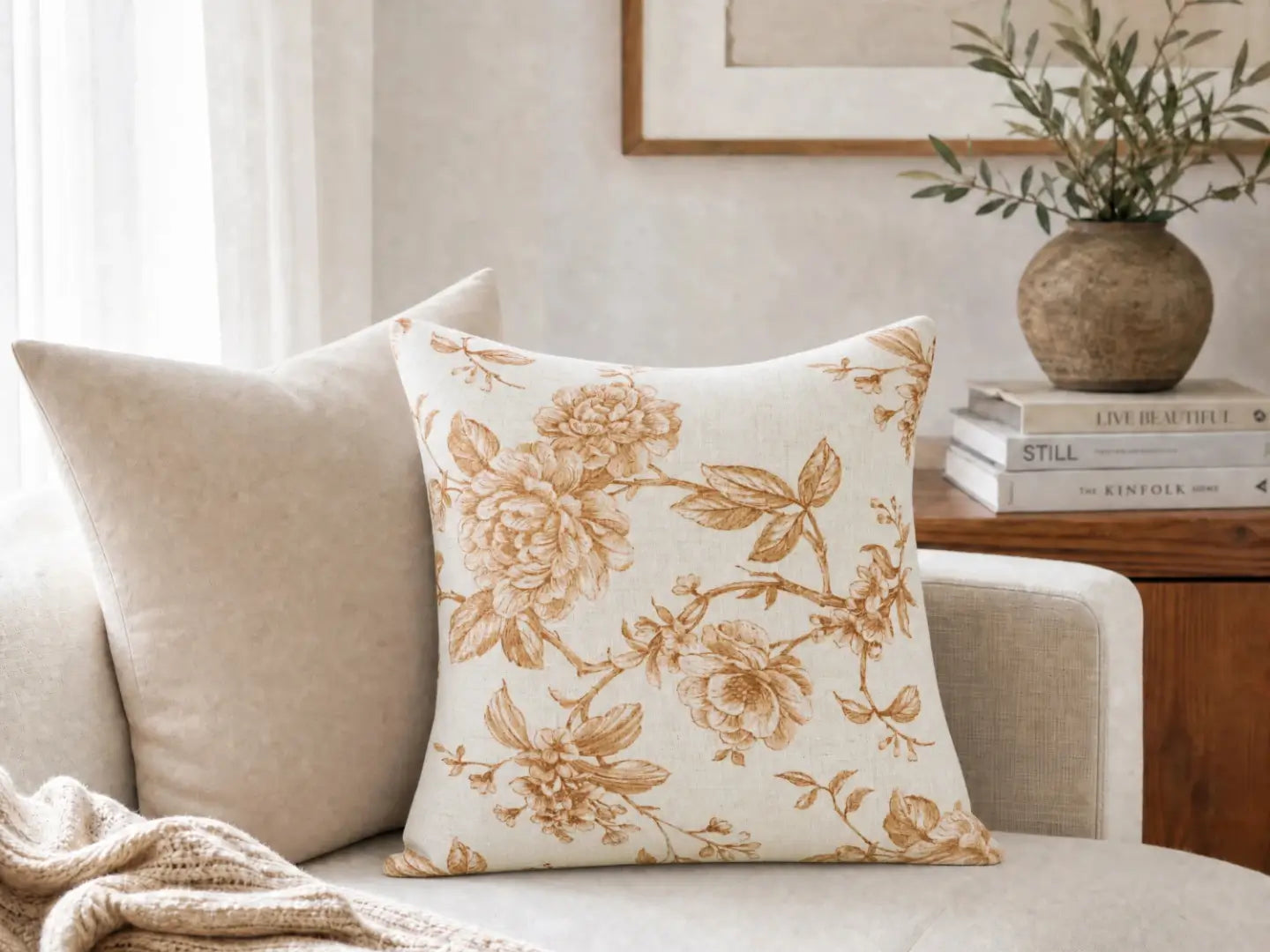
The premium version is jacquard-chenille — pattern woven into the structure using chenille yarn, so the motif is raised, multi-tonal and almost sculptural. It reads more tailored than a plain panel while staying inside the quiet, texture-led aesthetic: pattern you feel as much as see. Worth knowing how that construction differs from embroidery and printing before you spend — that is jacquard vs embroidered vs printed.
Shop the look: Talise damask jacquard chenille drapes for tone-on-tone, Cymbel vintage floral jacquard chenille blackout drapes for something richer, or on shades, Faelyn botanical bloom and Sariel botanical stripe.
What it costs
Chenille lands in the middle of the market, which is most of its appeal.
- Fabric by the yard: US retailers commonly list chenille drapery and upholstery fabric around $16–$50 per yard, depending on brand, fibre and pattern complexity.
- Ready-made panels: from low double digits for simple unlined pieces up to $200+ for tall, lined, custom-sized panels. Made-to-measure typically starts around $50–$60 per panel and climbs with height and width.
Positioned against its neighbours: more elevated than entry-level flat polyester, generally more accessible than high-end natural velvet or engineered performance velvet. You are paying for weight and hand, not for a brand story.
Who should buy it — and who shouldn't
| Buy chenille if you… | Choose something else if you… |
|---|---|
| Want warmth, weight and quiet texture over gloss | Have a cat that treats curtains as a climbing frame |
| Need real opacity for a bedroom or media room | Want a fabric you can throw in a hot wash and forget |
| Have drafty windows and want them to feel warmer | Need genuine soundproofing rather than softer acoustics |
| Are building a warm-neutral, quiet-luxury room | Want crisp, tailored, flat-fronted panels |
| Want pattern with dimension — jacquard-chenille | Are furnishing a very high-traffic, high-abuse space |
Glossary
- Chenille yarn — short pile fibres trapped between two twisted core yarns so the pile stands out at right angles, giving a soft fuzzy surface.
- Pile — the raised fibres on a fabric surface, responsible for softness and depth.
- Core yarn — the strong twisted carrier threads that hold chenille's pile in place.
- Crushing — flattening of the pile under pressure, leaving shiny or dull patches.
- Shedding — loose pile fibres working free from the yarn, mostly when new.
- Double rub — one back-and-forth cycle in an abrasion test; higher counts mean tougher cloth.
- GSM — grams per square metre; higher generally means thicker, more insulating and more opaque.
- Backing — an added layer supporting the face fabric, improving stability and limiting stretch.
- Viscose vs polyester chenille — viscose feels silkier with more sheen but crushes and spots easily; polyester is more durable and dimensionally stable.
FAQ
What is chenille fabric?
Chenille fabric is any textile made using chenille yarns — yarns built by trapping short pile fibres between two strong twisted core threads so the pile stands out and creates a soft, fuzzy surface. The fabric itself can be cotton, polyester, viscose or a blend; the defining feature is the yarn construction, not the fibre.
Are chenille curtains good?
They are, for the right buyer. Chenille gives a cozy, tactile look with genuinely good opacity and better thermal comfort at the window than a flat lightweight panel. Well-made, properly lined chenille performs well in bedrooms and living rooms. It asks more care than basic polyester and is not the right pick for a high-abuse household.
Do chenille curtains fade?
Yes, like all dyed pile fabrics in strong sunlight — fastest in dark, saturated colours. Lining the panels, choosing fade-resistant synthetic chenille, and favouring warm neutrals on south-facing windows keeps the fading gradual and much less noticeable.
Is chenille good for homes with pets?
It works if claws are trimmed and the curtains are not treated as a scratching post. The fuzzy surface snags more easily than a smooth tight weave and collects more hair. For a household with a committed scratcher, a tightly woven performance fabric is the safer choice.
Can you wash chenille curtains?
It depends on fibre, lining and construction. Long lined curtains are usually best dry-cleaned to avoid shrinkage, distortion and pile damage. Unlined cotton or synthetic chenille labelled machine-washable can take a gentle cold cycle — always follow the care label.
Ready to feel the difference? Start with the chenille collection, or go straight to Arlise 100% blackout chenille drapes if darkness is the priority. Prefer pattern woven in rather than a plain panel? Compare constructions in jacquard vs embroidered vs printed curtains.