
















Jacquard vs Embroidered vs Printed Curtains: Which Pattern Actually Lasts?
There are only three ways to get a pattern onto a curtain: weave it in, stitch it on, or print it on top. That single choice decides how the curtain ages, how it reads when the sun is behind it, and whether it looks expensive — far more than the colour or the motif does.
The 30-second answer
Jacquard (woven in) lasts the longest and reads the most expensive — the pattern is built from yarn, so there is no surface layer to fade or wear off. Embroidery (stitched on) gives the most tactile, couture-looking texture, but raised stitches are the easiest thing in the room for a cat to find. Printing (applied on top) is the most affordable and the most design-flexible, and it is the one that fades first in a sunny window.
Buying for a bright south-facing room or planning to keep the curtains a decade? Start with jacquard. Want a statement texture in a formal room? Embroidery. Want a specific motif on a budget? A good printed panel — lined.
In this guide
- The comparison at a glance
- How each pattern is actually made
- Which one lasts longest?
- Fading: the real dividing line
- Pets, kids and snags
- How each reads in daylight
- Which one looks expensive?
- What each actually costs
- Which should you choose?
- Washing and care
- Glossary
- FAQ
The comparison at a glance
| Jacquard | Embroidered | Printed | |
|---|---|---|---|
| How the pattern gets there | Woven into the cloth on a jacquard loom | Stitched onto finished cloth | Ink applied to the surface |
| The back side | Inverse or mirrored motif; damasks are often reversible | Motif visible, plus stitch backings | Near-solid or pale — pattern is one-sided |
| Abrasion resistance | Typically 30,000–50,000 double rubs (contract grades reach 100,000) | Depends on thread, not rub count; thread-based so it will not crack or peel | Printed cotton can show wear from ~5,000–7,000 double rubs |
| Fade risk | Lowest when yarn-dyed — colour lives in the fibre | Two variables: base cloth + thread | Highest — the motif is a surface layer |
| Body & drape | Denser, heavier, architectural folds | Local stiffness where stitching is dense | Follows the base cloth; heavy ink areas stiffen |
| Reads expensive? | Yes — texture and depth | Yes — handcraft and dimension | Only if the base cloth has weight |
How each pattern is actually made
Jacquard — the pattern is woven in
Jacquard is not a fibre; it is a weaving method. On a jacquard loom — the mechanism Joseph Marie Jacquard introduced in the early 1800s — every warp thread can be lifted or lowered individually, so the motif is built from the interlacing of yarns themselves. That is why a jacquard can be linen, cotton, polyester or a blend: what makes it jacquard is that the pattern is structural.
One distinction matters more than any other for longevity. In yarn-dyed jacquard, yarns are dyed before weaving, so the motif is made of coloured fibre. In piece-dyed jacquard, undyed cloth is woven first and dyed afterwards — cheaper, but motifs read more muted and lightfastness often tops out around grade 3.
The family you will actually shop:
- Damask — tone-on-tone, contrast coming from matte-versus-sheen rather than colour; frequently reversible.
- Brocade — heavier, raised, often multi-coloured motifs from supplementary weft yarns; usually not reversible, and the back shows floats.
- Matelassé — double-cloth with a puffed, quilted surface created by tension, no padding involved.
Shop the look: Talise geometric damask jacquard chenille drapes for the tone-on-tone version, Sariel botanical stripe jacquard for something softer, or Orielle dot-and-line jacquard for a graphic read. Full range in the jacquard collection.
Embroidered — the pattern is stitched on
Embroidery starts with finished cloth — plain weave, linen blend, or a sheer voile — and adds decorative thread on top. At production scale this is done on Schiffli machines (a two-thread system with hundreds of needles working at once across the fabric width) or multi-head machines (typically 6–8 heads, each stitching its own repeat).
- Crewel — traditionally wool; in modern drapery, thicker yarn-like stitching that leaves pronounced raised lines.
- Cutwork / eyelet — holes are deliberately cut and stitched around, creating a lace-like perforation. Common on sheers and café panels.
- Appliqué — fabric shapes stitched onto the base, sometimes outlined with further embroidery.
Because thread sits proud of the surface, embroidery adds local thickness and stiffness. On a lightweight base that is often a benefit — it gives a sheer some body — but very dense stitching can pucker if the cloth was not stabilised well.
Shop the look: Valora fern-embroidered leaf linen curtains for a natural, textural read; Phaelyn embroidered-rose sheers or Jessara black rose sheers for the light-and-lace effect. More in the embroidered collection.
Printed — the pattern sits on top
Printing applies pattern to woven cloth afterwards. Rotary screen printing pushes paste through cylindrical mesh screens onto continuous fabric and, for curtains, usually uses pigment inks precisely because they hold up to UV. Digital pigment printing jets ink directly onto the cloth; modern furnishing ink systems now report lightfastness at AATCC grade 6+, which is a genuine step up from older prints.
The trade-off is structural: the motif is a layer, so the reverse of a printed panel is essentially solid, and the design's fate is tied to the ink and its binder rather than to the weave. Printing is also where design freedom lives — engineered panel prints can place a single large motif exactly where you want it on the panel, which no loom will do affordably.
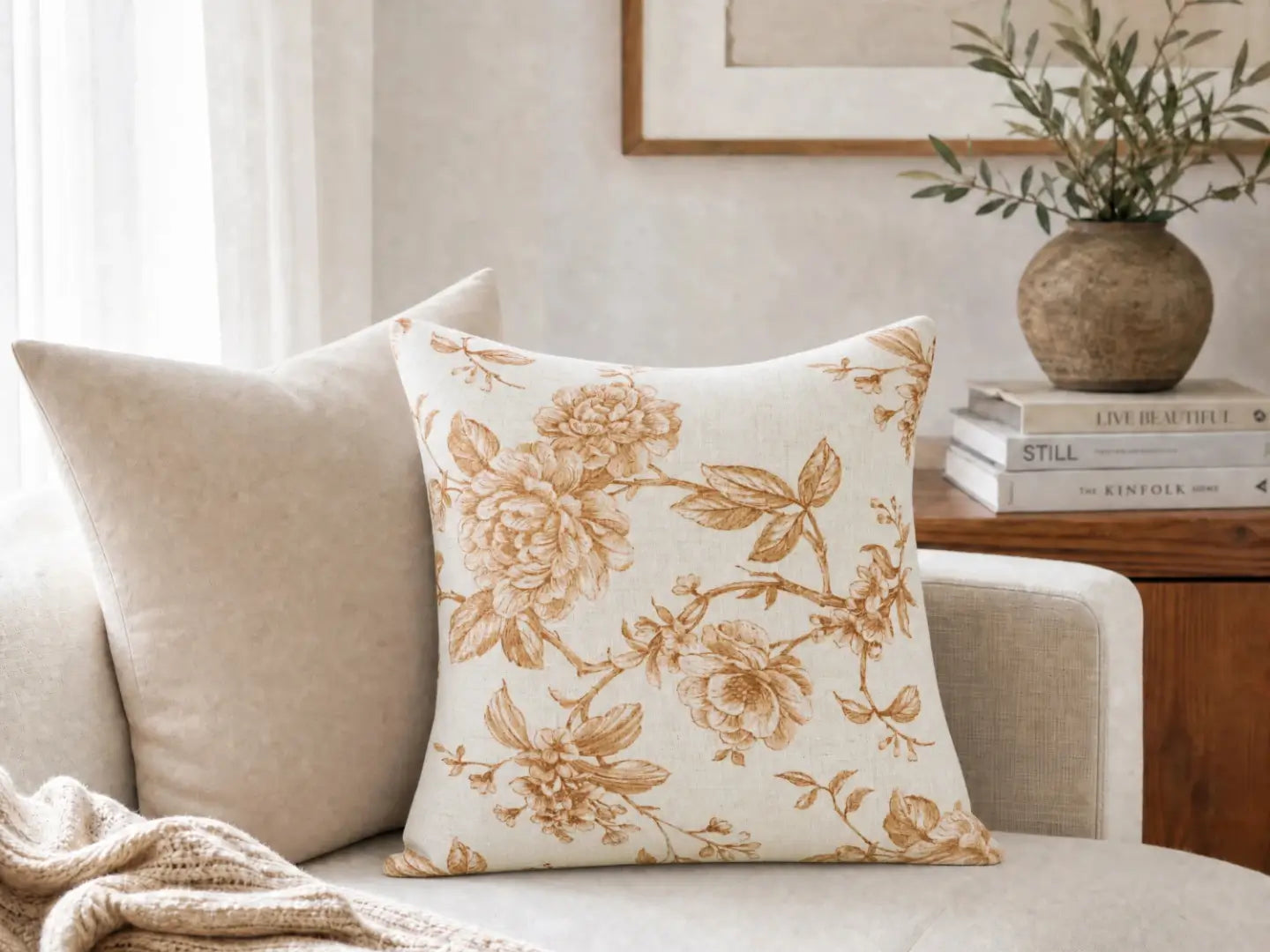
Shop the look: Aveline vintage mocha floral print linen curtains, or on shades, Ada antique-garden bird print and Isolde butterfly botanical sheer. For styling printed pattern specifically on shades, see our patterned roman shade styling guide.
Which one lasts longest?
Short answer: yarn-dyed jacquard, and the gap is not small.
Abrasion is measured in double rubs (one back-and-forth pass). Most published figures come from upholstery testing, but the same forces act on drapery at the pleats, the leading edge and anywhere hands and paws land. Jacquards for residential use commonly test between 30,000 and 50,000 double rubs, with contract-grade constructions reaching 100,000; polyester-rich jacquard blends land in the 40,000–60,000+ Martindale range. Printed cotton, by contrast, can begin showing visible wear — including pattern loss at friction points — from around 5,000–7,000 double rubs, because the design is on the surface and can literally abrade away.
Embroidery does not really belong on that scale. Thread-based decoration does not crack or peel the way a print film can, and embroidery is often described as having the best wash durability of any surface decoration. Its weakness is different, and we cover it under snags.
Washing is the other stress test, and it is where jacquard demands respect: testing labs report 8–12% dimensional change when jacquard is washed at 140°F, versus 2–3% at 86°F. Complex weaves release tension when hot — which is exactly why the care advice below matters.
Fading: the real dividing line
Lightfastness for drapery is typically tested to AATCC 16, reported on a grey scale of 1–5 or a blue-wool scale of 1–8. The recognised minimum standard for drapery is grade 4 at 60 hours of exposure — worth asking about if a retailer publishes specifications at all.
The mechanism is what separates the three:
- Yarn-dyed jacquard carries colour inside the fibre. There is no separate print layer to break down, so the motif stays legible for as long as the fibres do.
- Prints depend on dye or pigment held at the surface. Conventional dye prints range anywhere from grade 2 to 6, and the weaker end can visibly wash out within a few seasons on a south- or west-facing window. Modern pigment systems reaching grade 6+ change this materially — but only if the panel was specified that way.
- Embroidery has two clocks running: the base cloth and the thread. Good polyester or rayon embroidery threads hold colour well; poor ones yellow or go dull before the ground fabric changes at all.
Realistic expectations in a typical US home, assuming reasonable care:
| Construction | Partial sun | Strong direct sun |
|---|---|---|
| Yarn-dyed jacquard | 8–12 years with pattern intact | 5–8 years |
| Embroidered (sheer base) | 5–8 years | Shorter; lining strongly advised |
| Quality pigment print, lined | 5–8 years | Fading earlier on south-facing glass |
| Low-grade dye print on cotton | 3–5 years before noticeable dulling | Fastest to go |
Lining is the single cheapest intervention for any of them — and if sun damage is your actual worry, the physics of what UV does to fabric and furniture is worth ten minutes: our UV protection guide covers it.
Pets, kids and snags
Here the ranking inverts, which surprises people.
Jacquard wins abrasion tests but can lose the real-world test in a house with a cat. Long pattern floats — the giveaway you see on the back of a brocade — are catch points. Effective lifespan in homes with pets or toddlers is sometimes shorter than a tight plain weave, not from wearing through but from accumulated snags and pulls. Dense damasks and matelassés, with shorter floats, are more forgiving than open, highly textured jacquards. If a thread does pull, resist cutting it: gentle tension work and steaming let the weave settle back.
Embroidery presents the most obvious catch points of all, because raised crewel work and beading stand proud of the cloth by design. And a pulled embroidery thread distorts the motif — harder to rescue than a woven snag.
Prints have neither floats nor added thread, so they snag least. Their failure mode is cosmetic instead: scuffing or scratching that breaches the pigment layer and reveals the paler cloth beneath.
If claws are the governing constraint in your home, the fibre and weave density matter as much as the pattern method — we tested that question directly in are velvet curtains really cat-proof?
How each reads in daylight
This is the difference nobody mentions in product copy, and it is the one you actually live with.
Jacquard patterns are made of structure, so backlighting reveals them as subtle shadow motifs — especially tone-on-tone damask, where matte and sheen areas catch light differently. The pattern stays legible from both sides, and the mirrored reverse gives the window a richer silhouette from the street.
Printed patterns live on the face. Backlit, a print tends to flatten and wash out from the room side, while the exterior view is close to solid. High-contrast prints still throw a bold silhouette — it is depth they lack, not presence.
Embroidered panels on sheers do something neither of the others can: stitches cast their own small shadows, so the motif gains dimension in direct sun, and cutwork reads as deliberate holes of light — the lace effect people buy embroidered sheers for in the first place.
None of this changes room-darkening much on its own. Jacquards are usually denser and so block more light as a by-product; a print's opacity belongs to its base cloth, not its ink; embroidered sheers stay sheer. For real darkness, all three want a lining or a blackout layer behind them.
Which one looks expensive?
Designers are consistent on this: woven pattern reads more luxurious than printed pattern, because texture and depth signal that the design is part of the cloth rather than applied to it. Tone-on-tone damasks, matelassés and quiet geometrics sit squarely inside the "quiet luxury" direction — low contrast, high tactility, obvious craftsmanship.
Embroidery earns its luxury a different way: as dimensional, sculptural, hand-adjacent detail. Interior press treats hand-embroidered textiles as statement pieces and near-artworks, and couture embroidery techniques — metallic threads, raised stitches, artisanal motifs — have been feeding into interiors for several seasons now. Used selectively, on a border or a leading edge, it delivers a lot of perceived value for a little yardage.
Prints are not disqualified — but they are unforgiving of a thin base. A flat, high-contrast motif on lightweight cloth is the combination that reads mass-market. On a substantial fabric with a well-drawn design, a print looks intentional and modern.
Three levers matter regardless of construction:
- Contrast — tone-on-tone almost always reads more expensive than high contrast.
- Scale — larger, architectural repeats read tailored and deliberate; timid mid-scale motifs read builder-grade.
- Sheen — matte against subtle sheen is luxurious; uniform shine on a flimsy base is the opposite.
Worth knowing where the wind is blowing: pattern is coming back after a decade of plain neutrals, with 2026 trend forecasting pointing toward statement interiors, bolder patterning and tactile layers rather than strict minimalism. We mapped the whole picture in 2026 curtain trends, sorted into what is in and what is on the way out — and if it is texture-led calm you are after rather than bold pattern, the Japandi warm-minimalist look is the tonal end of the same idea.
What each actually costs
US retail fabric pricing tells the story cleanly:
- Embroidered drapery fabric from to-the-trade houses commonly runs roughly $180–$590 per yard. Stitch count and thread type drive it; dense multi-colour work costs machine time.
- Designer printed drapery fabric typically sits around $130–$260 per yard. Rotary printing carries heavy screen setup but cheap per-yard output at volume; digital removes the screens and suits short runs.
- Jacquard drapery fabric spans the widest range — commodity damasks from about $27–$52 per yard, richer metallic brocades and wide damasks around $37–$70+. Loom time and yarn-dyeing cost more than plain weaving, but at scale jacquard is far more accessible than embroidery.
In ready-made panels, budget jacquard and embroidered pairs turn up around $35–$40 at US big-box retail, with printed polyester holding the entry tier. That ready-made economy is exactly why jacquard is the value pick: loom programming amortises across long runs, so you get a structural pattern at close to print money. Custom is where the gap reopens — custom jacquard usually implies real minimum order quantities per colour, and bespoke embroidery is an investment decision.
If you are weighing ready-made against custom more broadly, we broke the maths down in what custom curtains actually cost.
Which should you choose?
| Your situation | Go with | Be careful with |
|---|---|---|
| Strong south-facing sun | Yarn-dyed jacquard, lined; or a print specified to grade 4+ lightfastness, lined | Cheap dye prints on cotton with no lining; delicate embroidered sheers as the only layer |
| Pets or small children | Tight-weave jacquard with short floats; mid-weight printed polyester; embroidery kept to a border above reach | Brocades with long floats; raised crewel or beading at paw height; foil prints on thin cloth |
| Formal living or dining room | Tone-on-tone damask or matelassé, optionally with subtle embroidery detail | Loud high-contrast prints; thin panels that collapse instead of draping |
| Bedroom layered for darkness | Jacquard or embroidered sheer as the decorative front layer, blackout behind | Expecting a sheer or light jacquard to darken a room on its own |
| Rental or tight budget | Durable printed polyester with a lining; simple jacquard that hides wear | High-maintenance embroidery needing professional cleaning |
| Kitchen or bathroom | Printed poly-cotton, easy to wipe and wash | Heavy embroidery, beading, or brocade that traps moisture and needs dry cleaning |
For a linen-led interior, jacquard in a linen blend is the sweet spot: the woven pattern reads premium, it fits the quiet-luxury direction, and lined it tolerates real sun. Browse tonal options in the linen collection alongside the jacquard range.
Washing and care, by construction
- Jacquard — cool or warm delicate cycle, mild detergent, low or no heat drying. Heat is the enemy: remember the 8–12% shrink at 140°F versus 2–3% at 86°F. Iron on the reverse so you do not crush the pattern relief or polish the sheen areas flat.
- Embroidered — hand wash or gentle cold cycle, panels inside a laundry bag so stitches cannot catch, then air dry. Heat magnifies puckering around dense stitching.
- Printed — the risks are cracking, crocking (colour transfer) and binder failure, all accelerated by hot water and dryer heat. Cool wash, low heat, and expect heavy solid-ink areas to be the first to micro-crack.
Heavy, lined or interlined panels and high-end natural-fibre jacquards are usually better off professionally cleaned. Full method, fabric by fabric, in how to wash curtains without shrinking or fading.
Glossary
- Jacquard — a fabric whose pattern is woven into the structure on a loom that controls individual warp threads. A method, not a fibre.
- Damask — tone-on-tone jacquard, contrast from matte versus sheen; often reversible.
- Brocade — heavier jacquard with raised, often multi-coloured motifs from supplementary wefts; typically not reversible.
- Matelassé — double-cloth jacquard with a quilted, blistered surface and no padding.
- Schiffli — industrial embroidery using a two-thread system and many needles at once; the machine behind most embroidered sheers.
- Crewel — traditionally wool embroidery; in drapery, thick yarn-like stitching with raised lines.
- Cutwork / eyelet — embroidery that cuts and finishes holes in the cloth for a lace effect.
- Yarn-dyed — yarns dyed before weaving, so colour lives inside the fibre. The key to fade resistance.
- Piece-dyed — woven undyed, then dyed as cloth. Cheaper, generally less lightfast.
- Colourfastness — resistance to colour change or transfer from washing, rubbing or light.
- Crocking — colour rubbing off onto something else.
- Double rub — one back-and-forth cycle in an abrasion test; higher counts mean tougher cloth.
- GSM — grams per square metre, i.e. fabric weight; drives drape, opacity and durability.
FAQ
What is jacquard curtain fabric?
It is fabric where the pattern is woven directly into the cloth on a jacquard loom, which controls individual warp threads so the motif is part of the structure rather than printed or stitched on. That is why jacquard curtains feel textured, often show a mirrored pattern on the reverse, and hold their design against fading and wear better than prints.
Do embroidered curtains fade?
They can, but usually not the way prints do. Embroidery thread does not crack or peel; the risk is that a low-quality thread yellows or dulls, or that the base cloth ages, before the motif does. Quality fade-resistant threads on a synthetic or blend base hold up well indoors — line them or place them away from harsh direct sun and they last years.
Are printed curtains cheap-looking?
Only when the base cloth is thin or the design is flat and high-contrast. A well-specified pigment print on a substantial fabric looks modern and deliberate. What woven jacquard and embroidery add that a print cannot is physical texture — and that is what the eye reads as expensive.
Which patterned curtains last the longest?
Yarn-dyed jacquard, in most homes. The colour is embedded in the yarn and the pattern is structural, so it resists both abrasion and fading. Good embroidery also lasts many years, particularly in lower-sun formal rooms. Prints depend heavily on ink quality and care; weak ones can dull noticeably in three to five years on a sunny window.
Can you wash embroidered or jacquard curtains at home?
Often yes, if the care label allows: cold or lukewarm water, gentle cycle, mild detergent, low spin, air dry. Keep the temperature down — heat is what causes jacquard shrinkage and embroidery puckering. Heavy, lined or interlined panels and premium natural-fibre jacquards are safer professionally cleaned.
Ready to pick a pattern? Compare the jacquard collection for woven-in durability, the embroidered collection for tactile statement texture, and printed patterns when a specific motif is the point. Choosing the cloth itself rather than the pattern? That is a different question — see our 2026 curtain fabric guide on linen, velvet and polyester.