
















Japandi Curtains: How to Get the Warm-Minimalist Look (2026)

Japandi is the calm, warm-minimalist love-child of Japanese wabi-sabi and Scandinavian hygge — and in 2026 it is only getting warmer. This is a look-book, not a buying guide: six named Japandi window looks, each with the exact kind of natural-fibre curtain that nails it.
The short answer
A Japandi curtain is almost always a natural fibre in a warm, muted neutral, hung simply and full-length. Think washed linen, cotton, or woven bamboo in oat, greige, clay or muted sage — floor-length, in soft S-fold waves, on a slim track or a plain wood rod. What it is not: shiny synthetics, cool millennial grey, ornate hardware, or fussy valances.
In this guide
- What makes a curtain "Japandi"
- The 6 Japandi curtain looks (shop the look)
- The 2026 warm-neutral palette
- Japandi vs Scandi vs minimalism vs coastal
- Why Japandi (and linen) is trending in 2026
- Glossary
- Japandi curtain FAQ
What makes a curtain "Japandi"
Japandi at the window does one job: it softens light and adds texture without ever shouting. The style lives in the details, so here is the spec designers keep coming back to — and the choices Japandi quietly avoids.
Fabric — natural, tactile, matte
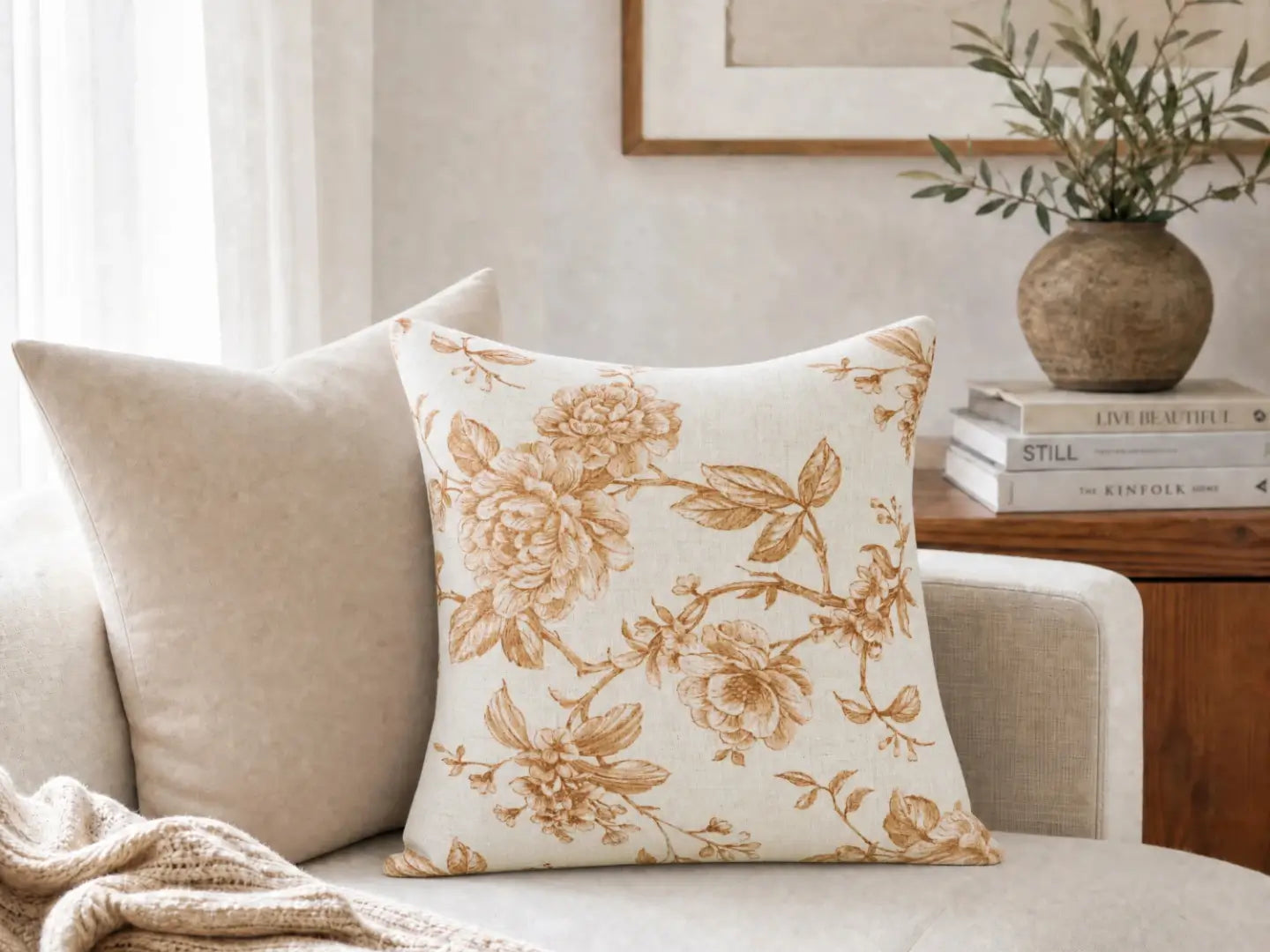
Start with washed or slub linen. Its faintly irregular weave is pure wabi-sabi — beauty in the imperfect — and it drapes soft rather than stiff. Organic cotton and cotton-linen blends work the same way, and woven bamboo or jute (as a shade or panel) pulls the whole nature-first idea together. For daylight, a light linen sheer keeps the room open. What to skip: shiny polyester satins, metallic weaves, and stiff jacquards that fight a soft fold. (If you want the full fibre-by-fibre breakdown, see our 2026 curtain fabric guide.) Japandi's warmer, more tactile cousin runs on the same fabric logic — see the organic modern lookbook for that variation.
Colour — warm neutrals, never cool grey
Japandi sits right inside 2026's shift away from stark cool greys toward sandy, earthy tones: greige, warm taupe, oat, warm white, clay, and muted sage, with charcoal used sparingly as a grounding accent. Blue-leaning greys and brilliant office-whites are the tell-tale sign a room has slipped out of Japandi and into plain minimalism.
Silhouette — full-length and calm
Hang panels floor-length, either just kissing the floor or with a small, deliberate puddle. Favour S-fold or ripple-fold waves over stiff pinch pleats, and keep fullness moderate (around 1.5–2× the window width) so the fabric reads as calm vertical rhythm, not dense ruffles. Skip swags, valances and apron-length curtains in main rooms — Japandi wants unbroken vertical lines.
Hardware — disappear it
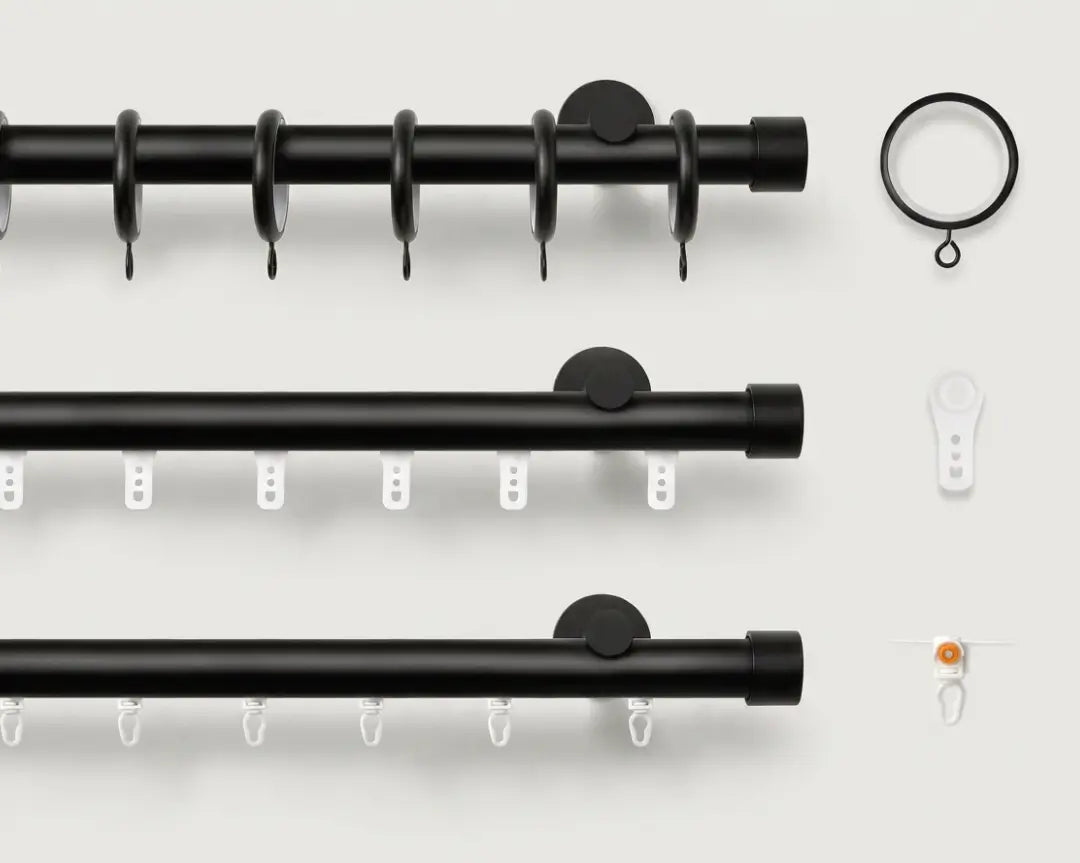
The goal is for curtains to read as architecture, not decoration. Use a slim ceiling or wall track in matte white, black or soft champagne, or a plain wood rod in oak, ash or walnut. Minimal brackets, tiny or no finials. Nothing ornate, scrolled, or high-polish chrome standing on its own.
The 6 Japandi curtain looks
Six named looks, from the safest entry point to the most architectural. Each one is a starting recipe — fabric, colour, and how to hang it — plus the kind of curtain in our range that gets you there.
1. Warm Oat Minimal
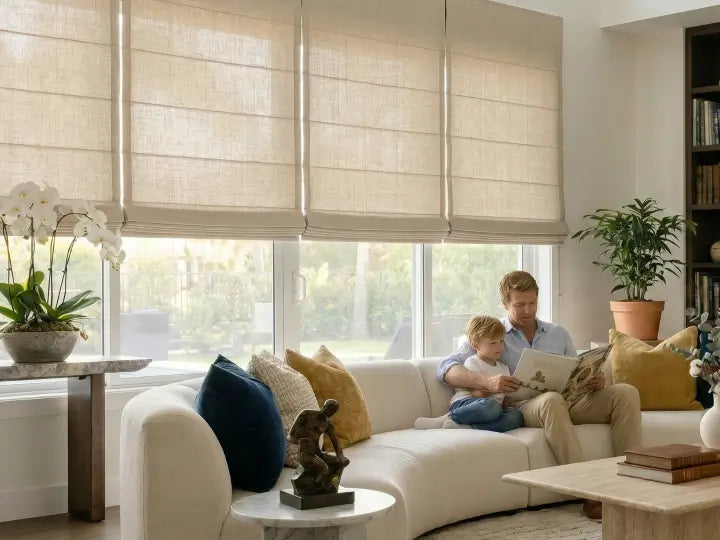
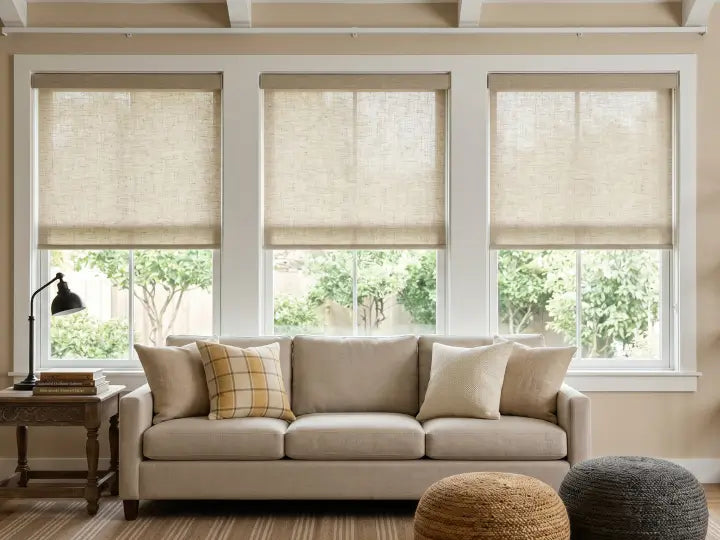
The gateway Japandi look: soft oat-coloured linen that reads barely-there but adds warmth and texture. Perfect if you want calm without committing to colour.
- Fabric: washed linen or linen-cotton blend with a subtle slub.
- Colour: warm oat / stone beige — the sandy-neutral family.
- Hang: floor-length S-fold on a slim ceiling track, just kissing the floor.
Shop the look: a soft-neutral linen like our Hestara herringbone linen-blend drape, or browse the full linen curtain collection for oat and greige tones.
2. Wabi-Sabi Textured Linen
A bedroom or reading nook where the texture is the point — visible slubs, a matte hand, gentle creasing. This is the look that leans into imperfection.
- Fabric: heavier slub or stonewashed linen with an honest, irregular weave.
- Colour: warm taupe or greige — richer than oat, still neutral.
- Hang: full-length with a gentle 2–4 cm puddle for weight and ease.
Shop the look: the textured Hestara herringbone linen. And if you have ever wondered why great linen creases at all, that softness is the feature, not the flaw — we explain it in why pure linen wrinkles (and why that is quiet luxury).
3. Natural Woven Layer
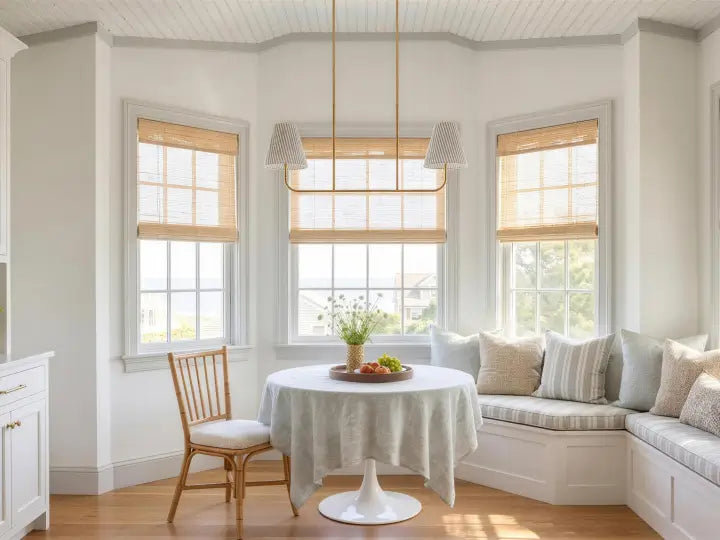
A layered window — a woven bamboo shade behind a soft linen sheer — for anyone who loves an organic, coastal-adjacent feel but wants a clean Japandi frame.
- Fabric: woven bamboo or jute shade + a linen sheer side panel.
- Colour: honeyed wood or sand for the shade; oat or off-white sheer.
- Hang: shade inside the frame, sheer on a slim track above, brushing the floor.
Shop the look: our Seris jute-bamboo woven shade layered with a light linen sheer.
4. Muted Sage Calm
A slightly more expressive Japandi moment: soft green that nods to 2026's sage and warm-eucalyptus paint trends while staying restful.
- Fabric: lightweight linen or linen blend for fluid drape.
- Colour: muted sage or an olive-leaning neutral.
- Hang: floor-length ripple-fold on a slim matte-black track; optional sheer behind.
Shop the look: browse muted, earthy tones in the linen curtain collection, set against a warm-white or clay wall.
5. Soft Clay Warmth
A dining or living space wrapped in clay-toned linen — a hint of colour and a cocooned, cosy feel that still reads minimalist.
- Fabric: medium-weight linen, optionally lined for a fuller drape.
- Colour: soft clay, terracotta-blush, or a dusty, earthy pink.
- Hang: full-length, lightly puddled, on a plain wood rod with minimal rings.
Shop the look: a refined faux-linen drape like Celina linen curtains in a warm neutral.
6. Bamboo + Sheer Layer
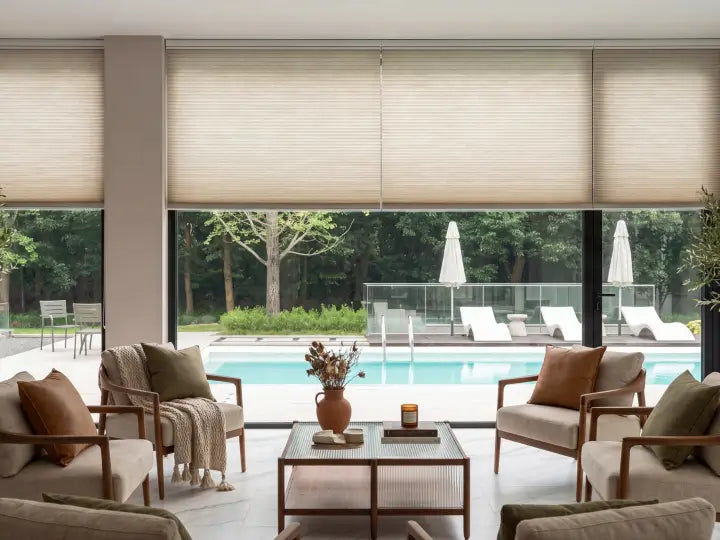
The most architectural look, made for large openings or sliding doors: woven bamboo paired with wall-to-wall sheers for indoor-outdoor flow.
- Fabric: vertical bamboo panels + extra-wide linen voiles.
- Colour: honey or smoked-oak bamboo; creamy white or light-beige sheer.
- Hang: ceiling-mounted track so sheers run the full wall; bamboo fixed or sliding.
Shop the look: the Seris woven shade plus extra-wide sheers. One privacy note for big glass: sheers alone are see-through after dark, so plan a night layer — here is exactly what sheer curtains look like at night.
The 2026 warm-neutral palette
The paint world is backing Japandi hard this year, which makes colour-matching easy. These are the warm neutrals and earthy tones designers are naming for 2026 — useful anchors when you pick a curtain shade.
| Tone | 2026 reference | Curtain read |
|---|---|---|
| Sandy neutral | Neutral Ground / Universal Khaki (HGTV Home by Sherwin-Williams) | Warm oat, everyday backdrop |
| Muted green | Warm Eucalyptus (Valspar 2026 Colour of the Year) | Restful sage, gentle expression |
| Warm taupe / beige | The "warm neutral" swing away from millennial grey | Greige, richer than oat |
| Earthy accent | Terracotta, clay, dusty pink, olive | Cosy warmth, used sparingly |
The rule of thumb: pick the undertone that is warm. A greige with a sandy base belongs in a Japandi room; the same "grey" with a blue base does not.
Japandi vs Scandi vs minimalism vs coastal
Japandi borrows from its neighbours, so it is easy to blur. Here is how the curtains differ.
| Japandi | Scandinavian | Plain minimalism | Coastal / organic-modern | |
|---|---|---|---|---|
| Palette | Warm neutrals + muted green, sparing charcoal | Light, cooler whites & pale greys | Black–white–grey contrast | Warm neutrals + sea blues, driftwood |
| Materials | Linen, cotton, bamboo; medium–dark woods | Cotton, wool; light woods | Smooth, often synthetic surfaces | Rattan, jute, linen; casual texture |
| Window | Soft linen + sheer, slim hardware, full-length | Light cottons, basic rings | Hidden tracks or no curtains | Layered sheers + heavier drapes, pattern |
| Mood | Calm, grounded, quietly luxurious | Bright, airy, cheerful | Efficient, sometimes austere | Breezy, relaxed, casual |
If you love the relaxed, textured end of this spectrum, our coastal, boho & farmhouse linen looks sit right next door to Japandi — same natural fibres, a little more pattern and ease.
Why Japandi (and linen) is trending in 2026
This is not a fading fad. Interest in "Japandi" climbed steadily on Google Trends from 2019 through 2024, and design press from LA Times to Homes & Gardens now lists it among the leading 2026 interior directions — evolving toward warmer tones rather than disappearing. On Pinterest, Japandi-tagged decor saves have kept rising into 2026.
Linen is riding the same wave. Trend coverage calls 2026 "the year of healthy, sustainable living," with 100% linen curtains at the front of it for their breathability and natural composition. Underneath the aesthetic, the U.S. and global window-treatment market keeps growing — the broad curtains-and-blinds market is projected to expand from roughly $24.9B in 2024 toward $57.6B by 2034 (about 8.9% CAGR), with residential use over 70% of demand, and the high-end segment growing from about $4.7B in 2025 toward $6.6B by 2033 — exactly where natural-fibre, design-led curtains compete.
Glossary
- Wabi-sabi — the Japanese idea that beauty lives in imperfection and simplicity; in curtains, that means slub linen and hand-woven bamboo over flawless, machine-perfect surfaces.
- Hygge — the Scandinavian sense of cosy wellbeing; Japandi fuses it with wabi-sabi for rooms that feel serene and warm.
- Greige — grey-plus-beige, the warm neutral that replaced cold grey.
- S-fold / ripple fold — heading styles where fabric forms soft, even, continuous waves along a track; the calm, relaxed drape Japandi favours.
- Slub linen — linen with intentionally uneven yarn, giving small organic lumps in the weave.
- Quiet luxury — understated quality and natural materials over logos and ornament; premium linen and slim hardware in muted colours.
Japandi curtain FAQ
What colour curtains work best for a Japandi look?
Warm neutrals — oat, greige, warm taupe, clay white, and muted sage — which match 2026's sandy, earthy paint trends. Cool blue-greys and stark brilliant whites are generally avoided because they read sterile against Japandi's warmth.
Are linen curtains considered Japandi?
Yes — 100% linen or a linen blend is almost archetypal Japandi, thanks to its natural origin, breathable feel, and subtly textured look. Keep the colour neutral or softly earthy and the silhouette simple, and linen curtains strongly support a Japandi room.
Do Japandi curtains puddle on the floor?
Usually they either lightly kiss the floor or use a small, intentional puddle for softness. Long, dramatic hotel-style puddles belong to a more traditional, opulent look, not Japandi's calm practicality.
How are Japandi curtains different from Scandinavian?
Scandinavian leans lighter and cooler — white or pale-grey cottons, light woods. Japandi favours warmer neutrals (oat, taupe, clay), can use darker woods, and layers more texture, while staying stricter about avoiding clutter.
What is the best fabric for a Japandi curtain?
Washed linen or a linen-cotton blend first, then natural bamboo or jute for shades. These fibres carry the sustainability and warm-neutral cues that make a window feel part of the whole Japandi room rather than merely decorated.
Ready to warm up your windows? Start with the linen curtain collection and layer in a natural woven shade. For the wider picture, see what else is in and out for 2026 curtain trends, or get room-specific with our living room and bedroom look-books.