
















Organic Modern Curtains: The 2026 Lookbook
Curved sofas, travertine, warm plaster, an olive tree in a clay pot — organic modern has quietly become the default way American homes do calm. This is a lookbook, not a buying guide: five named window looks, each built on a texture our linen range happens to speak fluently.

The short answer
Organic modern is warm minimalism with living textures — minimalist bones, natural materials, and rooms that feel like they breathe. At the window it comes down to one formula: textured natural weaves, in warm grounded neutrals, hung full height, with no hard pattern. Think slub linen, linen-cotton weaves and airy sheers in oat, mushroom and stone — and save smooth, shiny and high-contrast for a different style.
In this lookbook
- What makes a curtain "organic modern"
- The 5 organic modern curtain looks (shop the look)
- The 2026 palette: grey out, mushroom in
- Does "organic" mean organic cotton?
- The honest part: slubs, creases and glow
- Organic modern curtain FAQ
What makes a curtain "organic modern"
Organic modern pairs a minimalist frame — clean lines, open space, a restrained palette — with everything minimalism forgot: wood grain, stone, clay, plants, and above all textile texture. The test of the room is simple: nothing shouts, but every surface is one your eye can feel. And because the walls stay quiet and the palette stays neutral, curtains end up doing more of the sensory work here than in almost any other style. Fabric is the biggest soft surface in the room; in organic modern, it is also the pattern, the color story and the mood. The nearest neighbour to this look is modern farmhouse, which shares the texture-first instinct but keeps the shaker and shiplap references.
The formula, unpacked:
Texture over pattern
No florals, no geometry, no hard prints. Interest comes from the weave itself — slubs, irregular yarns, open basket-like structures — which reads as material honesty rather than decoration.
Warm grounded neutrals
Oat, bone, stone, mushroom, taupe with a red base — colors that behave like materials, not paint chips. Cool blue-greys are the tell that a room has drifted back to the last decade.
Full height, soft lines
Panels run floor-length or ceiling-to-floor, in relaxed folds or soft waves. The vertical line is architecture; a half-height café or a stiff, formal pleat breaks the spell.
Hardware that disappears
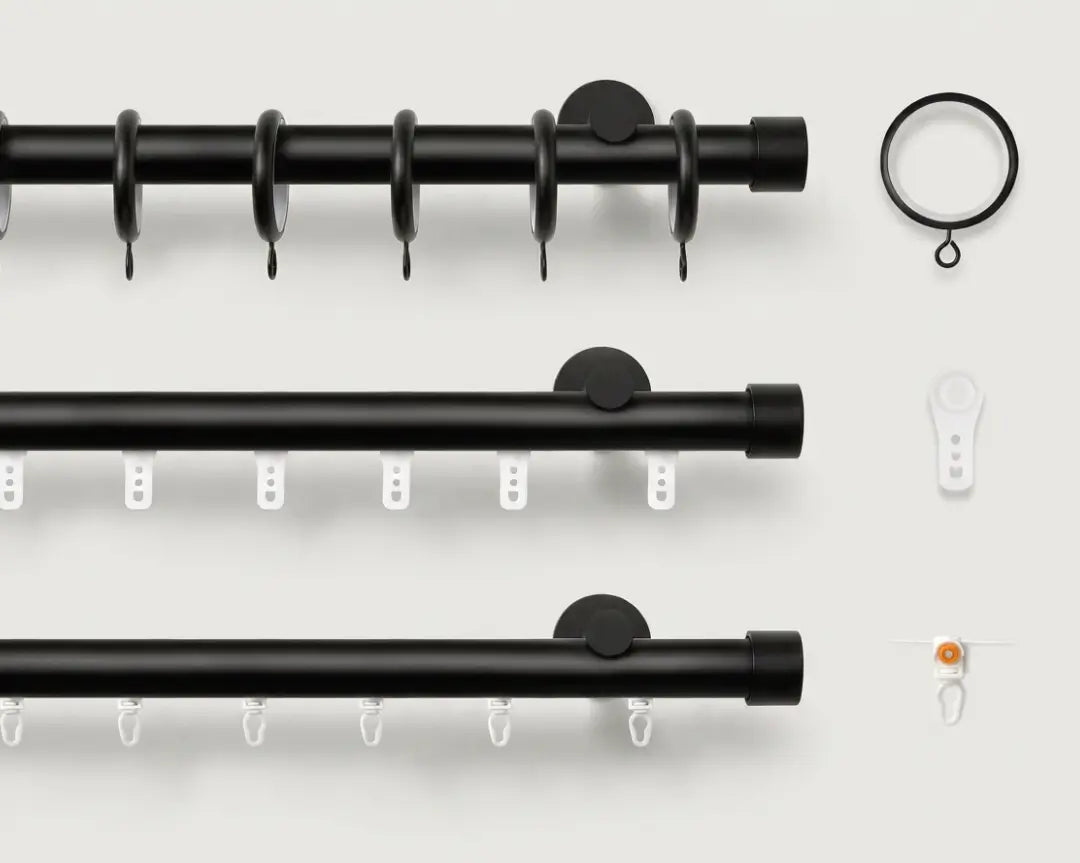
Slim tracks, plain wood rods, aged brass or matte black. The fabric is the ornament — the pole should never compete.
Sound close to Japandi? They are siblings: Japandi is the stricter, more pared-back Japanese-Scandinavian take — it has its own lookbook — while organic modern is the rounder, more layered version most American homes actually live in.
The 5 organic modern curtain looks
Five named looks, from the safest whole-room move to the boldest single gesture. Each one is a recipe — the room it suits and why the texture carries it — plus the curtain in our range that gets you there.
1. The Limewash Wall
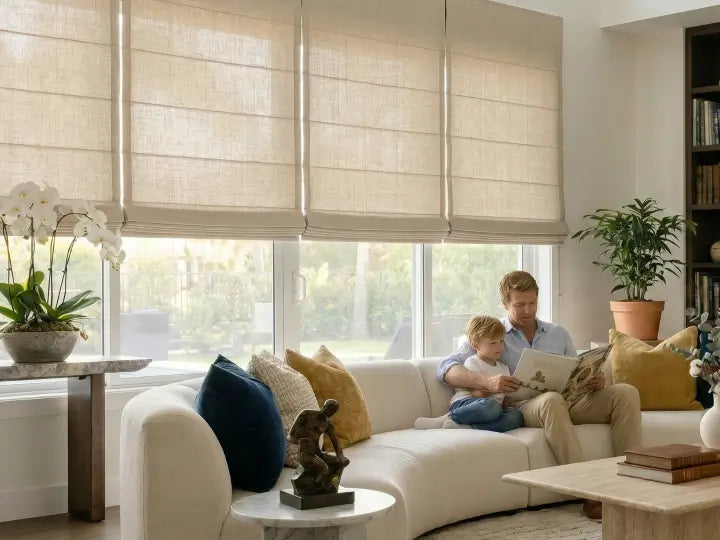
The whole-room move: one continuous run of slub-textured, light-filtering linen blend across the main window wall, in the same warm off-white family as plaster or limewash paint. The slub does for fabric what trowel marks do for a wall — it gives a plain surface movement — so wall and window merge into one calm, textured envelope. It suits the main living space best, especially where curved furniture needs a soft, unbroken backdrop.
- Fabric: linen blend with a pronounced natural slub, in a light-filtering weight.
- Color: bone, oat or warm ivory — match the wall's undertone, not the trim.
- Hang: wall-to-wall and full height on a slim track, panels stacking clear of the glass.
Shop the look: Delsia Premium Linen-Blend curtains — the natural slub texture is the entire point of the panel.
2. The Handwoven Statement
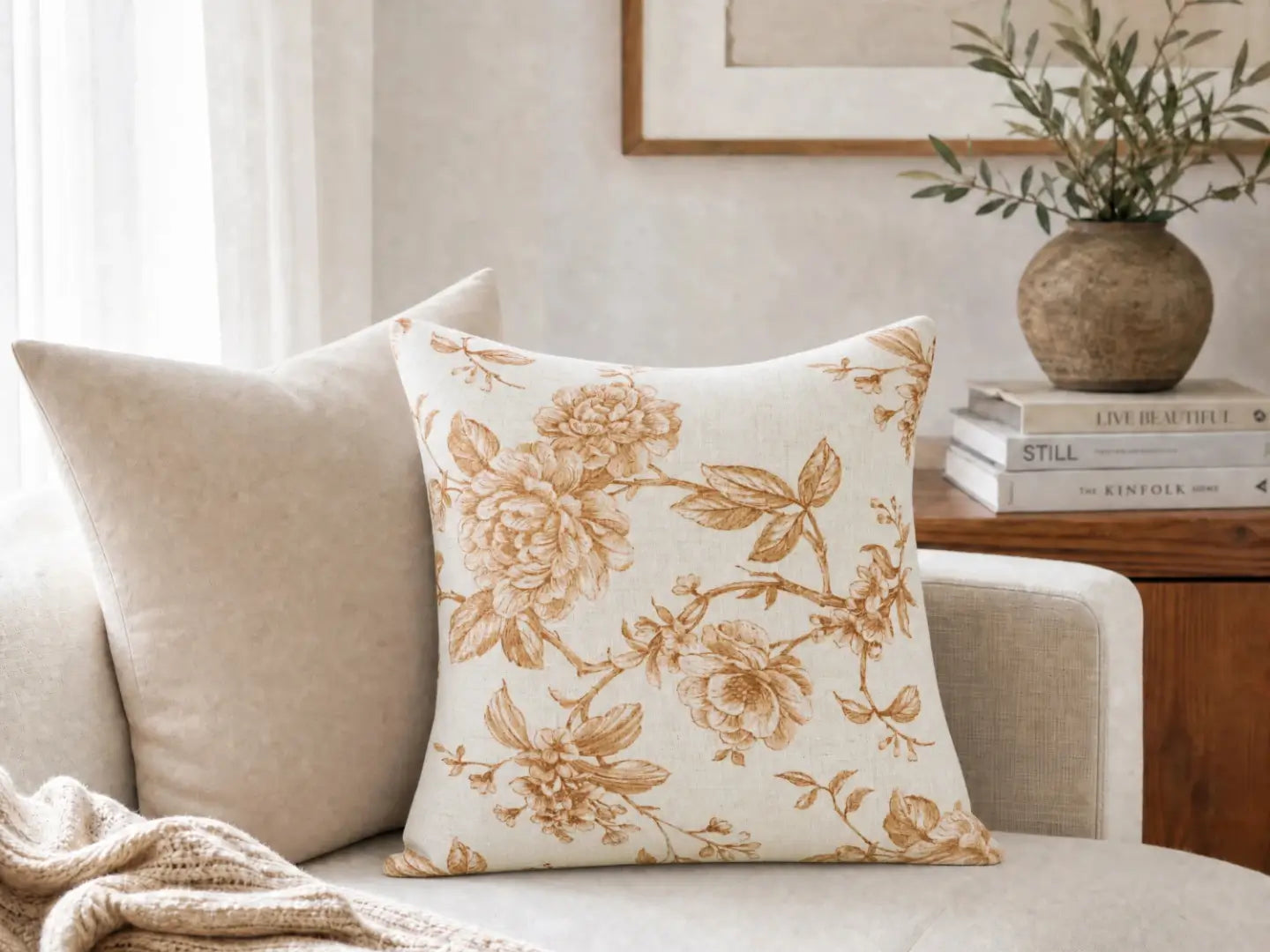
For the window that is the room's one moment — a dining room, an entry, a stair landing. A chunky, irregular slub weave reads artisanal, the textile cousin of the rattan chair and the jute rug, so a single window can carry the whole organic story on its own. At this scale the weave is the pattern: shadows settle into the thick-and-thin yarns and shift as the light moves, which is exactly why the look needs no print.
- Fabric: linen-cotton blend with a visible, organic slub weave.
- Color: raw flax, greige or mushroom.
- Hang: generous fullness — around 2× — so the folds run deep and the shadows do the decorating.
Shop the look: the Gwynara Textured Linen-Cotton curtain — its organic slub weave is precisely this recipe.
3. The Breathing Sheer
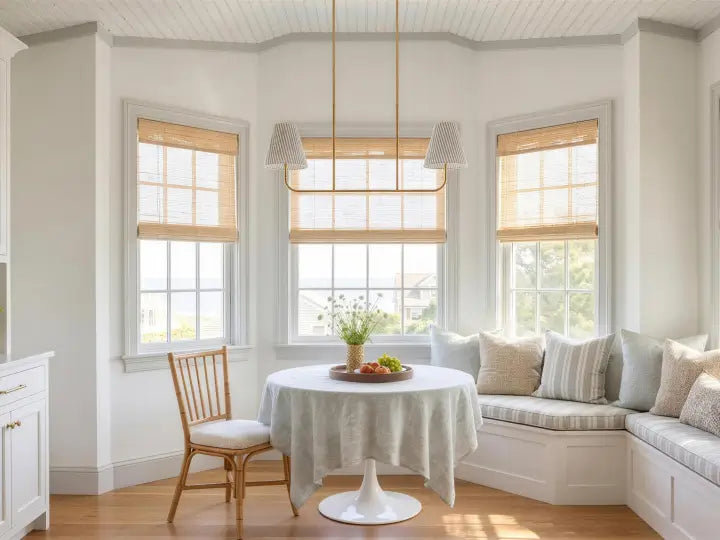
Organic modern rooms get photographed at golden hour for a reason: the style runs on diffused light. A floor-length sheer turns hard sun into the hazy, plant-warmed glow the whole aesthetic is built around, keeps the olive tree's silhouette in view, and moves with the air — the room literally breathes. It suits plant-heavy living spaces and breakfast corners, and doubles as the daytime layer in any two-layer window.
- Fabric: a light, airy sheer with a soft hand — crisp organza-like voiles read too formal.
- Color: warm white or oat-white; skip optic white, which turns the light cold.
- Hang: always floor-length; add an opaque panel over it where evenings need cover.
Shop the look: Liana Sheer Curtains, custom-sized so the sheer runs the full height of the wall.
4. The Travertine Column
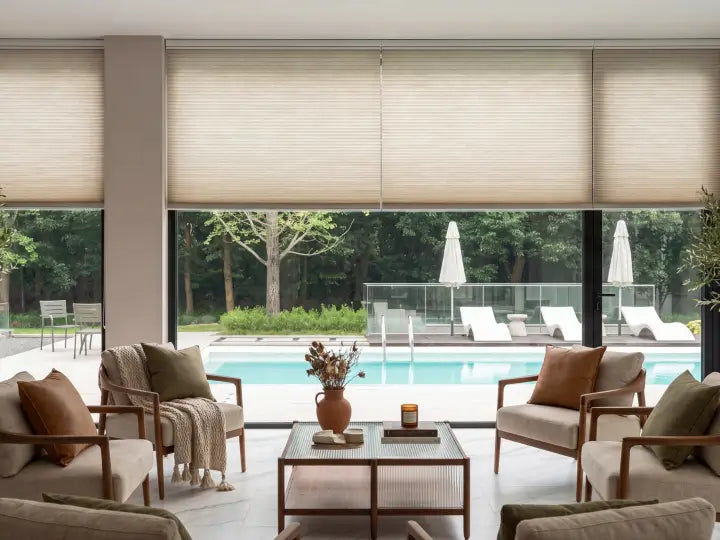
The look for height: floor-to-ceiling linen in stone and sand tones, standing in soft, even columns like the travertine it borrows its palette from. Verticality is the point — one unbroken texture from ceiling line to floor pulls the eye up, makes the room taller, and gives low, curved furniture something grounded to sit against. It suits great rooms and bedrooms with generous ceilings, and it is the strongest argument for ceiling-mounting anything.
- Fabric: a substantial linen with enough body to hold a column of folds.
- Color: stone, sand, warm greige.
- Hang: ceiling-mount, hem just kissing the floor; keep fullness moderate so the folds stay architectural.
Shop the look: Celina Linen Curtains — the floor-to-ceiling cut is what they are for.
5. The One Deep Note
An all-neutral room can float away. The fix is one deep note: a single window — or one layer of it — in chocolate-charcoal velvet, matte and shadowy rather than shiny, doing what a walnut credenza or a dark-glazed vase does for the rest of the room. This is the move 2026's color forecasting just legitimized (see the palette below), and it earns its keep in bedrooms and at the seating end of open plans, where a room needs anchoring after dark.
- Fabric: velvet with a low-sheen, matte-leaning pile — depth, never gloss.
- Color: chocolate-charcoal, espresso or deep olive.
- Hang: full height in soft, even waves; keep every other textile in the room pale.
Shop the look: Luna Premium Velvet Drapery, hung in relaxed ripple-fold waves so even the dark note stays soft.
The 2026 palette: grey out, mushroom in
The color story underneath all five looks is the same: the cool-grey decade is over. 2026 forecasting has converged on warm grounded neutrals — mushroom, red-based taupe, stone, bone — tones that read like materials rather than paint. Color consultant Charlotte Cropper, writing in Homes & Gardens, calls red-based taupe "particularly significant" for the year. Even the deep accent has gone warm: Benjamin Moore's 2026 Color of the Year is Silhouette, a chocolate-charcoal — the exact register the One Deep Note is tuned to.
| Tone | 2026 signal | Curtain read |
|---|---|---|
| Mushroom | The consensus successor to cool grey across 2026 trend reports | The everyday panel color — softer than grey, warmer than white |
| Red-based taupe | Charlotte Cropper's "particularly significant" pick (Homes & Gardens) | A richer main drape; flatters wood and leather |
| Stone & bone | The travertine-and-plaster material palette, translated to fabric | Sheers and light-filtering layers |
| Chocolate-charcoal | Benjamin Moore "Silhouette," 2026 Color of the Year | The single deep accent panel |
The undertone test: hold a swatch against a true grey. If it suddenly reads pink-brown or green-brown, it is warm enough for organic modern. If it disappears, it is still last decade's grey.
Does "organic" mean organic cotton?
Short answer: no — and the distinction saves both money and disappointment. "Organic modern" is a design term: it describes visible natural texture and warm, material-like color. "Organic cotton" is a fiber and farming claim, certified by standards like GOTS (the Global Organic Textile Standard, which covers the fiber and its processing). The two overlap far less than the shared word suggests: a certified-organic cotton sateen hangs smooth and flat, and will look less organic modern at your window than a slubby linen blend that carries no certification at all.
If the look is what you are after, linen and linen blends simply deliver it better — the visible slub, the relaxed drape, more body at the window and better long-term shape than smooth cotton. If fiber certification is your priority, that is a legitimate and different goal: look specifically for GOTS-certified cotton curtains, and know that safety-testing labels such as OEKO-TEX certify a fabric is free of harmful substances — a useful but narrower claim that is not an organic-fiber certification. "Organic linen" sits in between: flax is naturally a low-input crop, but certified organic linen is rarer in curtains than the marketing implies.
To be straight about our own range: our strength is linen and poly-linen texture — the slubs, weaves and drape this lookbook is built on. We do not claim organic-cotton certification, and you should not read "organic modern" on any store, ours included, as a fiber claim.
For the fiber-by-fiber trade-offs — how linen, velvet and polyester actually behave over years at a window — our 2026 curtain fabric guide goes deep.
The honest part: slubs, creases and glow

Three things to know before you commit, because texture-forward fabric is a taste, not an upgrade.
The irregularity is intentional. Slubs, nubs, thick-and-thin yarns, small variations from panel to panel — that is the look, by design, not a defect. If your eye would read those as flaws, you will be happier in a smooth, uniform fabric family; no judgment, but choose with open eyes.
Unlined textured linen creases. It relaxes, folds and holds soft wrinkles, especially where hands touch it. We have argued before that this is a feature — why linen wrinkles, and why that reads as quiet luxury — but you should want that lived-in ease before you buy it.
Texture glows; it does not black out. The weaves in this lookbook are chosen for how they transmit and scatter light. Where sleep matters, pair them with a blackout layer behind — do not ask a slub weave to be something it is not.
Which makes the lining the real decision here, not the face fabric: unlined keeps the airy, light-through look the style runs on, while a privacy or blackout layer behind buys you darkness at the cost of some of that glow. The trade-offs are mapped out in our guide to curtain lining.
Organic modern curtain FAQ
What are organic modern curtains?
Organic modern curtains are panels that carry the style's warm minimalism in fabric form: visible natural texture — slub linen, linen-cotton weaves, airy sheers — in warm grounded neutrals, hung full height with no hard pattern. The weave itself is the decoration, so the window reads as a calm, living surface rather than a printed one.
What colors are organic modern?
Warm grounded neutrals: cream, oat, stone, mushroom, and red-based taupe, with earthy support from clay, olive, and warm wood tones, plus one deep chocolate-charcoal accent. Cool blue-greys and stark optic whites sit outside the palette — 2026 color forecasting has moved decisively warm.
Are organic cotton curtains better than linen?
Not for this aesthetic. Certified organic cotton is a fiber and farming claim, and the fabric usually hangs smooth and flat. Linen and linen blends bring the visible slub and relaxed drape that make a window read organic modern, with more body and better long-term shape. If certification is your priority, look for GOTS-certified cotton; if the look is, choose linen.
Do organic modern rooms use sheer or opaque curtains?
Usually both, layered: a sheer or light-filtering natural weave diffuses daylight into the style's signature glow, and an opaque linen — or one deep velvet panel — grounds the room and covers evening privacy. If you only hang one layer, make it a textured light-filtering weave rather than a blackout-first fabric.
What curtain hardware suits organic modern?
Quiet hardware. Slim ceiling or wall tracks let the fabric read as architecture; if you prefer a rod, keep it simple in warm wood, aged brass, or matte black with small or no finials. Skip polished chrome and ornate scrollwork — in this style the weave is the ornament, not the pole.
Is organic modern going out of style?
No — it is settling in. Its core moves (warm neutrals, natural materials, curved lines, texture over pattern) run straight through 2026 trend reporting, down to Benjamin Moore naming a chocolate-charcoal as Color of the Year. Looks built on natural materials and quiet palettes age slowly; the churn risk sits with high-contrast, hard-patterned trends.
Ready to build the look? Start with the linen curtain collection — every slub, weave and warm neutral above lives there — then see where organic modern sits in the year's bigger picture in our curtain trends 2026 rundown.