




















No-Drill Roman Shades: The Damage-Free Window Treatment

A no-drill Roman shade holds itself in place with an internal tension rod, not screws. You extend the rod with a small Allen wrench until it presses firmly against both sides of the window frame, then lock it. No drilling, no holes, nothing to patch and repaint when you take it down.
Roman shades have always had one annoying catch: the fold-and-stack fabric looks tailored, but the install usually means brackets and a drill. A no-drill Roman shade keeps the look and drops the drill. It's the same soft, folded shade — linen-blend fabric, clean horizontal pleats — mounted by pressure alone.
How a No-Drill Roman Shade Stays Up
The mechanism lives inside the headrail, the slim bar that runs across the top of the shade. Built into that bar is a tension rod — the same idea as a spring curtain rod, but engineered for a shade's weight.
You adjust it with an Allen wrench, the only tool in the box. Turn the wrench counter-clockwise and the rod extends; turn it clockwise and it retracts. You extend it until both ends press firmly against the inside of the window frame, then tighten a set screw to lock the tension in place. The shade stays up because it's wedged, not because it's screwed.
A plastic cover snaps over the tension rod end to hide the hardware. Once the headrail is set, the fabric panel attaches to it.

No-Drill vs. Drill Mount: The Trade-Offs
Neither mount is inherently better — they're better for different windows.
| No-Drill Mount | Drill Mount | |
|---|---|---|
| Tools | Allen wrench (included) | Drill, screws, level, wall anchors |
| Holes | None | Screw holes in frame or wall |
| Install time | Minutes, one tool | Longer — brackets, leveling, anchors |
| Removal | Loosen, lift out, no trace | Unscrew, then fill and paint |
| Width ceiling | Up to 70" (tension limit) | Wider — up to 100" on comparable shades |
| Best for | Standard windows, hard-to-drill surfaces, easy changes | Extra-wide or very heavy shades |
The width ceiling is the honest caveat. A tension rod distributes its grip across the frame, and past about 70 inches the physics gets less forgiving. For a standard bedroom or kitchen window, a properly tensioned shade holds reliably. For a twelve-foot wall of glass, a drill mount still wins.
Why Damage-Free Matters Beyond Rentals
The no-drill story usually starts with renters — deposit-safe, landlord-approved, take it with you when you move. That's true, but it's only the first chapter. And no-drill isn't limited to Roman shades — we've compared the other damage-free ways to hang curtains too.
Think about the places you'd rather not put a hole:
- A newly painted window frame. Fresh trim, crisp paint — and then two screw holes. No-drill leaves it untouched.
- Old plaster walls. Century-old plaster can crack and crumble when you drill into it. Pressure mounts skip that risk entirely.
- Kitchen and bathroom windows. Tile, stone, and glass block don't forgive a misplaced drill bit. Tension doesn't care what the surface is.
- A room you redecorate often. If you swap window treatments seasonally, unscrewing and patching every time gets old fast. A no-drill shade lifts out in seconds.
- Anyone who'd rather not bother. No stud finder, no leveling brackets, no rented drill. The whole install is one small wrench.
There's a safety angle too. A no-drill Roman shade in cordless-lift form has no dangling cords, which makes it a calmer choice in a nursery or a house with pets.
How to Install a No-Drill Roman Shade, Step by Step
The whole job takes a few minutes. Before you start, one rule: when you open the package, don't cut or release any of the lines on the back of the shade. Those cords raise and lower the folds — leave them alone.
- Lay out the pieces. You should have three things: the shade, an Allen wrench, and one plastic cover. No extra tools needed for instllation.
- Extend the tension rod. Insert the Allen wrench into the end of the headrail and turn it clockwise to extend the rod. Set it slightly wider than the frame so you can compress it into place.
- Seat the first end. Place the tension-rod side against one inside edge of the window frame.
- Compress and lock. Press the opposite end in, compressing the rod to fit the other side of the frame. Release, and the rod expands to grip both sides.
- Tighten the set screw. With the shade level and flush against the top of the frame, tighten the screw to lock the tension firmly.
- Snap on the covers. Clip the plastic cover over the tension rod end of the headrail to hide the hardware.
- Attach the fabric. Secure the Roman shade panel to the headrail.
- Test it. Pull the shade down and let it back up once to confirm the folds travel smoothly.
If the shade ever needs to move, reverse the steps: loosen the set screw, retract the rod with the wrench, and lift the shade out. No holes to patch.
Getting the Measurements Right
The tension mount needs a frame with enough depth to sit in. For an inside mount, the window frame needs a minimum depth of 2 1/4" (flush mounting needs 2 3/4"). Measure the width at the top, middle, and bottom of the frame and use the narrowest number. For height, measure left, center, and right and use the longest.
If you need further support, our our shade-measuring guide covers detailed tips for inside mounting.
Where No-Drill Roman Shades Fit In

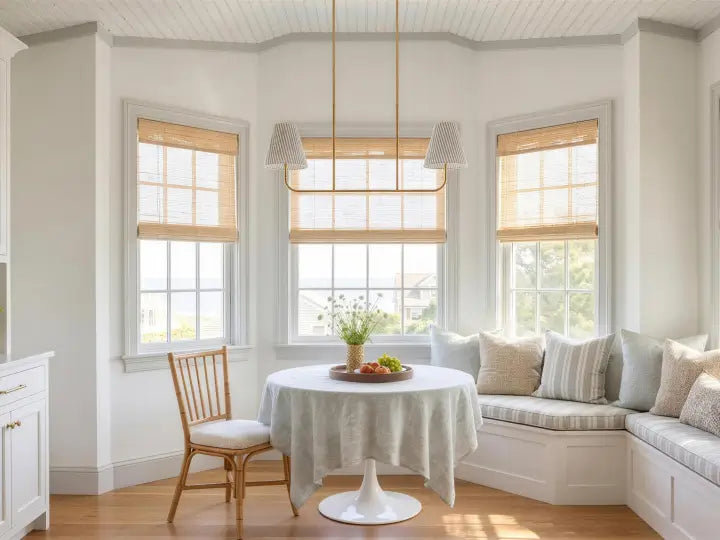
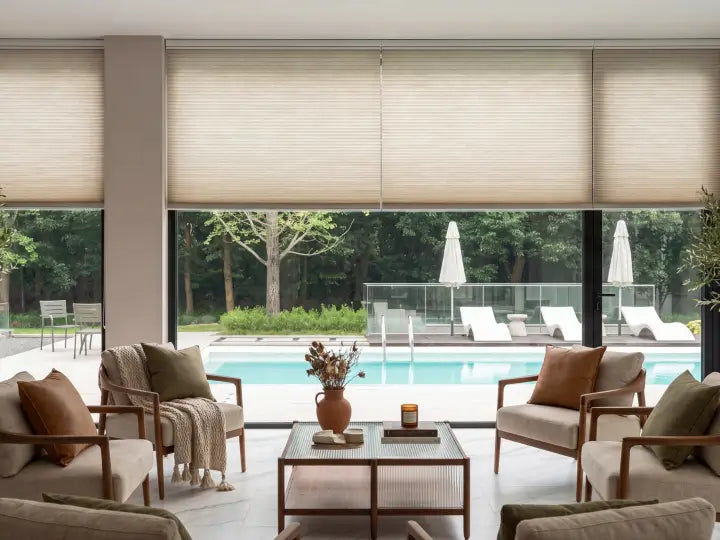
A linen-blend Roman shade reads soft and tailored at the same time, which is why it slides into so many rooms. In a bedroom, the fabric filters daylight to a warm, diffused glow — enough to soften a room without going blackout. In a kitchen, it brings texture above a sink where a heavy drape would feel wrong, and it mounts without drilling into tile. In living rooms and dining rooms, the neat folds read more finished than a flat roller shade and sit comfortably across modern, coastal, and transitional styles.
This is what the Elara No-Drill Linen Blend Roman Shade is built for. It's a custom-sized shade in an 8% linen / 92% polyester blend with a heavyweight 335 GSM body, so the folds hold their shape rather than looking limp. The fabric blocks 40–50% of light — a true light-filtering level that gives privacy by day while keeping the room bright. You choose your lift: a continuous cord loop, a cordless lift, or a motorized option. Each shade is cut to your measurements and backed by a lifetime limited warranty. Browse the full Roman shade collection to see the fabric options, and order a swatch before you commit.
FAQ
Do no-drill Roman shades actually stay in place?
Yes, when the shade fits the window. The tension rod presses outward against both sides of the frame, so the grip is active — not a one-time adhesive. The key is a correct measurement and a frame with the required depth.
Can I install a no-drill Roman shade on any window?
Inside-mount no-drill shades need a frame with parallel sides and enough depth to hold the rod. Tension mounts top out around 70" wide, so very wide windows are better served by a drill mount.
How do I remove a no-drill Roman shade?
Loosen the set screw, retract the tension rod with the Allen wrench, and lift the shade out. It leaves no holes, no adhesive residue, and no marks.
Are no-drill Roman shades safe around kids and pets?
The mount itself doesn't involve cords, but the cordless-lift option removes dangling cords entirely — a solid choice for nurseries and homes with pets.
Do no-drill Roman shades block light as well as regular ones?
The installation method will not alter the fabric’s ability to filter light. Elara fabric inherently provides 40–50% light blocking. You can choose to use the shade without a liner, or pick liners with varying shading capacities to reach your ideal light control. Available liner options include: white liners (30%, 50%, 80%, 100% light blocking), beige liners (50% light blocking), and black liners (80% and 100% light blocking).