




















Are Curtains a Fire Hazard? Radiators, Baseboard Heaters & Space Heaters
Curtains almost never start a fire by themselves; they catch fire when something hot gets too close, and in winter that something is often a heater a few inches from the hem.
The short answer
Curtains are combustible, so they can be a fire hazard, but the main hazard is distance, not fabric. The CPSC says to keep curtains at least 3 feet from the front, sides and rear of a space heater; NFPA says candles need 12 inches. Baseboard heater makers set their own minimums (Cadet: 12 inches above and in front), and no curtain should rest on or cover a radiator. NFPA counts curtains, blinds and drapery as the first thing ignited in about 1,241 US home fires a year.
Good fit if you're dressing a window above a radiator, baseboard heater or space heater. Skip / reconsider if a fire code requires certified flame-resistant drapery (schools, auditoriums, commercial buildings): you need NFPA 701-certified fabric from a commercial supplier, and we don't sell it.
In this guide
- How do curtains actually catch fire?
- How much clearance do curtains need from each heat source?
- Can curtains touch a radiator?
- Can curtains hang over a baseboard heater?
- How far should curtains be from a space heater?
- Does curtain fabric make a difference?
- What's the safest way to dress a window above a heater?
- The honest part
- Glossary
- FAQ
How do curtains actually catch fire?
Curtains catch fire when a heat source gets close enough to ignite them: a space heater, a candle, a hot lamp, a fireplace, or even sunlight focused by a glass object.
In NFPA's 2025 home-fire tables, curtains, blinds, drapery and tapestries were the first item ignited in an average of 1,241 reported home fires a year from 2019 to 2023, with 13 deaths a year: well under 1% of roughly 328,589 home structure fires. The bigger pattern is proximity. A heat source too close to combustibles was a factor in 27,178 home fires and 437 deaths a year, 17% of all home fire deaths.
Space heaters are where that pattern turns deadly. The US Fire Administration found that portable heaters were involved in only 3% of residential heating fires from 2017 to 2019, but in 41% of the fatal ones. The leading factor was a heater too close to something combustible (48%), and soft goods, including bedding, curtains and clothing, were the first thing ignited in 24% of those fires.
Candles are the other repeat offender: NFPA reports that more than half of home candle fires start when something flammable, curtains included, is too close, and that Christmas is the peak day.
Once lit, a curtain works against you. In a room-scale fire test published in Fire and Materials, flame climbed hanging curtain fabric at an accelerating rate, and pleating and cotton content both strongly affected how it burned.
How much clearance do curtains need from each heat source?
For heaters, fireplaces and stoves, the default is 3 feet; candles need 12 inches; for a permanently installed baseboard heater, use the clearance in its manual.
| Heat source | Keep curtains at least | Who says so |
|---|---|---|
| Portable space heater | 3 feet from the front, sides and rear | CPSC |
| Fan-forced wall heater | 3 feet from the front; away from the sides and rear | Cadet wall-heater guide |
| Fireplace or wood stove | 3 feet | US Fire Administration |
| Electric baseboard heater | 12 inches above and in front, 6 inches at the sides (Cadet); short drapes 6 inches above the top (Marley) | Owner's guides, quoted below |
| Radiator, steam or hot water | Never touching or covering it; the USFA's general rule is 3 feet from all heat sources, radiators included | US Fire Administration |
| Candle | 12 inches (NFPA); the USFA groups candles under its 3-foot rule | NFPA and USFA |
Treat these as minimums. A curtain that sways in a draft or swings when a door opens can close a gap you measured once. Where sources disagree, follow your own heater's manual; if you can't find it, use the larger number.
Can curtains touch a radiator?
No. Fabric shouldn't rest on or cover a radiator, for two reasons: safety and heat.
Steam radiators run hot. Heating author Dan Holohan of HeatingHelp notes that one-psi steam brings a radiator's surface to about 215°F, while hot water usually tops out around 180°F. The USFA makes no exception for either: its home-heating guidance names radiators among the heat sources to keep anything that can burn 3 feet away from.
Covering a radiator also wastes its heat. Radiators usually sit under windows so rising warm air can offset the cold glass; a curtain over one traps that heat against the coldest surface in the room. The Department of Energy's Energy Saver guide says to make sure radiators and baseboard heaters are "not blocked by furniture, carpeting, or drapes." To insulate a window without covering the heater, compare honeycomb shades and thermal curtains.
What works instead: curtains that stop at the sill, café curtains on the lower sash, or an inside-mount roman shade. If you love long panels, hang the rod wide so they stack beside the radiator, not over it.

Can curtains hang over a baseboard heater?
Not over it, and never touching it. Both manuals below tell you to keep curtains away from the heater, then set minimums that differ by brand.
- Cadet (electric baseboard owner's guide): "Keep combustible materials, such as furniture, pillows, bedding, papers, clothes, and curtains away from heater," with at least 12 inches clear of all objects above and in front of the baseboard and 6 inches on both sides. Dimplex's guide, from the same parent company, uses identical wording.
- Marley (Model D electric/hydronic baseboard instructions): short drapes need at least 6 inches above the top of the heater. Floor-length drapes are allowed only with at least 2 inches between the heater's front and the nearest fold when open, and 1 inch above the floor covering. Marley also says not to install vinyl drapes or vinyl blinds above the heater, and warns that some fabrics discolor faster in warm air currents.
Side by side, the practical answer is a hem at least 12 inches above the heater, which satisfies both brands; a 6-inch gap meets Marley's rule but not Cadet's. Find the model number on the heater's nameplate and read its manual before you order curtains.
The conflict is built in: Cadet says a baseboard heater works best under a window, and Marley recommends that placement "for maximum heating comfort." Measure from the top of the heater, not the floor; our guide to measuring for curtains shows how to take sill and apron lengths.
How far should curtains be from a space heater?
At least 3 feet in every direction. The CPSC says to keep curtains, beds, sofas, papers and clothes at least 3 feet from the front, sides and rear of a portable electric heater, warning that these high-wattage appliances can ignite nearby curtains. The rest of the agency checklist:
- Buy a heater that shuts off automatically if it tips over, from a recognized testing laboratory (USFA).
- Turn it off when you leave the room or go to bed; the CPSC says never leave one operating unattended or while you sleep.
- Plug it directly into a wall outlet, never an extension cord or power strip.
- Set it on a stable, level surface where it won't be knocked over.
Don't park a heater under a drafty window, directly below curtains that move in the same draft. In kids' rooms the same 3 feet applies; our child-safe window treatment guide covers cords and other hazards.
Does curtain fabric make a difference?
Some, but less than distance does, and no curtain fabric is fireproof. The Knoxville Fire Department's fabric guidance opens with "All fabrics will burn," then sorts them:
- Cotton, linen, silk (untreated): burn more readily than wool.
- Polyester, nylon, acrylic: resist ignition, but once lit they melt and drip, causing severe burns.
- Blends: can combine fast burning with melting, in some cases worse than either fiber alone.
- Wool: harder to ignite, burns slowly and may put itself out.
- Weave: heavy, tight weaves burn more slowly than light, loose ones; brushed or fluffy surfaces ignite more readily.
"Flame retardant" doesn't mean fireproof. Flame-resistant curtains are woven from inherently flame-resistant fibers or treated with chemicals that slow burning, and treatments wear off. New York City's fire code, as summarized by Weill Cornell Medicine's safety office, requires treated curtains in public and common areas to be re-treated after cleaning or pressing, or every three years, while inherently flame-resistant fabric is certified once. The test behind those rules is NFPA 701. For the trade-offs, see our pros and cons of fire-retardant curtains; for fiber basics, our curtain fabric guide.
What's the safest way to dress a window above a heater?
Pick a format that keeps fabric above or beside the heat, not in front of it.

| Situation | Better choice | Why |
|---|---|---|
| Radiator or baseboard heater below the window | Sill-length or café curtains ending above the heater | Nothing hangs into rising heat; 12 inches above an electric baseboard meets both manuals quoted above |
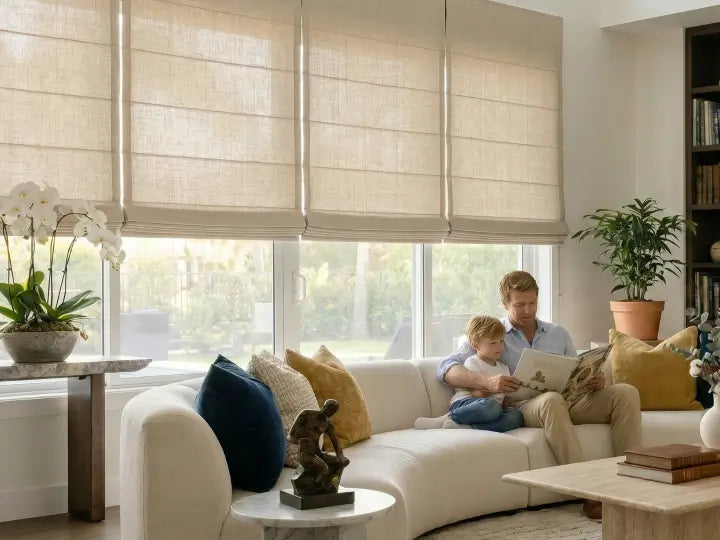
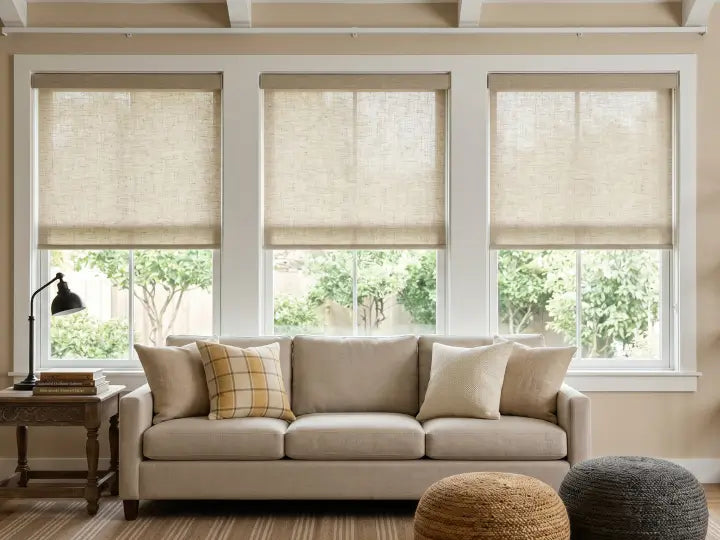
| Privacy with nothing below the sill | Inside-mount roman shade | Folds up inside the window opening and stops at the sill |
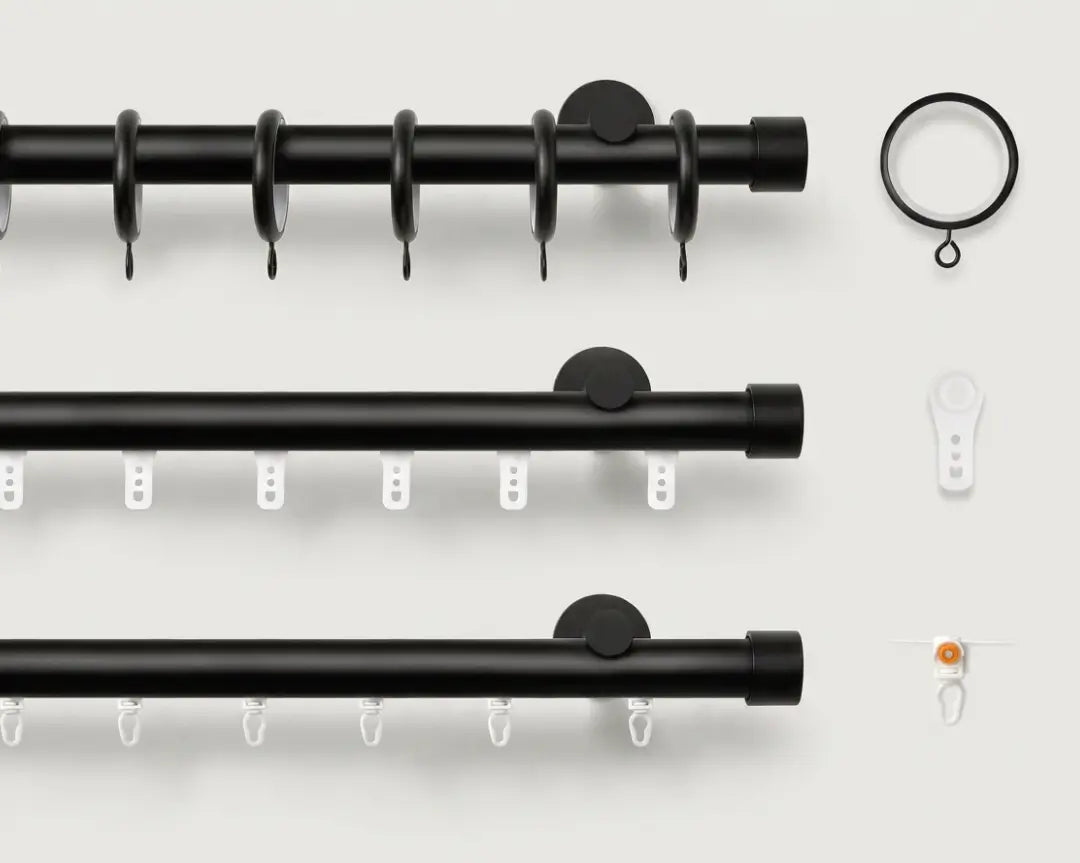
| Café curtain inside the frame | The slim Avelon 1/2-inch custom café rod with a light fabric such as Elara café curtains (linen-blend: 8% linen, 92% polyester; light-filtering; custom sizes) | The rod sits inside the frame, so fabric covers only the lower sash |
| Floor-length panels are non-negotiable | A wider rod so open panels stack beside the window, held with magnetic tiebacks while the heat runs | Tiebacks stop open panels drifting into the heater; closed panels still hang in front of it, so check the manual |
| Portable heater near a window | Move the heater, not the curtain | The CPSC's 3 feet covers the front, sides and rear |
| Candles on the sill | Move them at least 12 inches from fabric | NFPA's candle clearance |
| Glass ornaments or mirrors on a sunny sill | Move them off the sill | Essex firefighters traced a January 2025 bedroom curtain fire to sunlight reflecting off a glass globe on a windowsill |
Exact lengths make this easier: our custom curtains can be ordered to stop at the sill or apron, our guide to three curtain lengths weighs the pros and cons of each, and our café curtain style verdict covers whether café curtains still look current.
The honest part: what no curtain can do
- The absolute risk is small. Curtains are the first thing ignited in about 1,241 home fires a year; cooking causes 159,439, nearly half of all home fires, per the same NFPA tables. Keep perspective, and keep 3 feet around space heaters.
- No fabric is fireproof. Polyester melts, cotton and linen burn readily, and flame-retardant treatments can wash out.
- Heavy curtains over a heater cost you heat. Thick or thermal panels closed over a radiator hold its warmth against cold glass instead of the room. Keep them clear of the heater; our thermal curtain guide covers the energy side.
- Shorter isn't always prettier. Floor-length panels make a room feel taller, and a sill-length curtain over a radiator can look abrupt. A roman shade or café curtain is often the cleaner compromise.
- We don't sell flame-retardant curtains. None of the curtains, shades or café panels we make is flame-retardant or NFPA 701 certified. If a code requires certified drapery, buy from a commercial supplier that provides the certification. For homes, our honest advice is clearance, not fabric.
- Your heater's manual outranks this article. Clearances vary by model, and its instructions are the final word.
Glossary
Clearance — the open space required between a heat source and anything that can burn.
Item first ignited — the fire-reporting term for the first material that caught fire, as opposed to the heat source that lit it.
Flame retardant (FR) — fabric treated with chemicals that slow burning; topical treatments can wear off with cleaning.
Inherently flame resistant — fabric made from fibers that resist burning on their own, so the property doesn't wash out.
NFPA 701 — the National Fire Protection Association's flame-propagation test for curtains and other hanging textiles, required by fire codes in many public spaces.
Sill length / apron length — curtains that end at the windowsill, or just below it at the bottom of the window trim.
Tip-over switch — a space-heater safety feature that shuts the heater off if it falls over.
FAQ
Are curtains a fire hazard?
They can be, because every curtain fabric is combustible, but the real hazard is distance to a heat source. NFPA counts curtains, blinds and drapery as the first item ignited in about 1,241 US home fires a year (2019 to 2023). Keep curtains 3 feet from space heaters and 12 inches from candles, and never let them touch a radiator or baseboard heater.
How far should curtains be from a space heater?
At least 3 feet from the front, sides and rear, according to the CPSC. Also turn the heater off when you leave the room or go to sleep, plug it directly into a wall outlet, and choose a model that shuts off automatically if it tips over.
Can curtains touch a radiator?
No. Steam radiators can reach about 215°F at the surface and hot-water radiators about 180°F, and the US Fire Administration says to keep anything that can burn 3 feet from all heat sources, including radiators. Covering a radiator also traps its heat against the cold window. Curtains that stop at the sill, or a roman shade inside the frame, avoid both problems.
Can curtains hang over a baseboard heater?
Not over it, and never touching it. Cadet's owner's guide calls for at least 12 inches of clearance above and in front of its electric baseboards and 6 inches at the sides, while Marley's Model D instructions call for at least 6 inches between short drapes and the top of the heater. Check the manual for your exact model, and use the larger number if you're unsure.
Are blackout curtains a fire hazard?
They're combustible like any other curtain unless they're certified flame-resistant; blocking light doesn't change that. Give a blackout curtain the same clearances as any other. If its lining is vinyl, note that Marley's baseboard instructions say not to install vinyl drapes or vinyl blinds above its heaters.
Are polyester curtains safer than cotton or linen?
Not simply. The Knoxville Fire Department notes that untreated cotton and linen burn more readily, while polyester resists ignition but melts and drips once it catches, which causes severe burns. Blends can combine both behaviors. No fabric is fireproof, so clearance matters more than fiber.
Can sunlight set curtains on fire?
Yes, with the right setup. In January 2025, firefighters in Essex, England, found bedroom curtains burning after sunlight reflected off a decorative glass globe on the windowsill. Keep glass ornaments, crystal and mirrors off sunny sills.
If there's a radiator or baseboard heater under your window, start with our café curtains, which stop at the sill, clear of the heat below, or an inside-mount roman shade. For exact lengths in any style, browse custom curtains, and order free swatches to check color and weight before you commit.