

















Curtains for Wide Windows: Panels, Splits, and the Math That Makes Them Work
A curtain that is too short announces itself from across the room. A curtain that is too narrow fails more quietly: the pair that never quite meets in the middle, the seam glowing against the glass at four in the afternoon, the drawn-back stack that permanently swallows the left third of the view. Wide windows do not need longer curtains — they need a plan for panels, seams and stack space. The good news is that the plan is mostly arithmetic.
The short answer
Three configurations work on a wide window: a center-split pair (one panel from each side, meeting in the middle), multiple panels at fixed points (columns of fabric that mostly stay put), or a one-way draw (everything travels to a single stack). The choice decides your hardware, your seam plan and where the fabric stands when the window is open.
Budget wall space before anything else. An open stack eats roughly a quarter to a third of the run it covers — on a 12-foot window, three to four feet of standing fabric that has to live somewhere. Decide where, and most of the other decisions fall in line.
In this guide
- Why width is its own problem
- The three configurations that work
- The widths-of-fabric math
- Seams — and the seamless alternative
- Stack space: the wall budget
- Supports, splices, and why wide runs end up on tracks
- What to hang on a wide run
- Glossary
- FAQ
Why width is its own problem
Height scales gracefully. A 108-inch curtain is a 96-inch curtain with another foot of the same fabric: the widths don't change, the seams don't move, the hardware doesn't care. Width scales structurally. Somewhere past the standard window, a wide run crosses three thresholds in quick succession: the fabric runs out (drapery goods only come so wide), the rod runs out (every rod has a span past which it needs help), and the wall runs out (the open stack starts standing on glass instead of plaster).
That is why the difference between a window wall that looks commissioned and one that looks like hung bedsheets is rarely the fabric itself. It is panel count, seam placement and draw direction — three decisions that cost nothing if they are made before ordering and are nearly impossible to fix after. If your problem is the vertical axis instead — tall windows, high ceilings, long drops — that is a different rulebook and it lives in our complete floor-to-ceiling guide. This article is about the horizontal one. For the general rule on how much wider than the window a panel should be, start with our curtain width guide.
The three configurations that work
The center-split pair is the familiar instinct, scaled up: one panel from each side, meeting in the middle. It keeps the window symmetrical and reads as a single gesture, which is why it is the default for living-room window walls. It is also the most demanding layout — the two leading edges travel the farthest and have to actually meet, which, as the hardware section explains, is precisely what a cheap wide rod cannot deliver.

Fixed panels at intervals break the run into a rhythm of fabric columns — four, five, six narrower panels spaced evenly, mostly stationary, usually layered over sheers or shades that do the actual light work. This is the most forgiving layout for hardware and budget: because nothing traverses, the support brackets hide behind the panels and a plain long rod does fine. The trade is function — you are dressing the window, not really operating it.
The one-way draw sends the entire curtain in one direction, to a single stack. It is the specialist answer for sliding doors (stack on the fixed-glass side, so the door stays usable), for corner glazing, and for runs where only one flank has usable wall. You give up symmetry and accept the whole stack on one side; you get one clean sweep and no meeting point to misbehave.
| Configuration | The look | Hardware | Stack behavior | Best for |
|---|---|---|---|---|
| Center-split pair | Symmetrical; the window reads as one gesture | A track (or traverse system) once truly wide — a center-supported rod blocks the rings | Splits into two half-stacks at the jambs | Living-room window walls, symmetric rooms, windows opened daily |
| Fixed panels at intervals | Even columns of fabric; editorial rhythm | Most forgiving — a long rod with supports hidden behind stationary panels | No moving stack; the panels are the stack, distributed along the run | Window walls you rarely close; layering over shades; tight budgets |
| One-way draw | Asymmetric; one clean sweep | A track with a single master carrier | The entire stack lands on one side — budget the full quarter-to-third there | Sliders, corner windows, walls with one usable flank |
The widths-of-fabric math
Custom drapery is not planned by the window; it is planned by the width. Drapery goods come off the bolt at roughly 54 inches wide, so a workroom sees your window not as “160 inches” but as a number of 54-inch widths seamed edge to edge.
Run the example. A 160-inch window wall at 2× fullness needs about 320 inches of flat fabric. Divide by 54 and you get 5.9 — call it six widths. Made as a center-split pair, that is three widths per panel, two seam lines in each. Fullness is the multiplier doing the damage: it is the ratio of fabric to window that makes a curtain hang like drapery rather than like a sheet stretched to cover, and the trade-offs between the standard ratios are their own subject, covered in 1.5× versus 2× fullness. For this article, notice only that wide runs multiply fast.
Hold the number loosely, because that is how the trade holds it. Side hems, seam allowances and pattern repeats all eat inches, which is why workrooms round up to whole and half widths rather than shave down. And when the arithmetic lands on a half — two and a half widths per panel, say — the convention is to seam the half-width at the outside edge, so the leading edge everyone sees and handles is one full, uncut width. “Six widths” is not a shopping list; it is how the person cutting your fabric will think, and it is worth being able to think along with them.
Seams — and the seamless alternative
Retire the fear of seams early. Every custom curtain wider than one width of goods has them — which is to say, nearly every curtain on every wide window ever photographed. The craft is placement: the workroom plans the pleat or fold layout so each seam lands on the back of a fold, where it sits inside its own shadow. Where seams do betray a panel is backlight — on an unlined curtain with seams placed wherever the fabric happened to end, every join reads as a bright vertical scar at sunset. Lining, or planning, fixes that.
There is one honest route to genuinely seamless, and it is called railroading: turning the fabric 90 degrees so the length of the bolt runs across the window and the goods’ width becomes the drop. This is exactly why wide sheer goods are woven 110 to 118 inches wide — rotated, a single uncut piece can cross a very wide window with no vertical join to catch the sun. The constraints are simple: the drop must fit inside the goods’ width, and the weave must survive rotation — plains and open sheers railroad beautifully, while directional prints and slubbed textures turn sideways with the fabric. Hence the classic window-wall recipe: one seamless, railroaded sheer underneath, one seamed-and-planned opaque layer over it.
Stack space: the wall budget
Open curtains do not vanish; they stand. The working rule: a drawn-back stack occupies roughly a quarter to a third of the run it covers — toward a quarter for light, low-fullness cloth, toward a third for full, lined, heavy drapery. On the 160-inch example that is somewhere around 40 to 53 inches of standing fabric. A center-split pair divides it into two jamb stacks of 20-odd inches each; a one-way draw parks all of it on one side.

The professional move is to take the stack off the glass entirely: extend the hardware past the window so the open panels stand against wall rather than view. Which is where the plan meets the floor plan — the wall has to exist. Walk the flanks and check for door swings, corners, sconces, art and bookcases before you commit to a configuration, because a pair needs wall on both sides and a one-way draw needs a lot of it on one. This is why stack space gets budgeted first: it is the one constraint you cannot buy your way out of.
Thickness compounds the appetite. Blackout lining, interlining and high fullness all deepen a stack — which matters most in bedrooms, where extra-wide windows and total darkness tend to be wanted together; that intersection has its own playbook in our extra-wide blackout linen guide.
Supports, splices, and why wide runs end up on tracks
Every curtain rod has a published span past which it requires a center support, and a wide window is past it — usually well past, before the weight of a six-width pair even arrives. Ignore the limit and the rod answers with the most recognizable failure in window treatments: the long, shallow sag that makes even expensive drapery look tired.
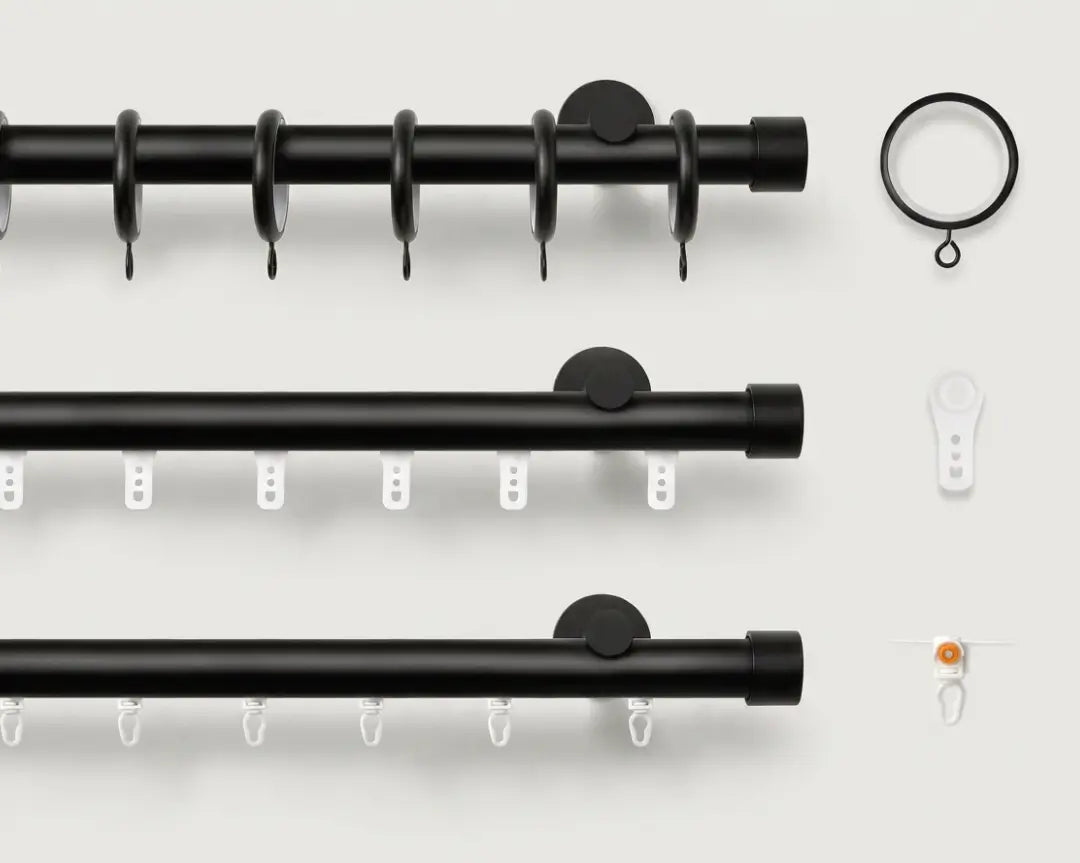
The catch nobody prints on the box: a center support interrupts a traversing pair. Rings stop dead at the bracket, so the panels of a center-split pair physically cannot cross it to meet. Bypass brackets and C-shaped rings exist as a workaround — they work, with added friction and fussy alignment. The clean solution is a track, where the carriers ride inside the channel and the brackets grip from above, leaving nothing in the fabric’s path.
That — not aesthetics — is the real reason wide runs migrate from rods to tracks. Tracks bring their own wide-window logistics: at roughly 96 inches and up they generally ship spliced, in two sections with a joiner, and manufacturer install guides call for a support bracket every 24 to 36 inches along the run, the tighter end for heavier fabric. Follow the chart in your track’s box rather than the minimum that looks tidy — a splice with its brackets too far away is where a wide track develops a click, or a sag of its own. The full rod-or-track decision, looks and budget included, is in curtain rods versus tracks.
One more thing belongs here, because it was engineered for exactly this situation. Once a wide run is on a track, ripple fold is the heading built for it: the wide-run specialist, turning a whole wall of fabric into one continuous, even wave with the most predictable stack of any full-height heading. We took that system apart — what it actually is, stack-back numbers by the foot, real US costs, who should skip it — in the ripple fold guide, so none of it needs repeating; if your run is ten feet or more and you intend to open it daily, read that one before you order anything.
What to hang on a wide run
Width rewards texture and punishes pattern. A print repeat has to be matched across every seam of every width — across six widths, that is yardage and labor spent persuading a pattern to behave — while a textured plain only gets more convincing as there is more of it. It is why the window walls in interior photography are so often linen: the slubs give the eye something at every scale, and no two widths have to agree on anything.
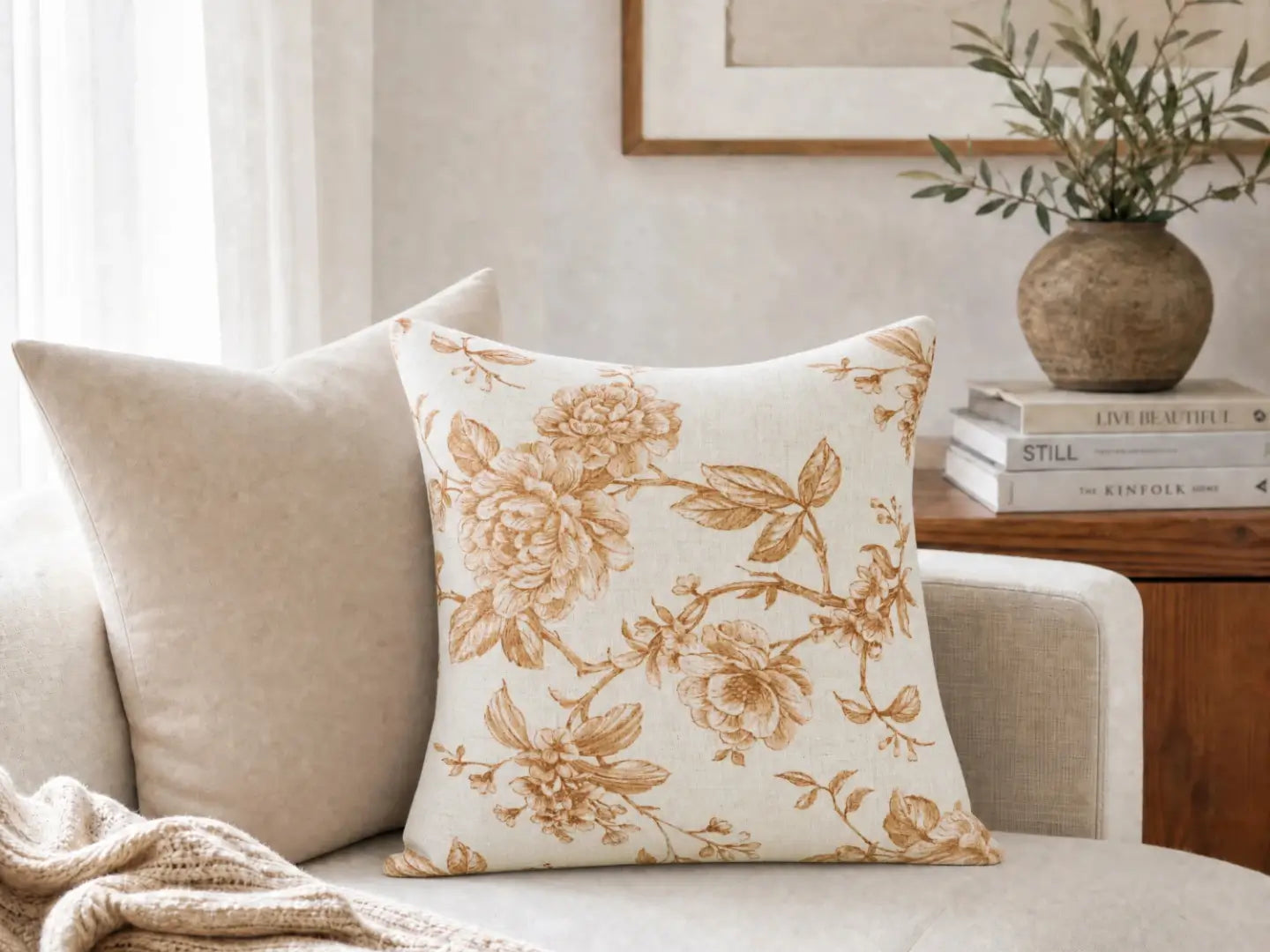
For the windows this article is about, you can also cut the problem down before it starts. Celina extra-wide linen is made to order at panel widths sized for large windows, so each half of a center-split pair arrives as one generously cut piece instead of a seam plan — the closest thing to skipping the math without railroading; the broader made-to-measure range is in Linen Curtains. Whatever you hang, measure the run, not the window, and measure it in more than one place — the sequence is in the step-by-step measuring guide. Length rules do not change just because width did: end just clear of the floor, or in a soft break, exactly as you would anywhere else.
One choice matters more on a wide run than a narrow one: what sits behind the face fabric. Lining adds the weight that keeps a long horizontal span hanging straight instead of rippling, and it is the difference between a wide window that looks tailored and one that looks like a bedsheet. Our guide to curtain lining — unlined, privacy, blackout and interlined lays out the four tiers and what each one changes.
Glossary
- Width (of fabric) — one bolt-width of goods, roughly 54 inches for drapery fabric. Workrooms plan and price wide curtains in widths, seamed edge to edge.
- Railroading — rotating fabric 90 degrees so the bolt’s length runs horizontally across the window; the route to a seamless wide sheer.
- Leading edge — the inner, handled edge of a panel, where a pair meets; by convention kept as a full, uncut width.
- Return — the short section at each end where the panel turns back to meet the wall, closing the side light gap.
- Stack (stack-back) — the width the open, gathered curtain occupies; plan on roughly a quarter to a third of the run.
- One-way draw — a layout in which the whole curtain travels in one direction to a single stack instead of splitting as a pair.
FAQ
How many curtain panels do I need for a wide window?
Work it as fabric first, panels second. Multiply the run by your fullness to get flat fabric, divide by the roughly 54-inch width of drapery goods, and you have the number of widths; panels are just how those widths get grouped. A 160-inch run at 2× fullness is about six widths — a pair of three-width panels if you draw them, or four to six slimmer fixed panels if you mostly don't. Decide the draw first, then divide.
Can curtains be seamless for a wide window?
Only two ways. Either the whole panel fits inside one width of goods — rarely true past a modest window — or the fabric is railroaded: turned sideways so the bolt's length runs across the window. Wide sheer goods are woven 110 to 118 inches wide for exactly this, which is why a seamless sheer is easy and a seamless blackout linen is not. Otherwise seams are normal, and well-placed ones disappear into the back of the folds.
Do wide curtains need a center support?
On a rod, yes. Every maker publishes an unsupported span, and a wide window is past it — especially under the weight of a multi-width pair. The catch is that a standard center support blocks the rings, so a pair that actually draws cannot cross it. Bypass rings work around it imperfectly; a track, supported from above along its whole length, removes the problem entirely — which is why wide traversing runs end up on tracks.
What is a one-way draw?
A configuration where the entire curtain travels in one direction and stacks on a single side instead of splitting into a pair. It suits sliding doors (stack on the fixed-glass side so the door stays usable), corner windows, and runs with usable wall on only one flank. The trade is symmetry for one clean sweep — and the full stack, roughly a quarter to a third of the run, lands on that one wall.
How much wall space do stacked curtains need?
Budget roughly a quarter to a third of the run being covered — the fuller and thicker the drapery, the closer to a third. A center-split pair divides that between the two sides, and a one-way draw puts all of it on one. To keep the glass clear when open, extend the hardware past the window so the stack stands on wall instead — assuming the wall exists, which is exactly why stack space is the first thing to plan.
Should wide-window curtains touch the floor?
The same length rules as any drapery: end just clear of the floor for daily use, or in a slight break for softer tailoring. Width changes only one thing: a long hemline makes floor slope visible, so measure the drop at several points along the run and cut to the plan, not to a single measurement.
If you’re dressing one
Decide the configuration first, budget the stack second, and only then order fabric. When you get there: Celina extra-wide linen is the made-to-order shortcut for large windows — one wide piece per side instead of a seam plan — with the rest of the made-to-measure range in Linen Curtains; for the seamless under-layer, the railroad-friendly options are in Sheer Curtains.