



















Blackout Curtains: Real Benefits, How They Work, and What Blocks 100%
“Blocks 99% of light” sounds like darkness, yet in direct sun that last 1% can put about 1,000 lux right behind the curtain, when sleep researchers recommend no more than about 1 lux at your eyes.
The short answer
Blackout curtains stop light with an opaque layer: a black-core triple weave (about 70–90% blocking), a foam coating, or a separate blackout lining (both can reach 100%). The US has no official definition of “blackout,” and decimals matter: in direct sun a 99% fabric still passes roughly 1,000 lux, while Japan's top grade (99.99%) passes 10 lux or less. The benefits that hold up are darker sleep, night privacy and modest heat control; with a true 100% fabric, any light left is coming around the edges.
Good fit if you sleep by day, face a streetlight or an early sunrise, or put kids to bed before summer sunset. Skip / reconsider if you only want softer daylight (room-darkening does that) or would keep them closed all day.
In this guide
- How do blackout curtains work?
- What does “100% blackout” actually mean?
- What are the real benefits of blackout curtains?
- Do blackout curtains block UV rays?
- Which fabrics block 100% of light?
- Why does a 100% blackout curtain still leak light?
- How do you make a room completely dark?
- The honest part
- Glossary
- FAQ
How do blackout curtains work?
A blackout curtain puts an opaque layer in the light's path, built one of three ways. A triple weave hides a black yarn core between colored face yarns; published figures put its blocking at roughly 70–90% (Textile Learner). A coated fabric carries layers of acrylic foam, called passes, on the back: a 2-pass coating (black plus a light coat) must face the window, while a 3-pass coating (white/black/white) works as face and lining in one (Wikipedia). A lined curtain hangs a separate blackout lining behind the face fabric, which is how linen-look, cotton-blend, chenille or velvet curtains become blackout (Vogue Fabrics).
| Construction | What stops the light | Blocking (fabric only) | Trade-off |
|---|---|---|---|
| Triple weave | Black core yarn | About 70–90% | Softest drape; light colors glow more |
| Coated | Foam layers on the back | Up to 100% (Textile Learner) | Durability claims are untested either way |
| Lined | Separate lining behind the face fabric | 100% at the fabric | Extra weight (about 11.5 oz per square yard for a premium 3-pass lining) |

Other lining types (unlined, privacy, interlined) are compared in our curtain lining guide.
What does “100% blackout” actually mean?
In the US, nothing official. There is no defined blackout measurement and no ASTM test method; the AATCC textile methods (TM148 and TM203) describe how to measure light through fabric, not what score earns the word “blackout” (Mermet).
Japan's interior-fabric industry grades blackout fabric with the JIS L 1055 test, which shines a lamp of about 100,000 lux, the top end of direct sun on a window, at the fabric (Kaken). Grade 1 must block at least 99.99%, Grade 2 at least 99.80% and Grade 3 at least 99.40%. At Grade 1 you can't read facial expressions; at Grade 3 you can see faces, but it's too dark for desk work. Europe's EN 14501 calls a fabric “black-out” only if no light is visible through it at 100,000 lux (Mermet).
Approximate light passing right behind the fabric:
| Fabric blocks | Direct sun (100,000 lux) | Bright daylight, no direct sun (10,000–25,000 lux) |
|---|---|---|
| 99% | About 1,000 lux | About 100–250 lux |
| 99.4% (Japan Grade 3 minimum) | About 600 lux | About 60–150 lux |
| 99.8% (Grade 2 minimum) | About 200 lux | About 20–50 lux |
| 99.99% (Grade 1) | 10 lux or less | About 1–2.5 lux or less |
Our arithmetic on the grade thresholds. Sun and daylight levels from Mermet's measurement guide.
For scale, a consensus of sleep and circadian researchers sets a ceiling of about 1 lux at the eye for sleep (Brown et al., 2022). These are values behind the fabric, not room averages. And a label doesn't guarantee a grade: when Mermet tested popular “blackout” fabrics under 100,000 lux with a camera, many blocked only 80–90%.
Room-darkening curtains sit a step below: our Liora velvet curtains, for example, block 70–85% of light. To choose between blackout, room-darkening and sheer room by room, see our blackout vs. room-darkening vs. sheer guide.
What are the real benefits of blackout curtains?
Sleep has the strongest evidence. Privacy is a given, heat control is modest, and the noise claims are mostly marketing.
Sleep: the lab evidence
- In 116 adults aged 18–30, room light under 200 lux before bed delayed melatonin onset in 99% of them and shortened melatonin duration by about 90 minutes (Gooley et al., 2011).
- One night sleeping in 100 lux raised heart rate, lowered heart-rate variability and increased next-morning insulin resistance in 20 adults, compared with under 3 lux (Mason et al., 2022).
- All-night dim light of 5–10 lux meant more awakenings and lighter sleep in 23 men (Cho et al., 2016).
The American Academy of Sleep Medicine advises a dark bedroom, with blackout curtains or an eye mask if it's too bright (AASM). For shift workers sleeping by day, NIOSH wants a room “so dark you cannot see your hand in front of your eyes” (NIOSH).
Young children respond to very little light: in 36 preschoolers, an hour of 5–40 lux before bed suppressed melatonin by 77.5% (Hartstein et al., 2022), which matters when bedtime comes before a summer sunset. No study we found tested blackout curtains on children's sleep directly; for setups, see our kids' room curtain ideas.
The bigger health claims: associations, not proof
Links to depression, weight gain and diabetes come from observational studies. They show associations, not proof that curtains prevent disease:
- Among 863 older adults, bedrooms at 5 lux or more at night were associated with more new depressive symptoms (hazard ratio 1.89) (Obayashi et al., 2018).
- Among 43,722 US women, sleeping with a TV or light on was associated with a 17% higher risk of gaining 5 kg, about 11 lb (Park et al., 2019).
- Among 552 older adults, light at night was linked to obesity, diabetes and hypertension, though the authors call reverse causation plausible (Kim et al., 2023).
Heat and cold: real, but modest
Per the U.S. Department of Energy's Energy Saver guidance (archived copy), medium-colored draperies with white-plastic backings can reduce heat gains by 33% on sunny windows, and most conventional draperies cut heat loss by up to 10% in cold weather. Interior coverings trail exterior shading because the sun is already through the glass (PNNL). The full numbers live in our thermal curtains guide and our thermal vs. blackout comparison for drafts.
Privacy yes, quiet not really
The DOE counts privacy among the core benefits of window coverings, and an opaque layer hides lit-room silhouettes after dark, which sheers can't. Noise is another story: even curtains sold as “soundproof” cut measured noise by only 5–10 dB in a test of seven sets (Bob Vila), and we found no published sound ratings for ordinary blackout drapes.
Do blackout curtains block UV rays?
While they're closed, very little UV should get through an intact blackout layer, but we found no independent test measuring it, so treat “blocks 100% of UV” as a seller's claim. Visible light fades color too, so blocking UV alone doesn't stop fading (Canadian Conservation Institute). A closed curtain blocks both, but only while closed; where you want daylight, the DOE points to window film. More in our guide to UV and fading.
Which fabrics block 100% of light?
Any face fabric can, with a blackout coating or lining behind it: construction beats fiber (Textile Learner). Weight isn't the test either. Blackout fabrics run about 180–400 GSM, and coated fabric can reach 100% at around 180–200 GSM. Color matters mainly for woven or thinly backed fabric: in Mermet's test, a white-on-white colorway blocked 89% while its other colorways blocked 98–100% (Mermet).
| The look you want | How it gets to 100% | Examples in our range |
|---|---|---|
| Linen-look | Coating or lining | Faye: coated, linen-look (10% coating, 90% polyester), 250 GSM. Isadora (240 GSM) and Saphira (250 GSM): linen-look, listed as 100% blackout; construction not specified. |
| Cotton-blend | Lining | Nolissa: 35% cotton, 65% polyester crossweave, 100% blackout lining, 242 GSM |
| Chenille | Lining | Arlise: chenille, 100% blackout lining, 256 GSM |
| Velvet | Lining; velvet alone may fall short | Brynna: devoré velvet, 100% blackout lining, 320 GSM. Liora velvet, by contrast, blocks 70–85%. |
| Triple weave | Usually doesn't (about 70–90%) | Check the rating; choose darker colors |
These are construction examples, not a ranking. For picks, see our best blackout curtains for complete darkness; for looks, our guide to styling blackout curtains in every room.
Why does a 100% blackout curtain still leak light?
Because the fabric is only part of the system, and light goes around it: over the rod, down the sides, under the hem and through the center seam. Europe's 2021 darkening-performance scale under EN 14501 reflects this by rating the installed system (fabric, blind design, installation and window size) from 0 to 4, with class 4 near blackout (Louvolite).

No independent study we found measures how much light edge gaps add. But if 5–10 lux of all-night light can fragment sleep, a bright seam down the side can matter more than a fabric's last 0.01%.
How do you make a room completely dark?
Close the four gaps, then test. The DOE's advice for energy-saving drapes doubles as a blackout checklist: close to the window, down to the sill or floor, a cornice or ceiling mount on top, sides sealed and the center overlapped with Velcro or magnetic tape (DOE Energy Saver). The measurements below follow common installation guidance (Family Handyman; Bob Vila).
- Go wide. Extend the rod 3–6 inches past the frame on each side (for blackout, stay at the wide end) so the panels overlap the wall.
- Go high. Mount it 4–6 inches above the frame or near the ceiling; a ceiling mount or cornice closes the top.
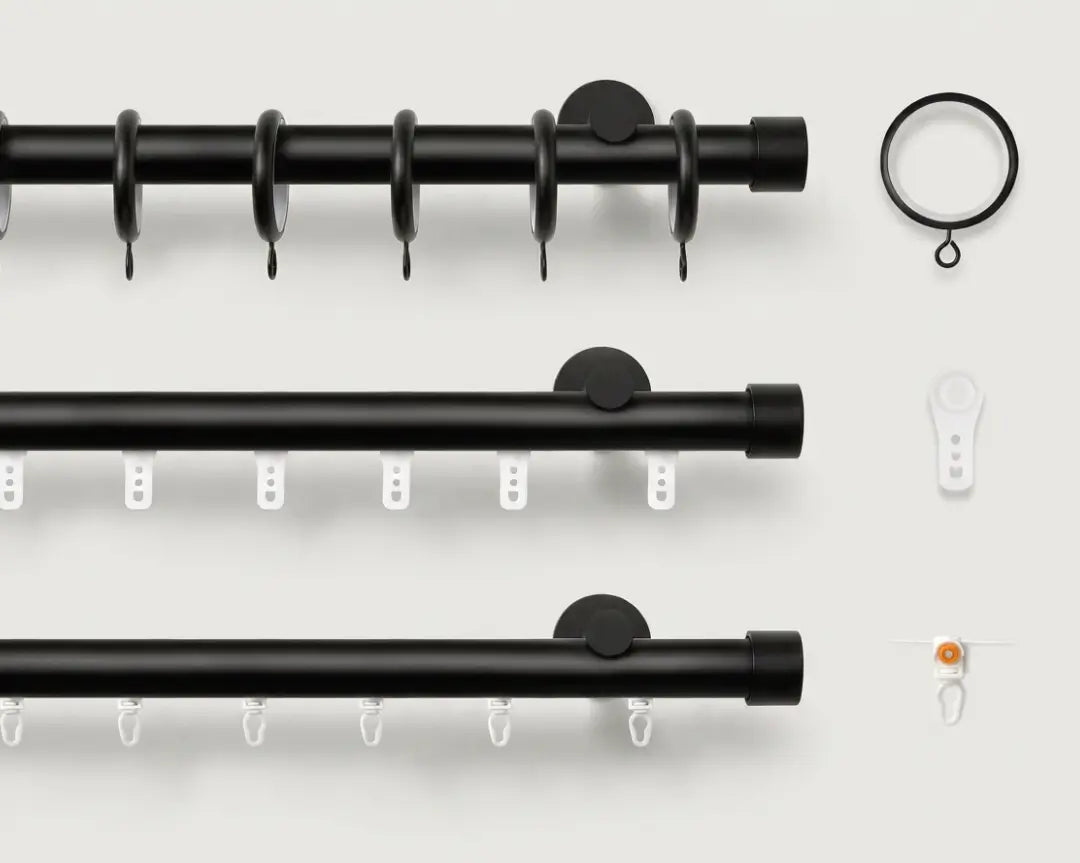
- Wrap the sides. A wraparound (return) rod or ceiling track turns the curtain back to the wall. See curtain rods vs. tracks.
- Overlap the center. Panels that only meet leave a bright seam.
- Reach the floor. Let the hem reach the floor so no light spills under it.
- Add a roller underneath. A blackout roller inside the frame, with the curtain covering its side gaps, is the belt-and-suspenders setup; a cassette header, as on our Fionis motorized blackout roller shade, covers the roll at the top. Shade options: light-filtering vs. blackout shades.
Made-to-measure makes this work: panels are cut to cover the window width plus both extensions, both returns and the center overlap, down to the floor. Renting? See our no-drill guide for renters.
Then test it. Turn off the lights, let your eyes adjust for 5–10 minutes, and look for glow and pinholes (Mermet). NIOSH's bar: you shouldn't be able to see your hand.
The honest part: where blackout curtains fall short
- Coatings are debated. Some sellers say coatings crack, flake or get pinholes after washing and sun; we found no independent test either way, nor any off-gassing study. Air new panels out and follow the care label.
- They're heavy. A premium 3-pass lining alone weighs about 11.5 oz per square yard (Vogue Fabrics), and the blackout curtains in this guide are listed at 240–320 GSM. Use a sturdy rod and enough brackets.
- Washing can shrink them. One budget blackout lining lists 3–5% residual shrinkage (Roc-lon), enough to lift a floor-length hem and reopen the bottom gap. The curtains in this guide are labeled gentle machine wash or dry clean, no bleach, air dry.
- They can worsen condensation. A closed covering slows airflow across the glass, and the pane cools down (PNNL). Control humidity and open them by day; PNNL's ½-inch gap under a shade trades a little light for airflow.
- They heat the glass in summer. Indoor drapes can raise the temperature of the glass behind them (Vitro). Don't aim heating or cooling vents at that glass, and prefer a light backing facing the window.
- They cost you daylight. The DOE notes that 75% of window coverings never move, and advises opening sunny windows in winter. If you won't open them daily, layer a sheer in front or put a motorized shade on a schedule.
Glossary
Blackout: fabric meant to stop visible light. No US standard defines the percentage.
3-pass coating: white, black and white layers of acrylic foam that let one fabric serve as face and lining.
Lux: how much light falls on a surface. Direct sun on a window can reach 100,000 lux.
JIS L 1055: the Japanese test behind blackout Grades 1–3.
EN 14501: the European standard defining “black-out” and “dim-out” fabric.
Return: the end of a rod or track that turns back to the wall.
GSM: grams per square meter, a fabric's weight.
FAQ
Do blackout curtains really work?
On the fabric, often; for the whole room, only with help. In one manufacturer's test at 100,000 lux, many popular blackout fabrics blocked just 80–90%, and even 100% fabrics leak around the edges unless the fit closes the gaps.
Are blackout curtains worth it?
For day sleepers, shift workers and bright bedrooms, yes: the American Academy of Sleep Medicine and NIOSH both point to blackout curtains or shades. They're worth less if you only want softer daylight or would keep them closed all day.
What is the best material for blackout curtains?
Construction beats fiber. Linen-look, cotton-blend, chenille or velvet can all block 100% of light with a foam coating or blackout lining behind them. Polyester triple weave drapes softly but typically blocks about 70–90%, and light colors leak more.
Do blackout curtains keep cold out?
A little. Per the U.S. Department of Energy, most conventional draperies reduce heat loss by up to 10% in cold weather, and sealing the sides and overlapping the center helps. For drafty windows, compare thermal curtains.
Will making your bedroom darker improve sleep?
Probably, if it's bright now. In a lab study, 5–10 lux of all-night light caused more awakenings and lighter sleep, and researchers recommend no more than about 1 lux at the eye during sleep.
Do blackout curtains make window condensation worse?
They can. A closed covering slows airflow across the glass, so the pane runs colder and moisture can condense on it. Control indoor humidity, open the curtains by day, and wipe away any water that collects.
Do blackout curtains block noise?
Only slightly. Even curtains sold as soundproof cut measured noise by just 5–10 dB in a test of seven sets, and we found no published sound ratings for ordinary blackout drapes. Treat any quieting as a bonus.
Ready to measure? Browse our blackout curtains, choose your width and length on the product page for a live price, and order free swatches to see the color and texture in your own light.