




















How to Layer Curtains: Sheer and Blackout on One Window
Layered curtains are the most-photographed and least-explained treatment in the house. Every image shows the finished look; almost none show the bracket holding it up, which is the part that decides whether you can actually do it at your window.
The short answer
Layering means two independent panels on two independent tracks: a sheer closest to the glass for daytime light and privacy, and an opaque or blackout panel in front for night. The sheer always goes at the back.
You need a double rod, two single rods at different projections, or a double track — and about 2–3 inches more wall clearance than a single layer. Skip it on shallow reveals, on doors you use daily, and on windows where you only actually have one problem to solve.
In this guide
- Which layer goes in front (and why)
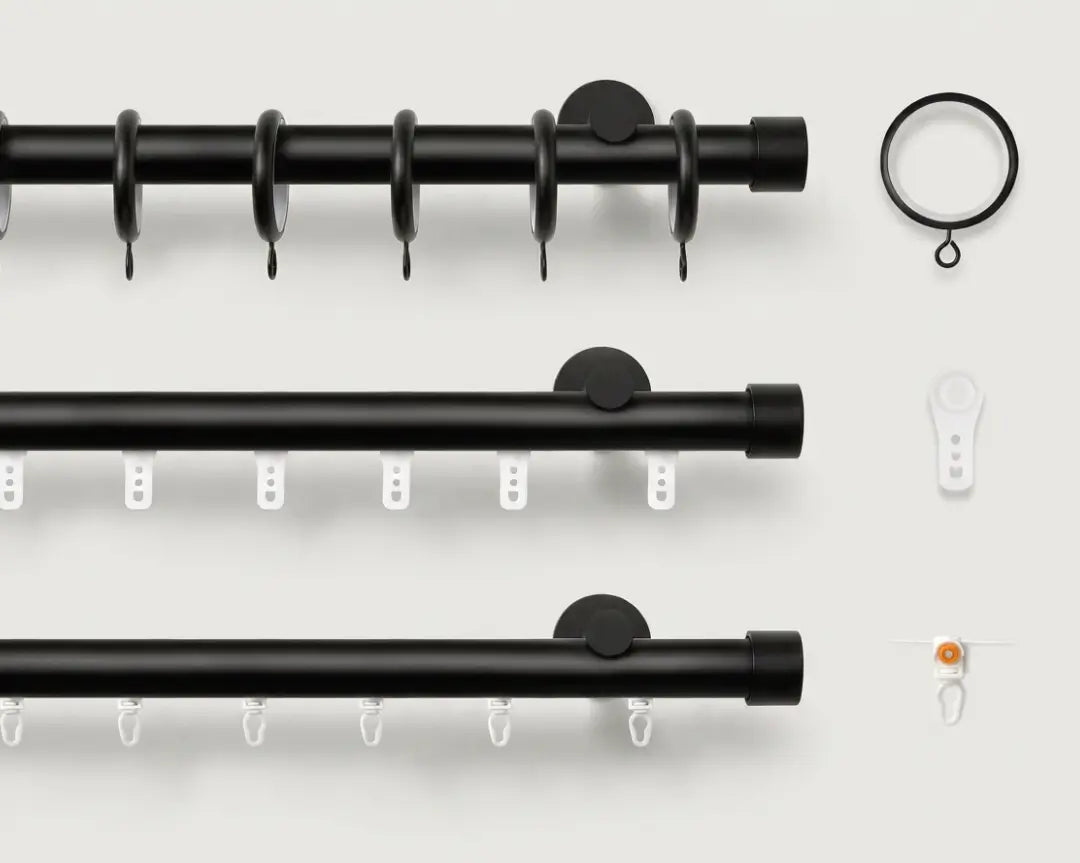
- The hardware: three ways to hold two layers
- Measuring for two layers
- Choosing the pair
- When not to layer
- FAQ
Which layer goes in front (and why)
Sheer at the back, against the glass. Heavy panel in front, toward the room. This is not a stylistic preference, and getting it backwards causes three separate problems.
- Daytime function. The sheer is the layer you leave closed all day. It has to be the one touching the glass so it can diffuse incoming light and blur the view in before the heavy panel is involved at all.
- Night-time function. The opaque panel is the one you close after dark. Closing a heavy panel behind a sheer means the sheer sits in front of a dark surface, which makes it look grey and lifeless.
- The stack. Drawn open, the front panel stacks outboard and frames the window; the sheer stacks behind it and disappears. Reverse them and your bulky panel is the thing peeking out from behind a thin one.
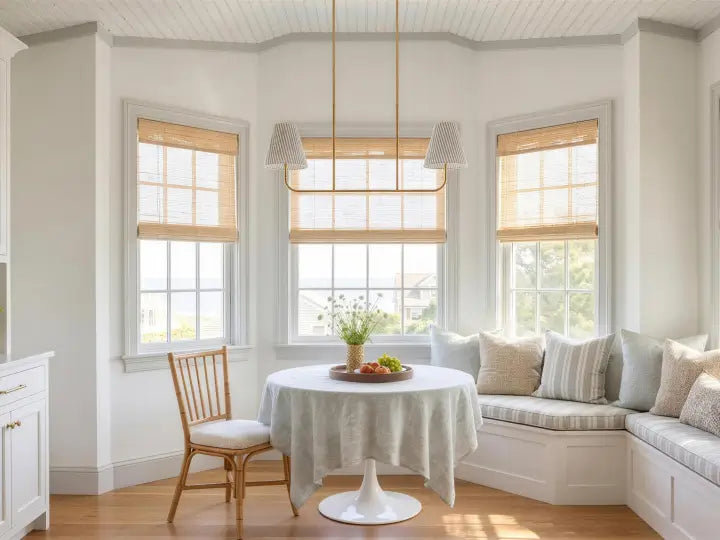
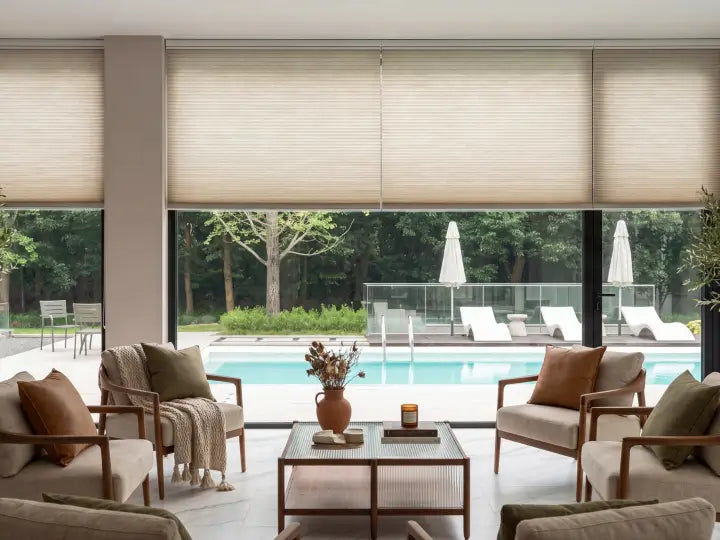
One useful exception: if you are layering a shade rather than a sheer — a Roman or cellular shade inside the window reveal with curtains outside it — the same logic applies with the shade taking the sheer's place at the back. That combination is also the strongest one for insulation, because the shade seals the opening and the curtain adds mass.

The hardware: three ways to hold two layers
This is where most layering plans fail, because the decision gets made after the fabric is ordered instead of before.
| Option | When it is right |
|---|---|
|
Double rod (one bracket, two rods) |
The default, and the tidiest. One set of brackets carries both rods at a fixed spacing, so the layers cannot collide. Choose this unless something specifically rules it out. |
|
Two single rods (different projections) |
When you want the layers at different heights, or different rod diameters and finishes. More holes in the wall, more chances to get the spacing wrong, but total freedom. |
| Double track | Ceiling mounts, very wide spans, heavy panels, and anything motorised. Tracks glide better than rings on a pole and hide the hardware completely. |

Our Collins double decorative rod is the straightforward version of this, cut to your width. If the span is wide, the panels are heavy, or you want the layers motorised later, read rods versus tracks before you buy — that decision is much more annoying to reverse than a fabric choice.
A note for anyone hoping to skip the hardware question: you cannot reliably layer two panels on one rod. They fight each other every time you draw them, the sheer gets dragged along with the heavy panel, and the stack becomes a single fat bundle. If the wall genuinely cannot take a double rod, layer a shade inside the reveal instead and hang one curtain outside it.
Measuring for two layers
Two layers are not simply two of the same measurement.
- Projection. The front rod needs to clear the back panel, its rings, and its stack. Allow roughly 2–3 inches more total projection than a single layer, and check that nothing collides with a handle, crank, or deep sill.
- Width, twice. Both layers need their own fullness. A sheer looks best generous — it is the layer whose gathers you actually see lit up — so do not skimp on it to save money. The trade-offs between 1.5x and 2x are worked through in our fullness comparison.
- Stack-back doubles. Two layers park two stacks beside the window. Mount the rod wider than you think, or the pair will cover a slice of glass even fully open.
- Length. Both layers should finish at the same point. A sheer that stops short of the front panel reads as a mistake rather than a choice.
Choosing the pair
The pairing that works almost everywhere is a light, textural sheer with a heavier plain panel — the sheer supplies the softness, the front panel supplies the weight and the colour. Two patterns rarely survive contact with each other; two flat solids look like a hotel.
- For privacy plus darkness: a semi-sheer behind, blackout in front. This is the bedroom default and the reason layering exists.
- For light control without darkness: a sheer behind, a light-filtering linen in front. Softer, and better in living rooms where full blackout would feel oppressive.
- For warmth: put a shade at the back rather than a sheer — the seal is what does the insulating.
Worth knowing before you rely on the sheer for daytime privacy: sheers behave very differently by day and by night, and the difference surprises people. Our guide to whether you can see through sheer curtains covers exactly when the sheer stops working. And if the front layer is doing the darkening, light filtering versus blackout explains the two numbers that get confused.
When not to layer
Shallow reveals and obstructed windows. If a casement crank, a deep sill, or a door handle sits where the front rod needs to be, layering will annoy you daily. One well-chosen panel beats two badly-clearanced ones.
Doors you actually use. On a patio or balcony door you pass through several times a day, two layers means moving two things every time. Most people quietly stop using the sheer within a month.
Windows with only one problem. Layering solves two problems — daytime light and night-time privacy. If your window only has one, you are buying and dressing a second panel to solve nothing. A north-facing bathroom that needs privacy full stop does not need a sheer behind the privacy panel.
Budgets that would rather be spent on quality. Two mediocre layers usually look worse than one excellent one. If the money only stretches one way, buy the better single panel.
FAQ
How do you layer curtains?
Hang two independent panels on two independent tracks: the sheer closest to the glass on the back rod, the opaque or blackout panel in front on the outer rod. Use a double rod, two single rods at different projections, or a double track — not two panels on one rod, which makes the layers fight each other. Allow roughly 2–3 inches more projection than a single layer so the front panel clears the back one's stack.
Which curtain goes in front, sheer or blackout?
Blackout in front, sheer at the back against the glass. The sheer is the layer you leave closed all day, so it needs to be the one diffusing incoming light; the blackout is the layer you close at night. Reversed, the sheer sits in front of a dark panel and reads grey, and the bulkier panel stacks awkwardly behind the thinner one.
Can you put sheer and blackout curtains on one rod?
Not well. On a single rod the two layers share the same rings and the same travel, so they drag each other along, bunch into one thick stack, and cannot be operated independently — which defeats the entire purpose. Use a double rod, two singles, or a double track. If the wall cannot take a double rod, put a shade inside the reveal and one curtain outside it.
Do you need a special rod to layer curtains?
You need two tracks, which usually means a double rod — one bracket carrying two parallel rods at a fixed spacing. Two separate single rods at different projections also work and give you more freedom over height and finish, at the cost of more holes and more chances to misjudge clearance. For wide spans, heavy panels, ceiling mounting, or motorisation, use a double track instead.
How much space do you need between layered curtains?
Enough for the front rod to clear the back panel plus its rings and gathered stack — in practice about 2–3 inches of additional projection over a single layer. Check for obstructions at that depth before you buy: casement cranks, deep sills, and door handles are the three things that most often make a layered plan unworkable.
Is layering curtains worth it?
When the window has two problems, yes: layering is the only way to get soft daylight and full darkness from the same window. When it has one problem it is an expensive way to solve nothing, and on doors you use daily most people stop drawing the second layer within a month. Two mediocre layers also tend to look worse than one excellent panel.
If you are putting a pair together
Buy the hardware first — a double rod or track sized to your wall, then the panels to suit it. For the back layer our sheer curtains keep the daylight and lose the view in; for the front, the blackout range is where the darkness comes from.
