
















Light Filtering vs Blackout Shades: The Two Numbers People Confuse
Two different measurements get printed on shade listings in the same place, in the same format, and they mean completely different things. That is why people buy a 5% shade for a bedroom and are unhappy with it.
The short answer
Opacity is about darkness. Light filtering blocks under about 95% of light, room darkening lands roughly 95–99%, blackout aims at 100%. Openness factor is a different scale entirely — it describes how open the weave is, so 1% is a tight weave with almost no view and 10% is loose with a clear view. It controls glare and view, not darkness.
The trap: a solar shade with an openness percentage is never a blackout product, no matter how low the number goes. If you want a dark bedroom, you want an opacity label, not an openness one.
In this guide
- The two systems people confuse
- System 1: opacity — how dark it gets
- System 2: openness — how much you see
- The night privacy trap
- The halo no shade fixes
- Which one per room
- Glossary
- FAQ
The two systems people confuse
Open two shade listings side by side and you will see numbers that look like the same kind of fact. One says "3%". The other says "blocks 99% of light". They are not points on one scale, and reading them as if they were is the single most common shade-buying mistake.
| Opacity | Openness factor | |
|---|---|---|
| Measures | How much light the fabric stops | How much of the fabric area is holes |
| Reads as | Light filtering / room darkening / blackout | 1%, 3%, 5%, 10% |
| Controls | Darkness, and therefore sleep | Glare, heat and how much you can see out |
| Lower number means | n/a — the label is a word, not a number | Tighter weave: darker, more private, less view |
| Good for a bedroom? | Yes — this is the scale you want | No. Even 1% is not blackout |
Solar shades — the ones sold by openness factor — are a daylight-management product. They are not blackout products at any openness level. If sleep is the job, that whole scale is the wrong aisle.
System 1: opacity — how dark it gets
Three labels, and the honest version of what they mean:
| Label | Light blocked (typical) | What the room feels like |
|---|---|---|
| Light filtering | under about 95% | Daylit but soft. Shapes outside disappear; the glow stays |
| Room darkening | roughly 95–99% | Dim, not dark. You can still tell it is daytime |
| Blackout | aiming at 100% through the fabric | Dark in the middle, bright at the edges — see below |
These numbers are not standardised. One retailer's "room darkening" is 95–99%; another's is 70–85%, with blackout starting at 85%. There is no industry body policing the words. Treat the label as a direction, and ask for the actual figure — or a sample — when the difference matters.
That inconsistency is worth taking seriously in exactly one situation: a room where somebody is trying to sleep past sunrise. For a napping toddler or a shift worker, the distance between 85% and 100% is not a rounding error — it is the difference between waking at five and waking at seven. Everywhere else, the labels are close enough to shop by.
The equivalent question on the curtain side — where the same three words get used about fabric and lining rather than about a shade — is laid out in blackout vs room darkening vs sheer curtains.
System 2: openness — how much you see
Openness factor is the percentage of the fabric surface that is hole rather than yarn. A 1% fabric is 99% solid. It is a weave specification, and it behaves in a straight line: tighter weave, darker room, more privacy, less view.
| Openness | View out | Where it belongs |
|---|---|---|
| 1% | Heavily restricted | Harsh west or south exposure; screen work where colour accuracy matters. Blocks around 99% of UV |
| 3% | Recognisable but softened | The popular default. Cuts heavy glare, keeps a usable view, around 97% of UV blocked |
| 5% | Clear enough to enjoy | Rooms where the view is the point and glare is secondary |
| 10% | Almost unobstructed | Mild exposures and covered porches, where daylight beats solar control |
Two practical notes. Most homes are well served starting at 3–5%; go down to 1–3% only when glare or west sun is the actual complaint, and up to 10% only when the view outranks everything. And fabric colour matters less than people expect for UV — a 3% white and a 3% charcoal block roughly the same amount — but it matters a lot for feel: pale fabric bounces heat away and glows, dark fabric absorbs heat and gives a crisper view with better glare control.

The night privacy trap
This is the part that catches people, and it is pure physics rather than a product flaw.
During the day, outside is brighter than inside, so you see out and nobody sees in. After dark with the lamps on, that reverses: inside is now the bright side. A woven shade that felt perfectly private at noon becomes see-through from the street at nine in the evening, and anything at 5% openness or higher gives a clear view in.
So a solar or woven shade is a daytime instrument. If the window faces a street or a neighbour and you use the room after dark, plan a second layer: a blackout or room-darkening shade behind it, or a curtain over it. The same day-versus-night reversal governs sheer curtains, worked through in detail in can you see through sheer curtains, day vs night.
The halo no shade fixes
Buy the darkest fabric made and you will still get a bright outline. Light does not come through a blackout shade; it comes around it — down both sides where the fabric is narrower than the opening, and over the top where the roller or headrail sits.
The fix is never a better fabric. It is the mounting:
- Mount outside the frame, wider and higher than the opening, so the fabric overlaps the wall rather than sitting in a channel of daylight.
- Add side channels if you want genuine darkness — this is what turns "dark-ish with bright edges" into an actually dark room.
- Cap the top with a cornice, a recessed pocket, or a curtain hung above the shade.
Which is exactly why the two-layer answer keeps winning: the shade does the fabric's job at the glass and a curtain closes the edges at the wall. We made that case across all three treatment types in curtains vs blinds vs shades, and the lining side of it is in curtain lining explained.

Which one per room
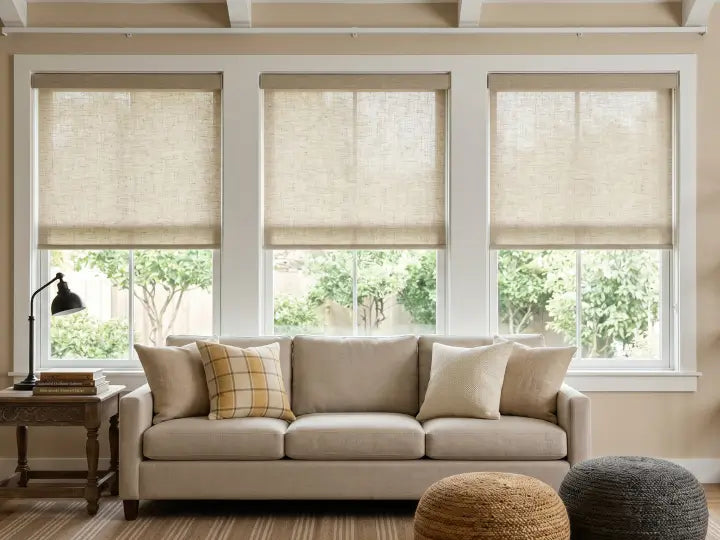
Bedroom. Room darkening at minimum, blackout if anyone sleeps past sunrise. Mount outside the frame. If the room also needs daytime privacy without darkness, layer a light-filtering shade under a blackout curtain rather than fighting to make one product do both.
Nursery. Blackout, and go further on the mounting than you would for an adult — naps happen at midday, which is the hardest light to beat. Cordless operation is the other non-negotiable here.
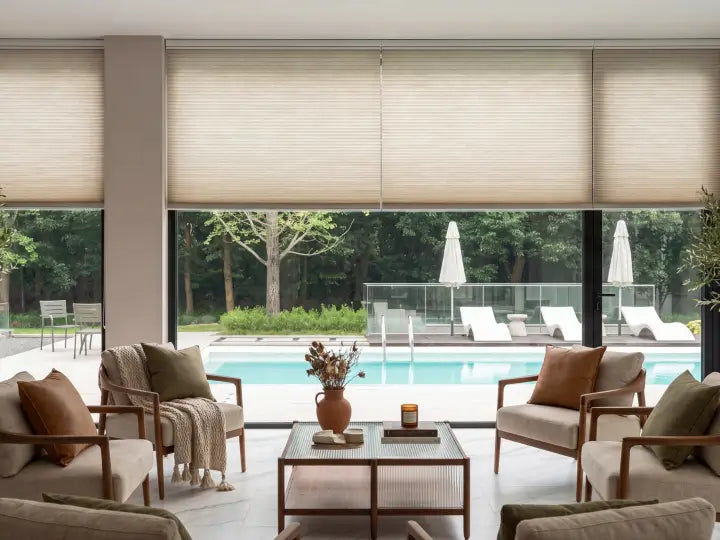
Living room. Light filtering. This is the room the label was invented for: glare gone, daylight kept, shapes outside blurred. The Avenia cordless cellular shades sit here, and the cellular build brings insulation with it — the head-to-head against a thermal curtain is in honeycomb shades vs thermal curtains.
Home office. A 1–3% solar shade if screen glare is the problem, because that is a view-and-angle issue rather than a darkness one. Add a room-darkening layer only if the room doubles as a guest bedroom.
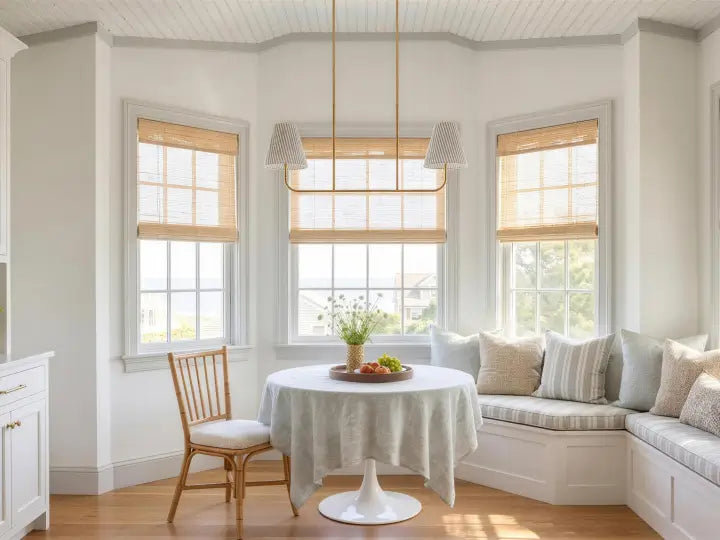
Kitchen and dining. Light filtering, or a woven wood shade if you want the warmth — the Seris jute-bamboo shade filters daylight into something softer than any flat fabric manages. Remember the night rule: pair it if the window faces neighbours.
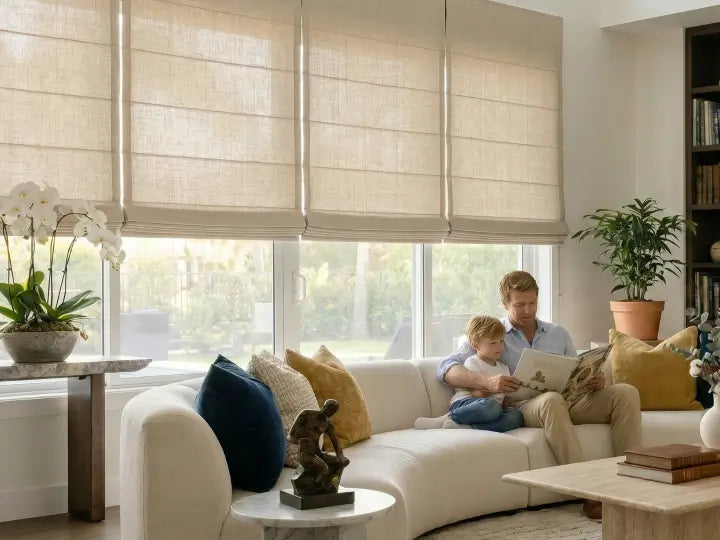
Anywhere the shade is the decorative element. A fabric Roman like the Elara linen-blend Roman shade reads as textile rather than equipment, and can be specified in either opacity.
Before you order
Decide which scale your problem lives on first — darkness or glare — then shop only that scale. Browse the full range in shades & blinds: cellular for light filtering plus insulation, woven wood for filtered warmth, Roman when it should read as fabric. And when sleep is the job, plan the blackout curtain layer at the same time, not later.
Glossary
- Opacity — how much light a fabric stops. Expressed as words: light filtering, room darkening, blackout.
- Openness factor — the percentage of a woven shade's surface that is open weave rather than yarn. 1% is tight, 10% is loose.
- Solar shade — a shade specified by openness factor, built to manage glare, heat and UV while keeping some view. Never a blackout product.
- Side channels — tracks fitted down both sides of the window that capture the shade's edges and close the light gap.
- Inside vs outside mount — fitted within the frame, or fixed to the wall beyond it. Outside mount is what removes the halo.
- Dual shade — two fabrics on one headrail, usually a solar and a blackout, so one window covers both jobs.
FAQ
What is the difference between light filtering and blackout shades?
Light filtering fabric lets daylight through while blurring anything outside — typically blocking under about 95% of light. Blackout fabric aims to stop essentially all light through the material. The middle label, room darkening, usually sits around 95–99%, though the numbers are not standardised between retailers. All three describe the fabric only, not the finished room.
What does openness factor mean on a shade?
It is the share of the fabric surface that is open weave rather than solid yarn. A 1% fabric is 99% solid: dark, private, very little view. A 10% fabric is loose: bright, clear view, little solar control. Most homes start well at 3–5%, dropping to 1–3% only when glare or a hot western exposure is the real complaint.
Is a 1% solar shade the same as blackout?
No. Openness and opacity are different scales. A 1% weave is tight enough to cut most glare and around 99% of UV, but light still passes through the fabric and the room stays clearly daylit. If you need darkness, buy on the opacity scale — light filtering, room darkening or blackout — not on openness.
Can people see through shades at night?
Through woven and solar shades, yes. Privacy depends on which side is brighter, so a shade that hides your room at noon reverses after dark once the lamps are on, and anything at 5% openness or above gives a clear view in from outside. For a street-facing room used in the evening, plan a blackout layer or a curtain over the shade.
Is room darkening enough for a bedroom?
For many people yes, for early risers no. Room darkening leaves a dim but readable room, which suits anyone who wakes with the alarm rather than the sun. For shift workers, light-sensitive sleepers and napping toddlers, choose blackout and pay attention to the mounting — the fabric grade matters less than closing the edges.
Why does light still come in around my blackout shade?
Because it is coming around the fabric, not through it. An inside-mounted shade sits in a channel narrower than the opening, so daylight runs down both sides and over the headrail. Mount outside the frame, wider and higher than the opening; add side channels and a cornice or curtain above if you want a genuinely dark room.
Still choosing between categories rather than opacities? Start one level up with curtains vs blinds vs shades, then come back here to pick the number.
