









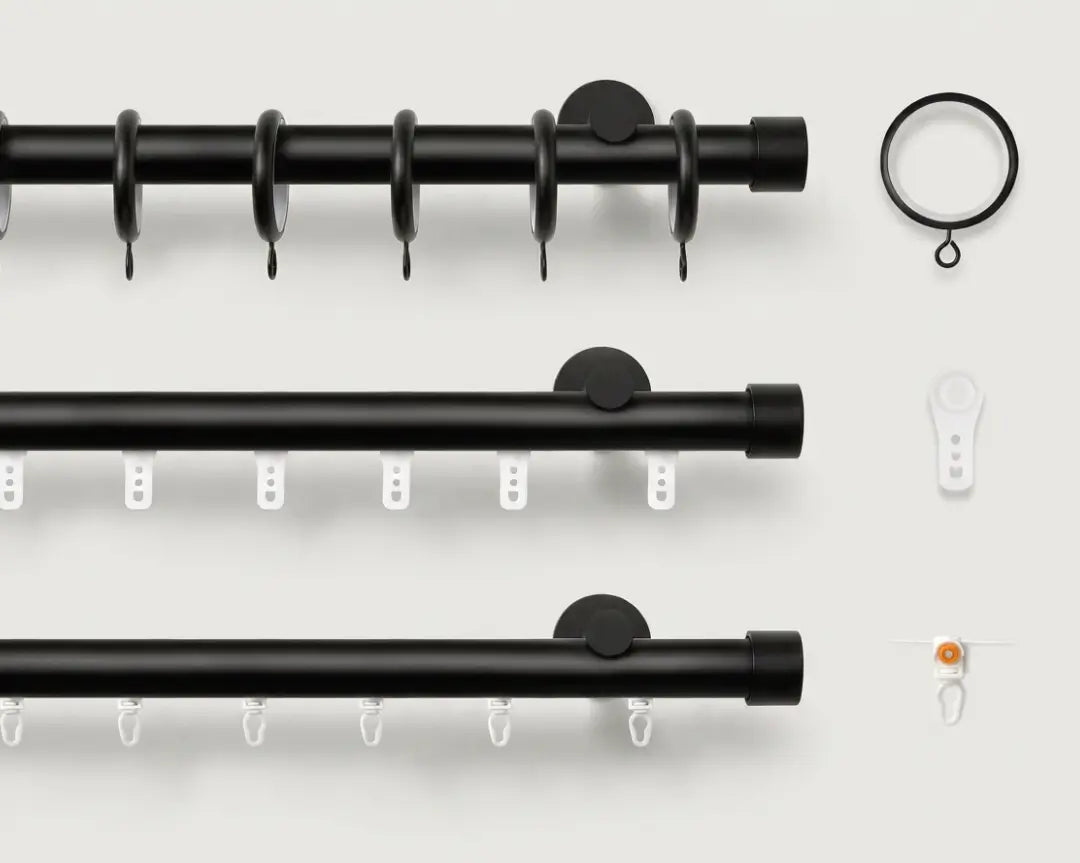









Bay and Corner Window Curtains: Tracks, Rods, and the Gap Problem
A bay window is usually the best light in the house, and it is always the hardest hardware problem in it. Rods and tracks leave the factory straight; your bay is not — and what happens at the two places where the hardware has to change direction decides whether the whole treatment works.
The short answer
Bay and corner windows have one problem, repeated: flat hardware meeting angled glass. Every seam between hardware sections becomes one of two failures — a light gap the fabric cannot cover, or a dead stop the curtain cannot travel past. There are three real ways to bridge the angles: a segmented traverse rod with corner connectors, a track bent to the bay in one continuous run, or one straight rod per facet.
Choose by travel. If you draw the curtains daily and want one pair to sweep the whole bay, you need the segmented traverse rod or the bent track. If the panels are mostly decorative, one rod per facet is honest and cheap — provided you can live with fabric doubling up in the corners.

In this guide
- What the geometry does to the hardware
- The three real solutions, compared
- Can your bay be curved? A per-system question
- Corner windows: turn the corner, or meet in the middle
- Mounting, window seats, and measuring
- What custom bay hardware costs
- FAQ
What the geometry does to the hardware
Three window shapes cause nearly all of the trouble here, and they punish hardware differently.
A canted bay — the classic three-facet bay — has a wide centre window parallel to the wall and two angled side windows returning toward the house. The joints between facets are gentle, most commonly around 135 degrees. Gentle matters: a shallow change of direction is something a well-made traverse system can carry gliders through, which is why the canted bay is the most solvable shape on this list.
A boxed bay squares that off: the side facets return at 90 degrees, like a shop window. Square corners are far harder on anything that travels — a right angle is beyond what most carriers will turn through — so boxed bays usually end up treated facet by facet, or with a track whose maker explicitly rates it for tight bends.
A true corner window is different again: two glass walls meeting, often glass-to-glass with no frame at the junction at all. There is only one joint, but it is the tightest kind, and it sits exactly where the eye goes.
Hardware is made straight, so every change of direction has to be manufactured: a connector, a factory bend, or simply a break between two separate rods. And each of those joints resolves one of two ways. Either the hardware is continuous but the curtain cannot pass the joint — a travel stop, stranding fabric on one side of it — or the hardware ends and restarts, which fabric can never quite cover: a light gap, and after dark a lit seam running down your bay. Every bay window scheme is, at bottom, a decision about which of those two failures you refuse to accept.
There is a quieter problem too: brackets. Wall-fixing near an angled joint means two brackets arguing over the same few inches of frame. Hold that thought — it is most of the reason ceiling mounting keeps coming up below.
The three real solutions, compared
Strip away the marketing and there are exactly three ways to dress a bay, which makes them easy to compare honestly. If you are still weighing rods against tracks in general — visible hardware versus a clean line — that is a different question, and our guide to curtain rods versus tracks works through it properly. Everything below is about what happens when either one has to turn.
| Solution | How the corner is handled | Panels travel the whole bay? | The honest trade-off |
|---|---|---|---|
| Segmented traverse rod | Straight sections joined by corner connectors set to your angles; carriers ride through the joint | Usually — past gentle angles; a square corner is a per-system question | Every connector is a precision part; an angle measured wrong becomes a permanent snag point |
| Bent curtain track | The profile itself is curved to the bay — one continuous channel | Yes — the whole bay is one run | Only some systems bend at all; minimum radii apply; it is factory work to your measurements |
| One rod per facet | It is not — each facet gets its own short straight rod | No — each panel is trapped in its own facet | Cheapest by far, but corners collect a double stack of fabric and every joint reads as a break |
The segmented traverse rod is the option most people have never seen done properly, because the ones that work are not off-the-shelf. The sections have to be cut to your facet widths and the connectors set to your angles, which is why this is custom territory: our Darian custom traverse rod for bay windows is built exactly this way — spliced sections, connectors matched to your window's configuration, and an integrated traverse system so the panels keep moving across the bends instead of stopping at them.
The bent track is the invisible version of the same promise: one channel, no joints, the curtain glides the whole bay. Its one big constraint gets a section of its own below, because it is the thing people most often assume wrongly.
And one rod per facet deserves a fair word, because it is not a mistake — it is a choice. If the panels are dress panels that frame the glass and rarely move, three short rods are cheap, simple and perfectly fine. The arrangement only turns wrong when you draw the curtains nightly: then you are herding fabric out of two corners where it doubles up, operating each facet separately, and living with a visible break at every joint.
Can your bay be curved? A per-system question
Whether a track can bend is not a property of tracks in general. It is a property of the specific system on your quote — and manufacturers are refreshingly exact about it in their spec sheets, far more exact than the retailers reselling them.
Some track systems cannot be bent at all; their profiles kink rather than curve. The ones that do bend publish a minimum radius, and the numbers vary more than you would guess: Kirsch's Architrac line allows angular bends around a 12-inch radius, while Lutron's drapery track curves to a 20-inch minimum radius — per their published spec sheets. Neither figure is a general rule. They are two systems' answers to the same question, and the system in your quote may answer differently.
What a minimum radius means in a real bay: the gentle joints of a canted bay usually sit comfortably within a bendable system's limit, while the square corner of a boxed bay may be past what a given profile can turn — which is why a boxed-bay quote sometimes comes back facet-by-facet from a maker whose track bends happily around canted bays. We ran into the same rule from the other side in our ripple fold guide: within a single product family, some tracks bend to spec and the rod-fronted traverse versions do not bend at all.
So treat the question the way the trade does — as a question about one SKU, answered by its spec sheet. Never assume, in either direction.
Corner windows: turn the corner, or meet in the middle
Corner windows get their own logic, because there is only one joint and it sits in the most visible spot in the room.
The first option is the continuous corner: hardware that turns the corner so the curtain travels through it, and the seam simply never happens. A bent track does this, and so does a corner-built traverse rod — our Darian custom traverse rod for corner windows is made for precisely this, set to the corner's angle so the panels slide around the bend rather than stopping at it. Drawn closed, the fabric reads as one unbroken plane wrapping the corner; there is no gap because there is no joint.

The second option is deliberate: two panels meeting at the corner. Done with generous width, the two leading edges overlap and you get a double-fullness moment — a full column of fabric standing in the corner. This is not a failure state; it is a look, and an old and rather good one. The corner reads soft instead of sharp, and each window operates independently.
Which reads better depends on what the room is doing. In minimalist rooms the continuous corner wins, and it is not close: the whole point of a glass-to-glass corner is the uninterrupted line, and a column of gathered fabric plants a visual pillar exactly where the architecture worked hard to remove one. Softer, more traditional rooms can absolutely carry the meeting-panels look — the corner column becomes a feature rather than an interruption. Fabric pulls its weight here too: cloth with real drape turns a corner far more gracefully than anything stiff, which is much of why corner treatments end up in linen so often.
Mounting, window seats, and measuring
Mount from the ceiling if you can. The ceiling inside a bay traces the bay's exact plan, so a ceiling-fixed track follows the bay's own line by definition — no bracket geometry to solve at the joints, no angled walls arguing over fixings. It flatters the architecture, too: the curtain hangs from the bay's outline instead of cutting across it. Slim profiles make the effect complete — a quarter-inch ceiling track like our Lior all but disappears, which is the point. And if a pelmet across the top of the bay is part of your plan, it will happily hide any hardware line, but that is its own project and beyond this guide.
Window seats force one honest decision. Either the curtain lives outside the seat — hung across the front of the bay opening, falling full-length to the floor, turning the whole bay into an alcove behind the curtain line — or it lives tight to the glass inside the bay, ending at the sill or seat top so the seat stays usable. Both are correct. The only wrong answer is the split: full-length panels inside the bay, crushed onto the cushion, permanently rumpled and permanently in the way. Pick a plane and commit.
Measuring a bay is measuring three windows and two angles. Each facet gets measured along its own line, at the height where the hardware will sit — not across the mouth of the bay. Then record the angles between facets: that is the number straight-window measuring never asks for and bay hardware cannot be built without. (Dressing the outside of the bay instead? Then measure the opening like any wide window.) Our step-by-step measuring guide covers the technique itself; for a bay, the workflow ends the same way every time — hand the facet widths and the angles to whoever is making the hardware, and let them build to the numbers. This is what made-to-measure is for.
Two neighbouring problems worth reading alongside this one: the width arithmetic for each facet is the same as any wide run, worked through in curtains for wide windows; and if one facet of your bay or corner is a door you use every day, the stack rules change again — curtains for sliding glass doors covers that case.
What custom bay hardware costs
There is a real search behind this section — people genuinely ask what custom curtains for a bay window cost, installation included — so here is the honest shape of the answer, without invented numbers.
Bay hardware costs more than the same length of straight hardware, for reasons you can now see coming: connectors are precision parts set to your angles, bends are factory work done to your measurements, each section wants bracket support near every joint, and the making-up is figured against three facet widths and two angles rather than one flat width. None of that is padding. It is genuinely more work.
What we will not do is print a price, because any figure would be fiction: two bays rarely share the same three widths, the same two angles and the same mounting surface, so this category is quoted per window — ours included. For how a custom quote actually comes together, from fabric to measurements to installation, our custom drapes guide walks the whole process.
Worth saying plainly: the cheap route is genuinely cheap. Three straight rods from any hardware aisle will dress a bay this afternoon. What you are paying for in a segmented traverse rod or a bent track is not appearance — fixed dress panels look fine from across the room — it is travel and continuity: one pair of curtains, moving across the whole bay, with no gaps. Decide whether that is your bay's job before you spend in either direction.
FAQ
Can you put curtains on a bay window?
Yes — every bay window can take curtains. The question is never whether, it is which hardware bridges the angles: a segmented traverse rod with corner connectors, a track bent to the bay in one continuous run, or a straight rod on each facet. Choose by whether the panels need to travel the whole bay or just frame each pane.
Do you need a special curtain rod for a bay window?
You need something a single straight rod cannot do. That means either a bay-specific rod — straight sections spliced with corner connectors, ideally custom-cut to your facet widths and angles — or a bendable track, or three ordinary rods used one per facet. Standard telescoping rods only work in that last, per-facet role.
Can curtain tracks be bent for a bay window?
Some can, some cannot — it is strictly a per-system question. Systems that bend publish a minimum radius: Kirsch's Architrac allows angular bends around a 12-inch radius, and Lutron's drapery track curves to a 20-inch minimum, per their published spec sheets. Check the sheet for the exact system in your quote before assuming your bay can be curved.
How do you hang curtains on a corner window?
Two honest ways. Run continuous hardware around the corner — a bent track or a corner-built traverse rod — so one treatment turns the corner with no gap; that is the cleaner, more modern reading. Or hang two separate panels that meet and overlap at the corner, a deliberate double-fullness column of fabric — softer, more traditional, and each window operates on its own.
Should bay window curtains be one panel or three?
It follows from the hardware. A continuous track or segmented traverse rod supports one pair of panels sweeping the whole bay — calmer to look at, easier to operate daily. One rod per facet forces a panel per facet, each trapped in its own section, with fabric doubling up at the corners. If you draw them every day, choose the traveling pair; if they are fixed dress panels, per-facet is fine.
Do bay window curtains go inside or outside a window seat?
Pick one plane and commit. Outside: hang the hardware across the front of the bay and let full-length curtains fall clear to the floor, turning the bay into an alcove. Inside: keep the track tight to the glass and end the curtains at the sill or seat top so the seat stays usable. The one arrangement to avoid is full-length curtains inside the bay crushing onto the seat.
If you're dressing one
Start with the hardware, because the geometry decides everything else: the Darian custom traverse rod for bay windows is built in spliced sections to your exact facet widths and angles, and its corner-window version wraps a true corner so the panels slide around the bend. The full range — slim ceiling tracks included — lives in Rods and Tracks. Then choose cloth that turns corners gracefully: the soft drape of linen is the classic answer.