




















Curtains for Sliding Glass Doors: Stack, Track, and Daily Traffic
Most curtain advice quietly assumes a window: something you look through, dress symmetrically, and touch twice a day at most. A sliding glass door is none of those things. It is a doorway — usually the busiest one in the house — and the moment you dress it like a wide window, the fabric ends up parked over the one panel that opens. Getting a slider right is not a fabric decision first. It is a traffic decision.
The short answer
Three rules, and everything else follows. One: stack toward the fixed panel — the open curtain must never sit over the operating leaf or the handle you reach for. Two: budget the stack — plan on roughly a quarter to a third of the run being occupied by gathered fabric when the curtain is fully open; the exact inch-by-inch numbers are in our ripple fold guide, and they transfer directly, because a slider is that system's natural habitat.
Three: buy hardware that traverses smoothly. A bedroom window curtain moves twice a day at most. A slider curtain moves every time someone lets the dog out. On this opening, glide is not a luxury — it is the whole purchase.
In this guide
- A door, not a window
- The three configurations that work
- Hardware: why the rod loses this one
- Retiring the vertical blinds
- Length, sun, thresholds: the practical details
- The farmhouse slider
- FAQ
A door, not a window
A standard US sliding glass door is two panels in one frame: one fixed, one that rolls. Patio walls sometimes run three or four panels, but the principle holds — part of the glass is architecture, and part of it is a door in daily service. Every curtain decision on this opening traces back to that split.
Think about what a door in use actually demands. The operating leaf has to open fully, on no notice, with one hand — often a hand already holding a tray, a leash or a toddler. The handle has to stay reachable without fishing behind fabric. That flips four defaults that window-curtain habit gets wrong:
- Draw direction is dictated, not chosen. The curtain must clear the operating side completely, so it draws toward the fixed panel — whichever side that is in your frame.
- The stack side follows. Gathered fabric parks over the fixed glass — or better, on wall beyond the frame, if you have it. Extending the track past the frame on the fixed side buys back glass for free.
- Hardware becomes a moving part you operate daily, which changes what "good" means. More on that below.
- Length ends just off the floor, because this fabric hangs in a walkway.
The prime rule: the curtain serves the doorway, not the glass. Any arrangement that parks fabric over the operating leaf, or turns the handle into a two-step retrieval, is wrong — however good it looks in a photograph.
So the first step comes before any fabric talk: stand inside and note which leaf slides. That one observation sets your draw direction, your stack side and, if you order a one-way track, the configuration of the hardware itself. It is the single thing no generic curtain guide can tell you.

The three configurations that work
1. The one-way draw. One wide panel, drawing one direction, stacking over the fixed leaf or the wall beside it. This is the default for the standard two-panel slider, and the configuration to argue yourself out of, not into: one motion opens the whole run, the leading edge lands exactly where your hand already is, and a single generous panel reads calmer on an asymmetric opening than a pair ever will. Cut it wide — one panel scaled to the entire run, not two narrow ones meeting awkwardly off-center. Our Celina extra-wide linen drapes exist for exactly this job: one generous width made for large glass, in a washable linen weave that shrugs off door-level handling.
2. The split pair. When the slider sits centered in a wider wall of glass — or a multi-panel door opens from the middle — a pair drawing to both ends keeps the symmetry the architecture is asking for, and splits the stack so neither pile runs deep. The rule survives intact: neither stack may land on the operating leaf, which on some frames means the pair parts off-center, with two different panel widths. Custom sizing makes that trivial; a boxed store-bought "pair" makes it impossible.
3. The layered double track. A sheer on the back channel for daytime — light in, view out, sightlines blurred — and an opaque or blackout layer on the front for night. Each layer traverses independently, so the door stays usable behind either one. This is the setup that replaces what vertical blinds actually did all day (more on that below), and the one we would specify for most family rooms that live around a slider. The trade: two channels of hardware, and roughly double the projection into the room. Back-layer options live in our sheer curtains collection.
If your slider sits inside a broader glass wall rather than standing alone, you are really solving a width problem as well as a door problem — the panel-count, seam and stack arithmetic in curtains for wide windows applies here unchanged.

Hardware: why the rod loses this one
Ask whether a slider wants a rod, a track or a traverse system, and the honest answer is that the door has already decided — you are just finding out. Two physical facts do the deciding.
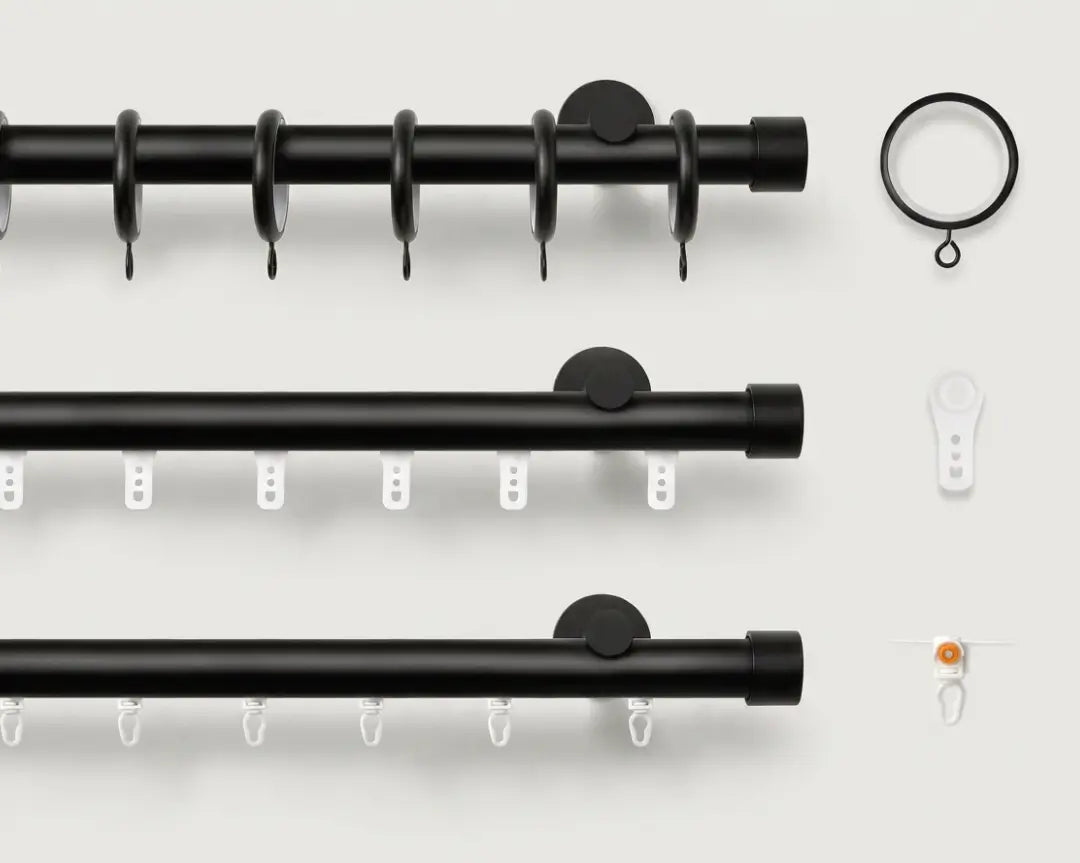
There is nowhere to put the center support. A rod long enough to span a slider wants a support bracket in the middle of the run, and rings cannot travel past a bracket. On a window you can sometimes live with that; over a doorway you cannot, because mid-span is exactly where the fabric — and everyone in the house — has to pass. Tracks and traverse rods solve this structurally: the carriers ride inside the channel while brackets grip from behind, so the run can be supported as often as needed and the curtain still glides end to end.
Daily traffic punishes friction. Rings dragged across a pole by hand, day in and day out, mean tugging, noise and a leading edge that gets handled to death. Track and traverse systems move on gliding carriers, pulled by a wand or cord, and are still smooth at year five. The full rod-versus-track question — looks, cost, mounting, ceilings — is worked through in our curtain rods vs. tracks guide. The slider-specific summary takes two sentences: a track earns its keep the day it is installed and disappears while doing it. A decorative rod over a slider spends the next decade being forgiven.
In practice that leaves two good buys. A wall- or ceiling-mounted track — our Arden adjustable track is the dedicated one — where you want the hardware to vanish and the fabric to read as a soft wall. Or the Darian custom traverse rod where you want a visible pole: it looks like decorative hardware, but it carries its own internal carriers, so it traverses like a track instead of scraping like rings.
And if any heading was invented for this exact doorway, it is ripple fold: carriers corded together at fixed spacing, one even wave that survives being drawn twice a day, and its tidiest stacks at the lower fullness settings — precisely what a stack-budgeted slider wants. What it is, what it genuinely costs in the US, and its one honest weakness are all in our ripple fold guide; the rest of the hardware range lives in Rods and Tracks.
Retiring the vertical blinds
A whole generation of American sliders is still wearing the vertical blinds the builder hung in the 1990s, and full-height drapery is the standard upgrade path. Be clear-eyed about the trade. The gains are real: soft fabric where there was clacking vinyl, a continuous insulating layer across the biggest glass in the room instead of a slatted one full of gaps, and a wall that reads finished rather than dated — with no more cracked vanes hanging at odd angles. The loss is just as real: vanes tilt. Verticals could take the glare off the room without surrendering the view or the doorway, and drapery has no tilted position — an opaque panel is open or it is closed. That one lost trick is the strongest argument for the double track above: a sheer layer is drapery's answer to the half-open vane, and it does the vane's old job while looking considerably better than the blinds ever did.
Length, sun, thresholds: the practical details
Length: just off the floor. About half an inch of clearance is right for a curtain in daily service. The romantic puddle belongs on a bedroom window you rarely touch; in a doorway it is a trip hazard, a dirt magnet, and a daily sweep of the threshold with expensive fabric. Measure the finished drop from the installed track or rod position — not from the old blind headrail you are about to remove. Our step-by-step measuring guide walks the whole sequence.
West-facing sliders are a heat problem wearing a curtain. The largest glass in the house aimed at the afternoon sun is where lining stops being an upholstery detail and starts being climate control. Whether that means thermal blackout, room-darkening or a lined mid-weight depends on the room behind it — the full breakdown is in blackout vs. room-darkening vs. sheer, so we won't re-teach it here.
Pet doors and thresholds get one honest note. If a pet flap lives in the glass or the frame, floor-length fabric will hang in front of it, and the dog will push through the curtain every single time. Expect fur on the lower leading edge, or plan the panel's everyday resting position so the flap zone stays clear. No product makes this problem vanish; only planning the stack around it does.
On a west-facing slider the fabric you can see is only half the answer — the lining behind it does most of the work on heat and glare, and choosing the wrong tier is the most common regret on a sun-facing door. Our guide to curtain lining covers what each tier actually changes.
The farmhouse slider
Asked for constantly, and easier than the inspiration boards make it look. The farmhouse elements that survive daily traffic are texture and color: a nubby linen or linen-look weave in warm white, oat or flax, hung generously full so the door reads soft rather than staged. The elements that do not survive are window-dressing habits — clip rings that stall at every bracket, and café-height anything, which on a door dresses the half nobody was worried about. Farmhouse on a slider is a fabric decision laid over the same traffic rules: full height, one-way draw, smooth traverse. The look comes from the cloth, not from fighting the hardware.
FAQ
What curtains work best for sliding glass doors?
Full-height drapery on a smoothly traversing track or traverse rod, sized so the open stack clears the operating panel completely. Fabric follows the room: a sheer-plus-opaque double track for family spaces, lined or blackout panels for bedrooms and west-facing glass, washable weaves wherever the door sees real traffic. The configuration matters more than the fabric.
Should sliding door curtains be one panel or two?
One, for the standard two-panel slider — a single wide panel drawing toward the fixed side opens in one motion and stacks where nothing needs to move. Choose a pair only when the slider sits centered in a wider run of glass, and even then neither stack may cover the operating leaf, which sometimes means an off-center split with two different panel widths.
Do you need a special rod for sliding glass doors?
Not "special," but different: skip the decorative pole with rings. A slider-length rod wants a center support, rings cannot pass a support bracket, and daily use punishes ring-on-pole friction. Use a wall- or ceiling-mounted track, or a traverse rod with internal carriers if you want a visible pole. Both glide daily without complaint.
How long should curtains be for a sliding glass door?
Just off the floor — about half an inch of clearance. Any longer and the fabric drags the threshold of a doorway people walk through every day; a puddle there is a trip hazard and a dirt magnet. Measure the finished drop from the installed track height, not from the blinds you are replacing.
Can you put blackout curtains on a sliding door?
Yes — a slider is one of the best places for them, since it is usually the largest glass and the largest heat leak in the room. Hang blackout or thermal-lined panels on hardware that still glides easily under the weight, and add a sheer on a second channel if the room needs daytime privacy with light.
What can replace vertical blinds on a sliding door?
Full-height drapery on a track is the standard replacement: softer, better insulating, quieter, and it still opens fully for the doorway. The one function it cannot copy is the tilting vane — light control without opening — so if you used that daily, choose a sheer-plus-opaque double track and let the sheer do the vane's old job.
The five-second version
Stack toward the fixed panel, never the handle. Budget a quarter to a third of the run for gathered fabric — or buy back glass by running the track onto the wall. Put it all on hardware that glides, hem it just off the floor, and if this is the year the vertical blinds finally go, a sheer-plus-opaque double track replaces everything they did — and looks like it belongs to this decade.