

















Home Theater Curtains: Light Control, Sound, and Screen Glare
"Soundproof" is the one promise home theater curtains can't keep; their real talents are keeping a projector's blacks black and taking the echo out of a hard room.
The short answer
Curtains are excellent at light and echo and close to useless at soundproofing. In one measured white-walled room, projector contrast fell from 86:1 to 20:1 once a side window let light in, so blackout drapery with closed edges is the biggest picture upgrade fabric offers. Heavy velour pleated to double fullness, 4 inches off the wall, absorbs echo at NRC 0.85–1.05 in lab tests; acoustic curtains block sound at only about STC 13–17, and a real-window test of curtains sold as soundproof found just 3–7 dB of noise reduction.
Good fit if you're darkening a projector room, taming echo from bare walls, or keeping window glare off a TV. Skip / reconsider if you need to keep movie sound out of the next room or fix boomy bass; that takes construction and bass traps, not fabric.
In this guide
- What the curtains need to do
- How dark a projector room should be
- Cinema room vs TV room
- Stopping edge leaks
- Curtains and acoustics
- Why curtains can't soundproof
- The screen wall
- Media room curtain ideas
- Tracks, motors and noise
- Fire rating
- The honest part
- Glossary
- FAQ
What do home theater curtains actually need to do?
Four jobs: keep window and lamp light off the screen, stop glare and bounce, absorb echo, and open easily when the room goes back to daytime use. For a projector, darkness comes first; for a TV, glare does. Soundproofing isn't one of them.
How dark does a projector room need to be?
As dark as you can make it. A projector can't project black; it can only leave parts of the screen unlit, and any room light that lands there becomes your new black.
On a matte screen with a gain of 1.0, each foot-candle of ambient light (10.76 lux) adds about one foot-lambert of glow, per the foot-lambert definition. A cinema image is only about 16 foot-lamberts bright, the SMPTE 196M target cited by Acoustic Frontiers. So one foot-candle of stray light caps contrast near 17:1, and 0.1 foot-candle near 160:1. That's our back-of-envelope math, ignoring the projector's own black level, but the lesson holds: a little light does a lot of damage.
For the windows, that means a 100% blackout lining, not "room darkening," on blackout curtains sized to overlap the frame.
Cinema room curtains vs a TV room: how much blackout do you need?
A cinema room needs real blackout; a TV room needs glare control, because a TV makes its own light.
Projector room, measured. Projector Central tested a white screen in a white-walled room with the lights off: 86:1 contrast on an ANSI checkerboard. An overhead light cut that to 39:1, and light from one side window to 20:1. Ambient-light-rejecting (ALR) screens scored 129–217:1 in the dark, but the testers concluded that in a properly blacked-out theater, ALR and white screens should perform about the same. Even the 86:1 was held down by room reflections alone, so dark, matte curtains on the side walls nearest the screen do double duty: they absorb echo and stop the bounce.
TV room. RTINGS names direct reflections, especially from large windows, as the main ambient-light problem for TVs, and the professional reference room for judging TV pictures isn't black: SMPTE ST 2080-3 calls for a dim surround of about 5 cd/m² (5 nits), matte decor, and no reflections that visibly impair the image. A velvet like Liora (400 GSM, 70–85% light blocking) suits a TV room; a projector room needs a blackout layer behind it.
| Projector room | TV room | |
|---|---|---|
| Main enemy | Ambient light washing out blacks | Window reflections on the screen |
| Target | As dark as possible, walls included | Dim, not black (about 5 cd/m² surround) |
| Curtain | 100% blackout lining, closed edges, dark matte face | Room-darkening that stops the glare |
| Our examples | Brynna, Arlise, Nolissa (100% blackout linings) | Liora velvet (70–85% light blocking) |

How do you stop light leaking around home theater curtains?
Close the edges. Blackout fabric only blocks the light that hits it, and in a dark room your eye finds the glow at the sides, top and hem. Our guide to how blackout curtains work explains why even 100% fabric leaks. The theater fixes:
- Sides and center: hang wide of the frame with returns (the ends that turn back to the wall) and an overlap master where the panels meet. Drapery Rods Direct suggests about 4-inch returns, or 6 inches on double tracks.
- Top: ceiling-mount the track, or close the gap above the heading with a cornice or ceiling pocket.
- Hem: let the curtain just touch the floor.
- Home theater shades: a blackout shade under the drapery should mount outside the frame or run in side channels. Our light-filtering vs blackout shades guide explains which shade specs actually mean dark.
Do curtains help acoustics in a home theater?
Yes, for echo. Heavy drapery absorbs reflected sound inside the room, tightening dialogue and taking the harsh slap off bare walls and glass.
The number to know is NRC, the noise reduction coefficient: average absorption at 250, 500, 1,000 and 2,000 Hz, from 0 (reflects everything) to about 1.0 (absorbs nearly everything). Rose Brand's published tests of theatrical fabrics hung 4 inches off the wall give realistic figures: heavy velour and wool serge measured NRC 0.60–0.75 hung flat and 0.85–1.05 pleated to 100% fullness (twice the finished width). On average, doubling the fabric raised NRC about 40%. Scores above 1.0 are an edge effect of testing pleated samples.
Fullness and air gap matter more than weight: hung flat, a 12 oz and a 32 oz polyester velour both scored 0.60. Hang at least 4 inches from the wall, since closer sharply cuts performance; two flat layers back to back barely helped. Moving wool serge from 4 to 18 inches out raised absorption at 125 Hz about 50%, with little change higher up. The source says fullness helps most at low frequencies, though its own averages peak at 500 Hz (+49%), not 125 Hz (+43%). Our 1.5x vs 2x fullness comparison covers what fullness does to the look and the yardage.
The bass blind spot. NRC leaves out 125 Hz, and theater bass goes lower still. Down there, drapery is unpredictable: a 32 oz cotton velour absorbed 0.43 at 125 Hz in an NGC lab report, while a pleated velour rated NRC 0.90 absorbed 0.04 in its WEAL test (the seller's lab-test page lists that velour at 0.85–1.0 instead). Curtains won't fix boomy bass; bass traps will.
One caution: these are theatrical fabrics, not any home curtain, ours included. Read them as a direction, not a rating.
Can curtains soundproof a home theater?
No. Curtains absorb sound inside a room; soundproofing blocks it between rooms, which takes mass and airtight seals that fabric can't provide.
Blocking is rated by STC, sound transmission class. Purpose-made acoustic curtains are listed at STC 13 and STC 17, and normal speech is still understood through an STC 25 barrier. At a real window, a reviewer measured only 3–7 dB of noise reduction from curtains sold as soundproof. If you've seen 15–25 dB claims, one acoustics vendor notes they come from curtains sealed into lab test openings, which no home window resembles.
| Measure | What it tells you | Heavy drapery, measured |
|---|---|---|
| NRC, hung flat | Echo absorbed inside the room | 0.60–0.75 |
| NRC, 100% fullness, 4 in. off the wall | The same, with twice the fabric | 0.85–1.05 |
| Absorption at 125 Hz | Bass, which NRC leaves out | 0.04–0.43 |
| STC | Sound blocked between rooms | 13–17 for acoustic curtains; speech carries through STC 25 |
| Real-window test | Noise drop through a curtained window | 3–7 dB |
What should go on the screen wall: masking, borders or a stage curtain?
Black, matte fabric, as far as the projector's spill reaches, because anything pale or shiny around the image throws stray light back onto it.
- Masking: black panels that frame the picture to its aspect ratio, so letterbox bars disappear. Motorized masking is the premium route; Seymour's retrofit kit launched at $1,195 in 2023.
- Borders: matte black velour; theatrical velour is sold on its matte finish. SMPTE's reference room even asks for front speakers in medium-to-dark gray or black.
- No sheen: skip satin, faux silk and shiny velvets on the screen wall and the side walls nearest it.
- Stage curtain: a reveal curtain is showmanship, not picture quality; hang it on a ceiling track, clear of the screen surface.
Media room and home theater curtain ideas that actually help the picture
Every idea that works is some mix of dark, matte and full.
- Dark velvet near the screen. Velvet curtains in a deep shade on the side walls closest to the screen absorb echo and stop the bounce; our old-money velvet guide covers styling it elsewhere.
- A blackout lining behind a face you love. The lining does the darkening, so the face can be chosen for texture, like the cotton-blend crossweave on Nolissa; our curtain lining guide compares blackout lining with interlining.
- Blackout-lined velvet. Brynna puts devoré velvet and a fully dark window in one layer.
- Chenille for a softer hand. Arlise is blackout-lined chenille; our chenille guide explains who it suits.
- Wall-to-wall on a ceiling track. Drapery across the whole window wall hides the frame and delivers the fullness acoustics want.

| Curtain | Face fabric | Light control | Weight | Best fit |
|---|---|---|---|---|
| Brynna | Devoré velvet | 100% blackout lining | 320 GSM | Media room or bedroom windows |
| Arlise | Chenille | 100% blackout lining | 256 GSM | Projector or media room windows |
| Nolissa | 35% cotton / 65% polyester crossweave | 100% blackout lining | 242 GSM | Multi-use media room |
| Liora | Velvet | 70–85% light blocking | 400 GSM | TV room; add blackout for a projector |
Notice that weight isn't light blocking: the heaviest fabric here, Liora at 400 GSM, is the only one that isn't blackout.
What track and motor do heavy home theater curtains need?
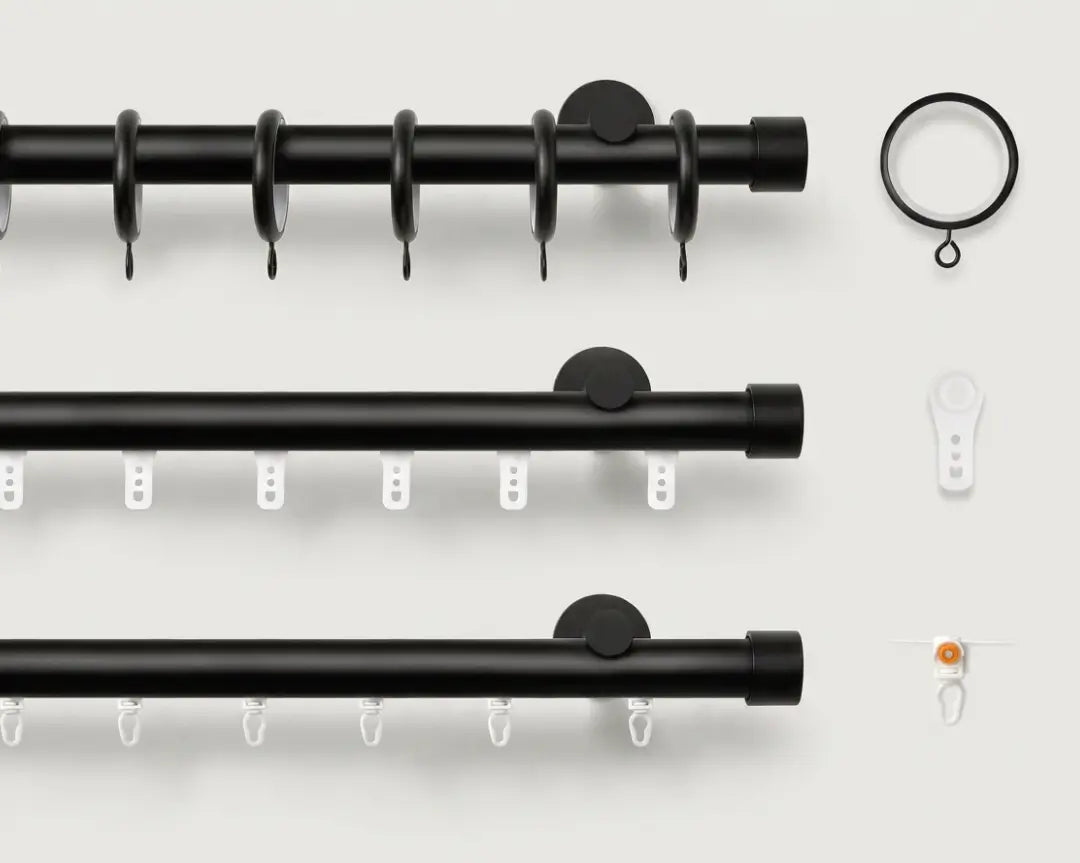
A ceiling-mounted track rated well above the curtain's weight, plus a quiet motor if you motorize. Our rods vs tracks guide covers the trade-offs; rods and tracks has the hardware.
Weight. At 100% fullness, a 32 oz cotton velour weighed 0.46 lb per square foot of wall in its NGC report, about 37 lb for a 10 × 8 ft wall by our arithmetic. For scale, a Somfy Glydea 35 motor is listed for 77 lb over 32 ft. Our Kaelen motorized track is a wired aluminum track (100–240 V, 34 W, 1.2 N·m torque) rated for a 50 kg (about 110 lb) load and built for double or triple pinch-pleat, double or triple Euro-pleat and flat-panel headings. Being wired, it needs power at the track.
Noise. Ask for a dBA figure at a stated distance. Dealer figures for Somfy's Glydea Ultra are 39.7 dBA at default speed, 45.2 fast and 29.8 in silent mode, with no distance given (Meyer Blinds).
Heading and control. Ripple fold runs on its own carriers; our ripple-fold guide covers how it behaves at the top edge. With a smart-home hub, one "movie" scene can close the drapes and dim the lights. To motorize a shade under the drapery instead, see our motorized Roman shades guide and the motorization collection.
Heat. Keep fabric clear of projector exhaust and equipment-rack vents, and follow the clearance in your projector's manual.
Do home theater curtains need to be fire rated?
Not in a one- or two-family home. Under the model fire code, curtains in commercial and public buildings, hotels and dorms must be flame-retardant fabric that passes NFPA 701. The list covers assembly, business, educational, institutional and mercantile occupancies, hotels (Group R-1) and dormitories in Group R-2, as adopted in the 2021 Seattle Fire Code, based on the 2021 IFC. One- and two-family homes aren't on it.
The honest part: what curtains can't fix in a home theater
- They don't soundproof. STC 13–17 and 3–7 dB at a real window is the realistic range; the next room will still hear the movie.
- They barely touch bass. Lab absorption at 125 Hz runs 0.04–0.43, and theater bass goes lower.
- They're heavy. About 37 lb of velour for a 10 × 8 ft wall at 100% fullness, so check the track rating before the color.
- Edges undo blackout. A glowing gap at the top defeats a 100% blackout lining.
- They hold dust. Deep pile and pleats collect it; vacuum regularly with a brush attachment.
- They cost real money. Theatrical cotton velour lists at $29.39 a yard (54 inches wide, 25 oz) at Georgia Stage as of September 2026; a 10 × 8 ft wall at 100% fullness needs about 15–16 yards, roughly $440–470 in fabric alone (our arithmetic). One US dealer's list put a motorized track for a 9–10 ft run at about $1,081 the same month ($546.25 motor, $450 track, $85 ripple-fold carriers). Our curtains are priced by your exact width and length, so the live quote on each product page is the number to trust.
Glossary
NRC — Noise reduction coefficient: average sound absorption at 250–2,000 Hz. Higher means less echo.
STC — Sound transmission class: how much a barrier blocks sound between rooms.
Foot-candle / foot-lambert — Light falling on the screen versus brightness coming off it; on a gain-1.0 matte screen, 1 fc adds about 1 fL.
Fullness — Extra fabric width; 100% fullness means twice the finished width.
Overlap master — A center carrier that lets two panels overlap instead of just meeting.
NFPA 701 — The NFPA fire test for flame propagation in curtain and drapery fabrics.
FAQ
Do blackout curtains reduce noise?
Only slightly. Even curtains sold as soundproof cut only 3–7 dB in one reviewer's real-window test, and purpose-made acoustic curtains rate just STC 13–17. Blocking sound between rooms takes mass and airtight seals.
Do I need blackout curtains for a projector?
Yes, for real contrast. Projector Central measured 86:1 for a white screen in a dark, white-walled room, and 20:1 once light came in from one side window.
What color should home theater curtains be?
Dark and matte, especially near the screen, where pale or shiny fabric throws projector light back onto the image. SMPTE's reference room calls for matte decor and medium-to-dark gray or black front speakers.
Is velvet good for home theater curtains?
Yes, with one check. Heavy theatrical velours tested at NRC 0.95–1.05 at 100% fullness and have a matte pile, but velvet alone isn't blackout: Liora blocks 70–85% of light, while Brynna adds a 100% blackout lining.
How far from the wall should acoustic curtains hang?
At least 4 inches; closer sharply cuts absorption. Moving wool serge from 4 to 18 inches off the wall raised its absorption at 125 Hz by about 50%.
Are motorized curtains loud?
Good ones are quiet, but ask for a number. Dealer figures for Somfy's Glydea Ultra are 39.7 dBA at default speed, 45.2 dBA fast and 29.8 dBA in silent mode.
Ready to build the room? Start with our velvet curtains for the side walls and windows, add blackout curtains where windows are the problem, and hang heavy panels on a track from rods and tracks or a motorized system. Everything is made to your measurements, and free swatches let you check color and sheen in your own room, lights down, before you order.