








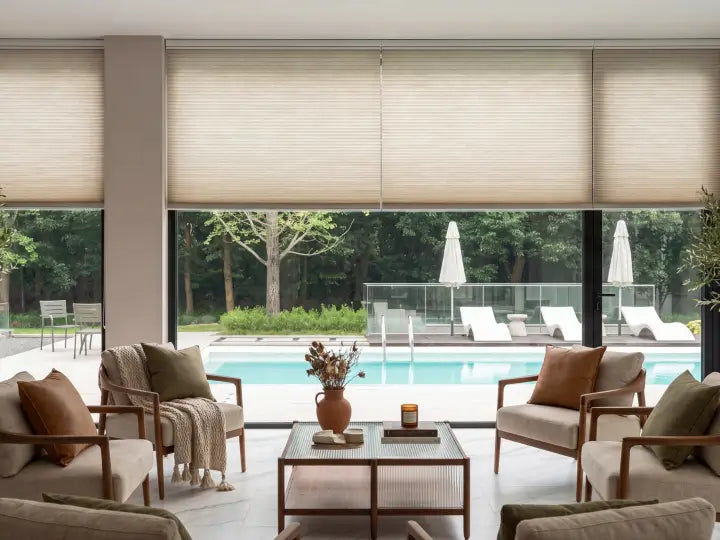

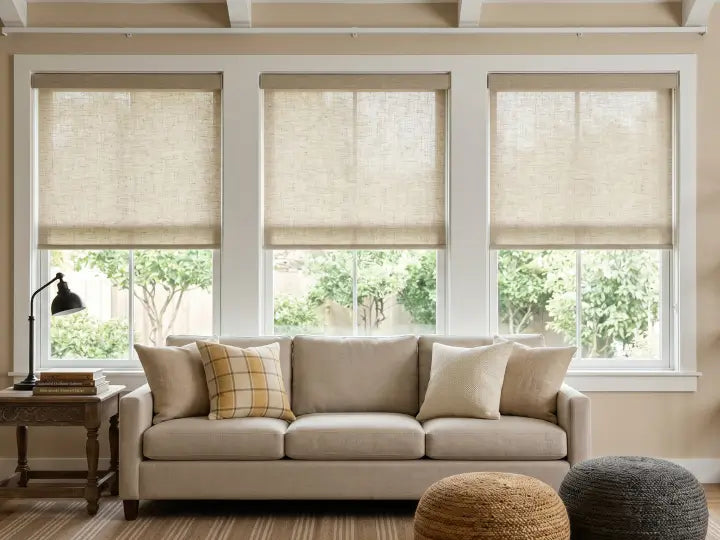










Best Curtains for a Bedroom: Match the Curtain to Your Sleep Problem
There is no single best bedroom curtain: the panel that blacks out a 5:25 a.m. June sunrise does little against traffic rumble, and the sheer that hides you all day stops hiding you the moment you switch on a lamp.
The short answer
Match the curtain to what wakes you. Light needs a 100% blackout lining hung wider, higher and longer than the window; noise needs heavy, lined, full panels, which soften voices and echo but not rumble (pleated drapery absorbs 75% of sound energy at 1,000 Hz, only 7% at 125 Hz). For heat and cold, hang lined panels close to the glass: the U.S. Department of Energy credits draperies with up to 10% less winter heat loss and, with white-plastic backings, 33% less summer heat gain. Night privacy takes an opaque layer, and dust allergies take fabric you actually wash.
Good fit if you know what keeps you up and can hang the curtain past the frame. Skip / reconsider if the problem is noise through a shared wall, a window that needs real insulation (cellular shades do more) or a severe dust-mite allergy.
In this guide
- What are the best curtains for a bedroom?
- What curtains are best for sleep when light wakes you?
- Do curtains reduce noise in a bedroom?
- Can curtains keep a bedroom cool or warm?
- Why can people see in at night?
- What curtains are best for dust allergies?
- What curtains work for kids' rooms and naps?
- Why does fit matter more than fabric?
- The honest part
- Glossary
- FAQ
What are the best curtains for a bedroom?
The best bedroom curtains are the ones matched to what keeps you awake; a curtain that solves one problem can do nothing for another:
| What keeps you up | Fabric and lining | Fit and hardware | Example from our range |
|---|---|---|---|
| Light: street lights, early sunrise, daytime sleep | 100% blackout lining | Rod past the frame and near the ceiling; returns; floor length; overlapped center | Arlise chenille (256 GSM) or Nolissa cotton-blend (242 GSM), both 100% blackout-lined; add a Fionis blackout roller for the darkest room |
| Noise: voices, echo | Heavy fabric, ideally lined | Generous fullness, floor length | Liora velvet (400 GSM; room-darkening at 70–85%), or Arlise if you also need blackout |
| Too hot or too cold | Lined; two layers in winter | Close to the glass, sides sealed, center overlapped | Nolissa or Arlise, plus a sheer on a double rod |
| Privacy at night | An opaque layer | Double rod: sheer by day, opaque panel at night | Liana sheer plus a lined panel such as Nolissa |
| Dust allergies | Fabric you can wash often, or a roll-up shade | Easy to take down | Any panel you will wash on a schedule |
| Kids' naps | Blackout lining | Cordless; crib away from the window | Arlise or Nolissa on a plain rod |
| Nothing: you like waking with daylight | Light-filtering fabric | Any | Celina linen-blend (30% linen, 70% polyester), blocking 40–50% of light |
The table leaves out color and pattern on purpose: once the lining and fit do the work, the face fabric is a style choice, covered in our guide to bedroom curtains sorted by the look you want.

What curtains are best for sleep when light wakes you?
Lined blackout curtains, hung so light can't get around them, for light sleepers facing a street light or an early sunrise and for day sleepers alike. NIOSH's sleep guidance for nurses who work shifts is blunt: “Your bedroom should be very dark. You can block out all light coming in through windows by using room-darkening shades and/or heavy, lined draperies” (NIOSH). It adds that blinds can let too much light filter in.
Summer mornings are the usual culprit. On June 21, 2026, the sun rises at 5:25 a.m. in New York (versus 7:17 a.m. on December 21), 5:08 in Boston, 5:16 in Chicago and 5:12 in Seattle, and the sky starts to brighten at civil dawn, 33–41 minutes earlier: 4:52 a.m. in New York (U.S. Naval Observatory data). The late-June sun also rises well north of due east (about 33 degrees north of east in New York, by our own calculation), so east- and northeast-facing bedrooms get light first.
Does it matter? In a small, one-night lab study of 20 healthy young adults, those who slept under 100 lux of overhead light had a higher nighttime heart rate and more insulin resistance the next morning than those kept under 3 lux (Mason et al., 2022): a short-term effect, not proof of disease.
The blocking comes from an opaque layer; in the panels above, it is a blackout lining behind the face fabric. That lining can stop 100% of light at the fabric, yet light still slips in over the rod, down the sides and under the hem; our guide to how blackout curtains work explains the constructions and the leaks, and the fixes are in the fit section.
For the darkest room, add a blackout roller inside the frame, such as our Fionis motorized blackout roller shade, whose cassette header hides the roll; the curtain outside covers the roller's side gaps. Already have blinds? Draw a full-width curtain over them.

Rather wake with the sun? Our Celina linen-blend (30% linen, 70% polyester) blocks 40–50% of light, softening dawn without hiding it; for that look, see our guide to linen drapes for a cozy bedroom.
Do curtains reduce noise in a bedroom?
A little, and mostly not the noise that keeps people up. Curtains absorb sound rather than block it: an absorber cuts echo inside a room, while a blocker stops sound crossing a wall or window (Quiet Curtains).
Pleated drapery of 14 oz per square yard absorbs 0.75 of the sound energy hitting it at 1,000 Hz, in the range of voices, but only 0.07 at 125 Hz, where traffic and train rumble sit. Its NRC is 0.55, against 0.05 for 6 mm glass (Commercial Acoustics). So heavy drapes calm a hard-surfaced bedroom and soften higher-pitched noise, but barely touch bass.
Blocking is where curtains fall short. One acoustic-curtain maker rates even the best curtains at roughly STC 20–30, below the STC 33 of an ordinary interior stud wall, and notes that it takes a 10 dB cut for noise to sound about half as loud (Quiet Curtains). At a real window, one reviewer measured just 3–7 dB from curtains sold as soundproof (Talk of the House).
To get the most from fabric anyway, go heavy, lined and full: in theater-drape lab tests, 100% fullness (fabric twice the covered width) raised absorption by about 40% on average (Rose Brand; see our 1.5x vs. 2x fullness comparison). Rumble and shared walls need fixes to the window or wall itself: sealed air gaps and added mass.
Can curtains keep a bedroom cool or warm?
Yes, modestly, and it matters because most people sleep best in a cool room: the Sleep Foundation suggests about 65°F (Sleep Foundation).
According to the U.S. Department of Energy (DOE Energy Saver, archived copy), medium-colored draperies with white-plastic backings can cut heat gain through sunny windows by 33%, and draperies can cut heat loss in cold weather by up to 10%. East- and west-facing windows have greater potential for heat gain, so close those curtains on summer days; in winter, open the curtains on sunny windows in the morning.
How you hang them matters too. The DOE advises draperies as close to the window as possible, falling onto the sill or floor, with a cornice or ceiling mount, sealed sides and a center overlap, and notes that “two draperies hung together will create a tighter air space than just one drapery”: a case for a sheer plus a lined panel in a cold room.
Be realistic about the ceiling, though: the same page credits cellular shades with cutting heat loss by 40% or more and solar heat by up to 60%. Our thermal curtains guide has the full energy numbers.
Why can people see in at night?
Because at night your bedroom is the bright side of the glass. As with a two-way mirror, whoever is on the darker side can see into the brighter one (How It Works), so a sheer that hides you by day shows you once the lamps are on. The DOE notes that greater openness “increases visibility and light transmission.”
The fix is an opaque layer for night. Pair a sheer such as our Liana (100% polyester, blocking 15–20% of light) with a lined panel on a second rod. Our post can you see through sheer curtains? has the day-versus-night details, and our guide to layering sheer and blackout curtains covers the hardware.
What curtains are best for dust allergies?
Ones you can wash, and will. The Asthma and Allergy Foundation of America (AAFA) says the bedroom usually has more dust mites than anywhere else in a home. It advises getting rid of fabric you can't easily wash regularly in hot water, keeping indoor humidity at 30–50% and considering roll-up shades (AAFA).
Check the care label first. The panels in this guide are labeled gentle machine wash or dry clean, no bleach, air dry, and one blackout-lining maker lists 3–5% residual shrinkage (Roc-lon), enough to lift a floor-length hem. Our guide to washing curtains without shrinking or fading covers the routine.
One label confuses people. OEKO-TEX STANDARD 100 means a textile was tested for harmful substances, with every thread, button and accessory checked against more than 1,000 of them (OEKO-TEX). It makes no dust-mite or allergen claim, so it doesn't mean “hypoallergenic.”
What curtains work for kids' rooms and naps?
Dark ones with no cords. Kids often go to bed before a summer sunset, and little light affects them: in 36 preschoolers, an hour of 5–40 lux before bed suppressed melatonin by 77.5% (Hartstein et al., 2022).
For safety, the Consumer Product Safety Commission says “the safest option when young children are present is to go cordless,” and to move cribs and beds away from windows (CPSC); curtains drawn by hand on a plain rod have no operating cords. See our child-safe window treatments guide for the full checklist and kids' room curtain ideas for the fun part.
Why does fit matter more than fabric?
Because light, drafts and sound all go around a curtain before they go through it. Common installation guidance puts the rod 3–6 inches past the frame on each side (Bob Vila) and 4–6 inches above it (Family Handyman), or near the ceiling, with the hem reaching the floor. In short:
- Go wide, so closed panels cover wall, not just glass.
- Go high. A ceiling mount or cornice closes the top gap, as the DOE also advises.
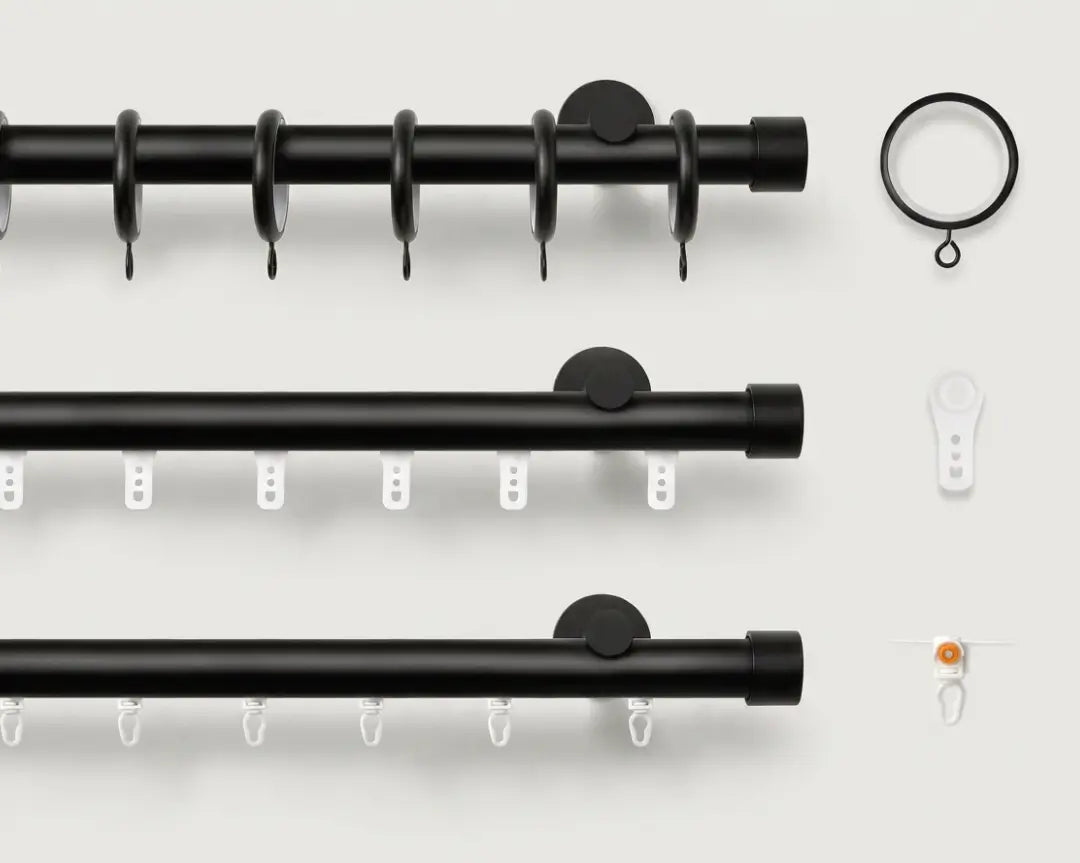
- Wrap the sides with return rods or a ceiling track. See curtain rods vs. tracks.
- Reach the floor and overlap the center, so no bright line shows.
This is where made-to-measure earns its keep: the width to cover is the window plus both extensions, both returns and the center overlap, and custom panels are cut to that number rather than a stock size. Our measuring guide walks you through it. Price depends on width, length and lining, so check the product page for a live price, or see how much custom curtains cost.
The honest part: what bedroom curtains can't fix
- They don't soundproof. Bass, traffic rumble and a neighbor's TV need work on the window or wall.
- They aren't the best insulators. Cellular shades beat draperies by a wide margin, and the DOE says roller and roman shades “offer only a small amount of insulation,” so the roller we suggest is there for darkness, not warmth.
- Blackout costs you daylight. If you would rather wake with the sun, a light-filtering fabric or a sheer layer suits you better.
- Closed curtains can mean condensation. A closed covering slows the airflow across the glass, so the pane cools (PNNL). Keep indoor humidity in check and open them by day.
- The strictest allergy advice is no curtains. The American College of Allergy, Asthma and Immunology advises removing curtains and drapes, particularly in the bedroom (ACAAI). If yours stay, wash them, or switch to a roll-up shade.
Glossary
Blackout lining: an opaque layer behind the face fabric that stops light.
Room-darkening: dims a room without blacking it out; Liora velvet blocks 70–85%.
Light-filtering: softens daylight; Celina blocks 40–50%.
Civil dawn: when the sky starts to brighten, 33–41 minutes before sunrise in late June in the cities above.
NRC: noise reduction coefficient, a surface's average sound absorption across the middle frequencies. It measures echo control, not blocking.
STC: sound transmission class, a rating of how well a barrier blocks sound; an interior stud wall is about STC 33.
Return: the end of a rod or track that turns back to the wall, closing the side gap.
FAQ
What curtains are best for a bedroom?
The ones matched to what keeps you awake: blackout-lined panels hung wide, high and to the floor for light; heavy, lined, full panels for noise; lined panels close to the glass for heat or cold; an opaque layer for night privacy; washable fabric for dust allergies.
Do blackout curtains help you sleep?
They can if light wakes you. In a small lab study, one night under 100 lux of room light raised young adults' nighttime heart rate and next-morning insulin resistance compared with a night under 3 lux. NIOSH advises a very dark bedroom.
Do curtains reduce noise?
Mostly echo and higher tones, not outside noise. Pleated drapery absorbs 0.75 of the sound energy at 1,000 Hz but only 0.07 at 125 Hz. One acoustic-curtain maker rates even the best curtains at about STC 20–30, below an interior stud wall's STC 33.
Do curtains keep a bedroom cool?
They help. The U.S. Department of Energy says medium-colored draperies with white-plastic backings can cut heat gain through sunny windows by 33% when closed on summer days, which makes the Sleep Foundation's suggested bedroom temperature of about 65°F easier to reach.
Are curtains bad for dust allergies?
They can be. The American College of Allergy, Asthma and Immunology advises removing them from the bedroom; the Asthma and Allergy Foundation of America accepts fabric you can wash regularly in hot water, or roll-up shades.
Does OEKO-TEX mean hypoallergenic?
No. OEKO-TEX STANDARD 100 means the textile was tested for more than 1,000 harmful substances. It makes no claim about allergens or dust mites.
Why is my bedroom bright so early in summer?
Because the sky brightens before sunrise. In New York on June 21, 2026, civil dawn is at 4:52 a.m. and sunrise at 5:25 a.m., versus a 7:17 a.m. sunrise on December 21. East- and northeast-facing bedrooms get the light first.
Know your problem? Browse our bedroom curtains (or blackout curtains if light is the issue), choose your width and length on the product page for a live price, and order free swatches to check color, weight and light-blocking at your own window before you commit.