





















Curtains Over Blinds: How to Hang Them So Everything Clears
Curtains over blinds rarely go wrong on style. They go wrong on one number nobody measures: how far the blind already sticks out from the wall.
The short answer
Yes. The back of the rod should sit about 2 inches in front of the blind's deepest point. Manufacturer specs put that point at about 1¾ inches off the wall for a 1-inch mini blind and about 3 inches for an outside-mounted 2-inch faux-wood blind. Vertical blinds sit 3–4 inches out and looped roman shades about 5. Mount the rod above the blind's headrail (4–6 inches above the frame is the usual start) and wide enough that open panels stack beside the glass.
Good fit if your blinds sit inside the frame, or you want blackout, privacy and softness without losing tilt control. Skip / reconsider if an outside-mounted blind plus thick trim would push brackets past 5–6 inches on drywall. A ceiling track or a different blind is usually cleaner.
In this guide
- Inside vs outside mount
- How far blinds stick out (chart)
- How far the rod should stick out
- Rod height and width
- The best hardware
- Vertical blinds on sliders
- Step by step
- Combinations that look good
- Renter-friendly options
- The honest part
- Glossary
- FAQ
Are your blinds inside-mount or outside-mount, and why does it matter?
The mount decides how much depth the blind adds, and that decides the bracket.
Inside mount. The blind sits within the window opening. If the frame is deep enough for a flush mount, the blind adds nothing, and standard brackets with a 3–4 inch return work, per Continental Window Fashions. If it isn't, the difference sticks out. Levolor's wood-blind guide says its 2-inch blinds need 2½ inches of depth for a flush headrail and 3½ inches for a flush valance. In a 2½-inch frame, the valance stands about an inch proud.
Outside mount. The blind is screwed to the wall or trim, so its full depth counts, plus the trim. It's also bigger than the window: Levolor tells buyers to overlap each side of the frame by at least 1½ inches. Your rod has to clear it outward, upward and sideways.
How far do blinds and shades stick out from the wall?
Between about 1¾ and 5 inches, depending on type. The deepest point is often the valance, the folds or the vanes, not the headrail.
| Blind or shade | Depth from the mounting surface | Rod clearance to look for | Maker figure |
|---|---|---|---|
| 1-inch metal mini blind | 1¾ in. (2¼ in. with a valance) | about 3¾–4¼ in. | Levolor metal blinds guide |
| 2-inch wood or faux wood | 2⅞–3⅛ in. at the valance (headrail 2¼ in.) | about 5 in. | Levolor wood blinds guide |
| 2½-inch wood or faux wood | 3¼–3½ in. at the valance | about 5½ in. | Levolor wood blinds guide |
| Cellular shade | 2¼ in. (⅜- and ¾-in. pleats); 3 in. (1¼-in.) | about 4¼–5 in. | Hunter Douglas Duette guide |
| Roller shade | 2½ in. open roll; 3 in. cassette; 3¼ in. standard valance | about 4½–5¼ in. | Levolor roller instructions |
| Roman shade, flat folds | 1⅞–2⅛ in. | about 4 in. | Bali Classic Roman guide |
| Roman shade, looped folds | 4⅞–5⅛ in. | about 7 in. | Bali Classic Roman guide |
| Vertical blind | 3 in. to recess; 3–4 in. on the wall | about 5–6 in. | Levolor vertical guide; Canisteo Blinds |
Depths are each maker's outside-mount valance return or fully recessed depth, both good stand-ins for projection. Brands vary, and trim or spacers add to them, so measure your own. The clearance column is depth plus 2 inches.
How far should the curtain rod stick out to clear blinds?
Far enough that the back of the rod sits about 2 inches in front of the blind's deepest point, so pleats swing without brushing the slats. Continental Window Fashions uses the same add-two-inches rule for a bracket's return; applying it to the back of the rod adds a little margin.
The box will use one of three terms, and they aren't interchangeable:
- Return is the distance from the wall to the center of the rod, as Kirsch defines it.
- Clearance is the distance from the wall to the back of the rod, as Highland Forge defines it. This is the number that has to beat your blind.
- Projection is the distance from the wall to the bracket's farthest point, as Drapery Rods Direct defines it. It's always the biggest number.
Deeper brackets are ordinary catalog items: Drapery Rods Direct lists wood brackets in 3½-inch (standard) and 6-inch returns, and wrought iron in 3½, 5⅜ and 7½ inches. A standard 3–4 inch bracket can't give an outside-mounted faux-wood blind that 2-inch gap.
How high and how wide should the rod go over blinds?
High enough that the curtain heading clears the top of the blind, and wide enough that open panels stack beside the glass.
Height. The usual start is 4–6 inches above the frame; see our rod height and installation guide. The Shade Store suggests going about two-thirds of the way from the top of the window to the ceiling. With an outside-mounted blind, measure from the top of its headrail or valance.
Check the raised blind too. In Levolor's stacking chart, a 72-inch blind stacks 7⅛ inches with 2-inch slats and 11 inches with 1-inch slats. If you mount the blind high so that stack clears the glass, the rod has to go higher still.
Width. Run the rod at least 4–6 inches past the frame on each side, or more to get the panels fully off the glass. Our curtain width guide has the details. With an outside-mounted blind, count from the blind's edge. Fuller curtains stack wider; see 1.5x vs 2x fullness.
Which hardware works best over blinds?
A single rod on deep brackets handles most windows; a ceiling track is the fix when the numbers get big. Our rods vs tracks comparison helps you choose.
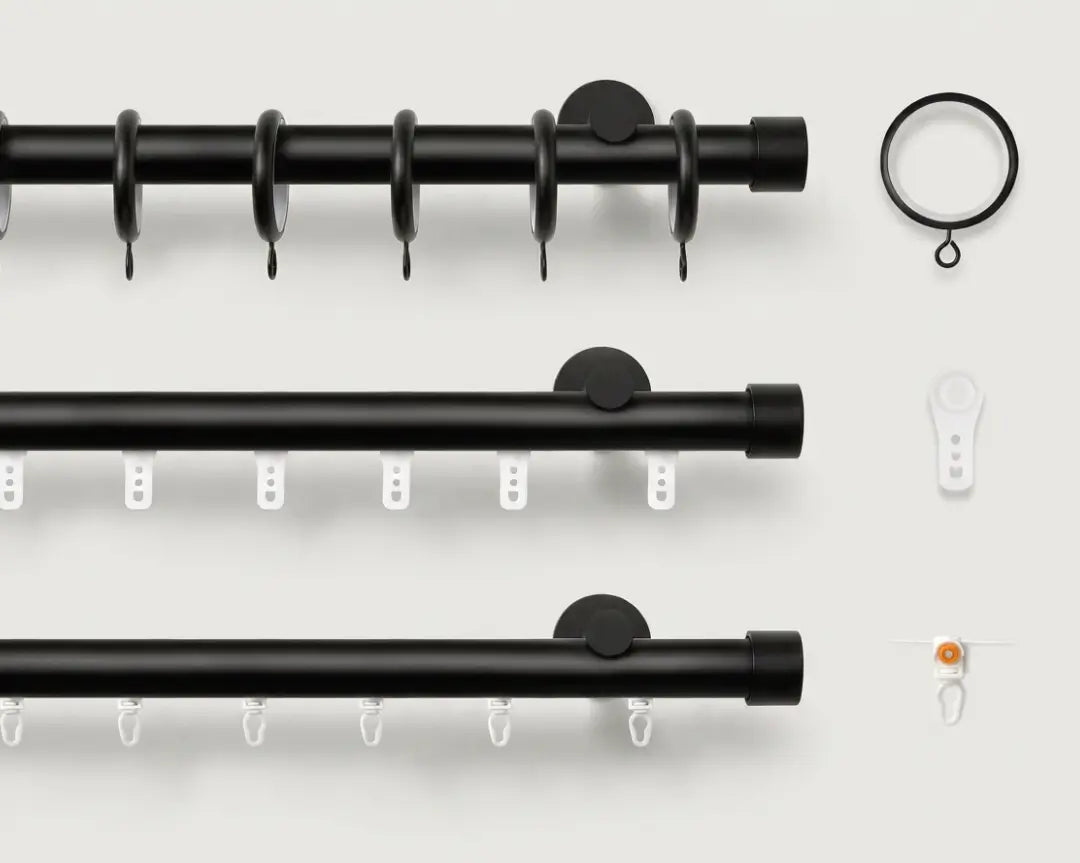
A single rod on deeper brackets. Our Collins custom rod is aluminum, cut to length, mounts on the wall or ceiling and has brackets rated to 22 lbs each. Check the bracket's clearance against your table row; if a wall bracket won't reach, ceiling-mount it.
Double rods (curtain plus sheer). The back rod is the one that must clear the blind. Kirsch's standard double bracket has a 3½-inch return for the back pole and 6½ for the front (3–4 and 6–7 inches adjustable), measured to the rod's center. So the back pole can't leave a 2-inch gap in front of an outside-mounted faux-wood blind about 3 inches deep. Double rods suit inside-mount and mini blinds best. The Collins double rod and Collins double brackets mount on the wall or ceiling at 22 lbs per bracket. For pairing the two curtain layers, see how to layer sheer and blackout curtains, which advises 2–3 inches more total projection.

A ceiling-mounted track. This clears everything: the track sits wherever you screw it, just in front of the deepest blind, and it works when there's little wall above the window. Lior is a ceiling-mount aluminum track ¼ inch thick and 1¼ inches deep, rated up to 15 kg with its brackets. Tavira is a low-profile aluminum track for wall or ceiling, at about 53 lbs per 24-inch section.

Return (wraparound) rods. A French return bends the rod back to the wall, so the curtain wraps the corner and closes the side gap that deep brackets leave. Kirsch makes 3- and 6-inch versions that replace finials.
How do you hang curtains over vertical blinds on a sliding door?
Treat the vertical blind as the deepest thing on the wall. Plan for 5–6 inch brackets or a ceiling track, and size the curtains around the blind's stack.
Verticals are deep because 3½-inch vanes rotate on carriers. Levolor needs 3 inches of depth to recess one and warns the vanes won't open and close properly if it's mounted too close to the window. Retailer Canisteo Blinds says most vertical tracks sit 3–4 inches off the wall, while a standard bracket gives only about 2.5 inches.
Then there's the stack. On Bali's stacking chart for 3½-inch vanes, an 87½-inch blind drawn to one side leaves a 76⅜-inch clear opening. That puts about 11 inches of vanes beside the door, and a 100-inch blind leaves about 12½. Draw the curtains to the same side so both stacks share that wall. Then extend the rod far enough to hold the curtain stack too, which our sliding glass door guide puts at roughly a quarter to a third of the run.
How do you hang curtains over blinds, step by step?
- Find the deepest point: headrail, valance, tilt wand, folded roman stack or open vanes, measured from the wall, not the trim. Check for window cranks and handles too, as Levolor advises.
- Add 2 inches. Compare that target with the bracket's clearance, not its projection.
- Find the top of the blind or its raised stack, and set the rod above it.
- Set the width: at least 4–6 inches past the frame, or past an outside-mounted blind's edges, on each side.
- Count brackets. For Collins rods, the maker specifies 2 brackets under 63 inches, 3 for 63–157, 4 for 157–236, 5 for 236–315 and 6 for 315–354. Center brackets stop rings, so use 2 panels with 3 brackets, 3 with 4 and 4 with 5. For studs and anchors, see our installation guide.
- Dry-fit one panel, then tilt, raise and draw everything, listening for rubbing at the wand and center bracket.
- Measure the curtains last. Take the length from the rod you've placed; see how to measure for curtains.
Which curtain-and-blind combinations look best?
Give each layer one job: the blind handles angle and privacy, and the curtain adds softness, color and darkness.
- Sheers over white faux-wood blinds. Soft daylight, nearly invisible slats, and the blind still covers night privacy. Wondering if sheers look current? See are sheer curtains still in style.
- Linen-blend drapes over woven wood shades. Texture on texture. Woven shades fold like romans, so measure the raised stack too.
- Blackout drapes over vertical blinds on a slider. The drapes hide the vane stack and darken a bedroom. Pick the darkness level with our blackout vs room-darkening guide.
- A roman shade inside the frame with stationary side panels. The panels never close, so clearance only matters at the edges. More ideas: the roman shade renaissance.
- A cellular shade under lined drapes in a cold room. The shade seals the glass and the curtain adds mass. Our curtains vs blinds vs shades guide explains why the pair wins.
Can renters hang curtains over blinds without drilling?
Yes, within tight weight limits. Clip-on brackets slide over the blind's own headrail. NoNo Bracket says its outside-mount model is designed for outside-mounted vertical blinds with an adjustable 1.5–2 inch range and fits a standard 1-inch rod. Its page lists no weight rating (viewed October 12, 2026), so keep panels light. Our no-drill methods guide compares tension rods, adhesive hooks and magnetic rods, with their load limits. A tension rod inside the frame competes with an inside-mount blind for the same depth.
The honest part: what layering over blinds costs you
- Deep brackets show. From the side, a rod 5–7 inches out looks like it's floating. One Houzz poster said the deep brackets over their outside-mount blinds looked "ridiculously far from the wall". The bigger gap also leaks more light at the sides unless you add return rods or a ceiling track.
- Deeper means weaker. Highland Forge rates its brackets at 30 lbs at 3 inches of clearance, about 12 lbs at 5 and about 5 lbs at 7. That's its hardware only, but the leverage applies to every bracket, so use studs and extra brackets for heavy lined panels.
- Vertical blinds stay bulky. A typical slider ends up with about 11 inches of vanes plus a curtain stack beside it.
- Two layers, twice the upkeep. There's more to dust and two things to operate, and the blind is harder to reach.
- Tight rooms pay for it. By a hallway or door swing, 5–7 inches of hardware is in the way; sometimes one good shade or curtain is the better call.
Glossary
Headrail — the box across the top of a blind that holds the mechanism.
Flush (fully recessed) depth — the window depth a blind needs to sit entirely inside the frame.
Return / clearance / projection — wall to rod center, wall to back of rod, and wall to the bracket's farthest point.
Stack — the space a blind or curtain takes up when fully open.
French return rod — a rod whose ends bend back to the wall, replacing finials.
FAQ
Can you put curtains over blinds or shades?
Yes. The blind handles privacy and light angle; the curtain adds darkness, insulation and softness. Just keep the back of the rod about 2 inches in front of the blind's deepest point.
How far should a curtain rod stick out to clear blinds?
Measure from the wall to the blind's deepest point and add about 2 inches. An outside-mounted 2-inch faux-wood blind is about 3 inches deep, so look for roughly 5 inches of clearance. Fully recessed blinds usually need only a standard 3–4 inch bracket.
How high should you hang curtains over blinds?
Start 4–6 inches above the frame, or higher, and always above the blind's headrail or valance so the curtain heading doesn't ride on it. For a blind mounted above the frame, measure from its top.
How do you hang curtains over vertical blinds?
Use brackets of about 5–6 inches, or a ceiling track just in front of the blind, so the vanes can rotate behind the fabric. Draw the curtains to the side where the blind stacks; an 87½-inch vertical blind alone stacks about 11 inches.
How do you hang curtains over blinds without drilling?
Clip-on brackets that slide over the existing headrail can hold a light 1-inch rod; one maker specifies its outside-mount model for vertical-blind headrails in a 1.5–2 inch range. Tension rods, adhesive hooks and magnetic rods work too, with low weight limits.
Do curtains over blinds block more light?
Yes, if the curtains are lined and overlap the window. Blinds leak light between slats and at the edges; a lined curtain drawn over them cuts most of it, and a return rod or ceiling track closes the side gaps. Sheers only soften the light.
Do the curtains need to be longer than usual?
Usually, because the rod goes higher to clear the headrail. Measure from the rod to the floor once the brackets are up, not from the top of the window.
Ready to layer? Start with the hardware: browse rods and tracks cut to your length, then order custom curtains made to the length your new rod height calls for. If you're replacing that layer too, see our shades and blinds. Order free swatches first to see each fabric in front of your blinds.
