






















Closet Curtains Instead of Doors: Hardware, Fabric & Measurements
Most closet-curtain swaps that look cheap make the same mistake: the hardware is sized to the opening, so the fabric you push aside ends up parked in front of your clothes.
The short answer
Yes. Curtains can replace bifold, sliding or hinged closet doors and usually improve access, if you size the hardware rather than the hole: run the track or rod past the opening so the gathered fabric stacks clear of it (per Kirsch’s stack guide, a pinch-pleated pair at 2x fullness needs about 12 inches per side to clear a 48-inch closet). Float the hem ½ to 1 inch off the floor, and use opaque or lined fabric to hide clutter.
Good fit if your bifolds or sliders block part of the closet, the bedroom is tight, or you rent and want a change you can undo. Skip / reconsider if you need sound control, a door that keeps pets and toddlers out, or the closet holds a furnace or water heater.
In this guide
- Curtains vs. bifold and sliding doors
- Step by step
- Width and length
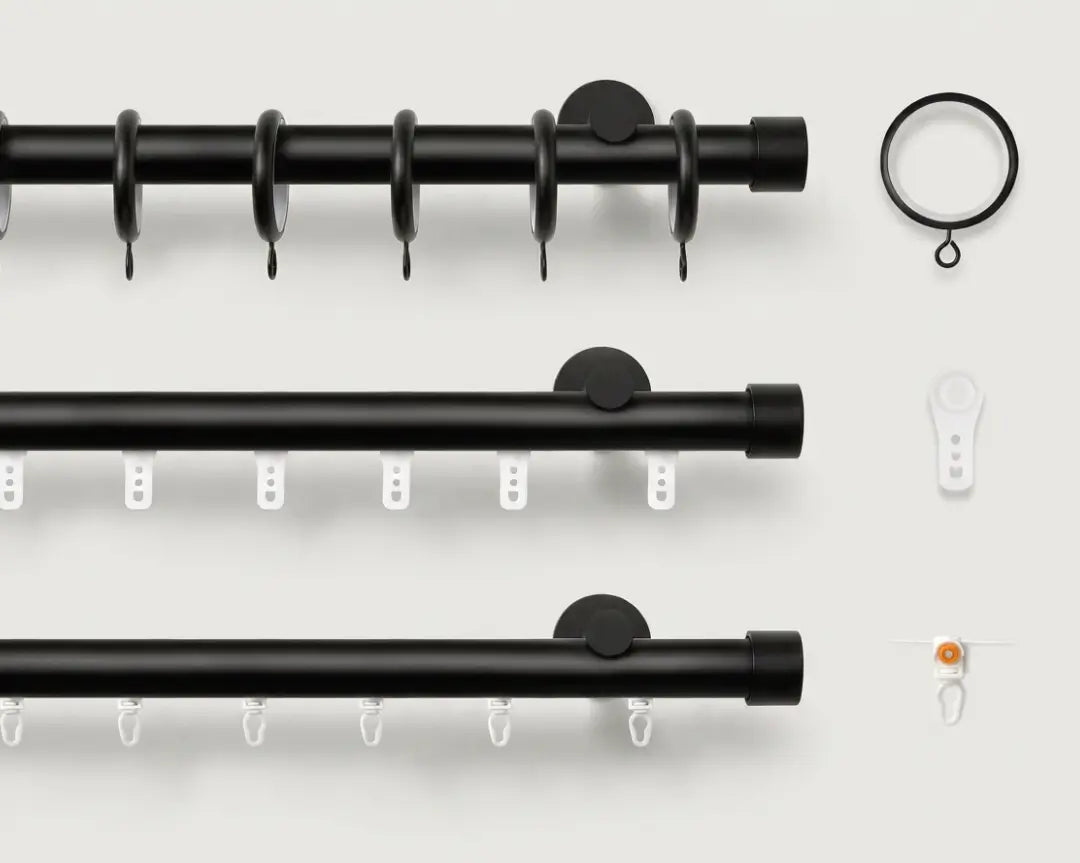
- Track, rod or tension rod
- Fabric that hides clutter
- Walk-ins, kids’ rooms, laundry, rentals
- The honest part
- Glossary
- FAQ
Are curtains better than bifold or sliding closet doors?
For access and small rooms, usually yes; for sound, dust and pets, no. Designer Kati Curtis told Homes & Gardens that curtains suit a wardrobe or pantry, where soundproofing and privacy matter less.
| Curtains | Bifold doors | Sliding (bypass) doors | |
|---|---|---|---|
| Access | The whole opening, if the track extends past it | Folded panels still cover part of it | Half the closet at a time |
| Hiding clutter | Good with opaque or lined fabric; sheers show everything | Complete | Complete |
| Sound | Softens noise, doesn’t block it | Blocks more | Blocks more |
| Pets and toddlers | Walk straight through | Can be kept shut | Can be kept shut |
Curtains are also the budget route: New Orleans designer Aaron Hahnselle told Southern Living they are more cost-effective, especially for cased openings that would otherwise need a custom door. And with no door swing, they free up floor space in tight bedrooms (see our small-space curtain guide).
How do you replace closet doors with curtains, step by step?
Remove the doors and track, patch, then measure from the new hardware, not the opening.
- Remove the doors. Bifolds ride on spring-loaded pivots: lift the panel, swing the bottom out of its bracket and drop the top pivot out of the track. Sliders lift and tilt out once the floor guide is off. If a post divides two sets of doors, confirm it isn’t structural first.
- Unscrew the old hardware. JELD-WEN’s bifold instructions fasten the track to the head jamb and the lower bracket to the jamb and floor; that is where the screws are.
- Patch and paint. Fill screw holes, hinge mortises and strike-plate holes, then repaint the jamb.
- Size the track and panels (next section).
- Screw into solid wood. The head jamb is solid. On drywall or between ceiling joists, use anchors rated for the load; our rod installation guide covers studs and anchors.
- Hang and check the edges. Close the panels and look for gaps. On a bracketed rod, a return (the panel edge wrapped back to the wall) closes the side gap; Fabritec’s workroom standard is 3½ inches.
How wide and long should closet curtains be?
Wide enough to fill a track that runs well past the opening, and long enough to float ½ to 1 inch above the floor. Size the track first.
Track width: leave room for the stack
Open curtains gather into a stack at each end; if the track stops at the edges of the opening, that stack hangs in front of your clothes. Fabritec’s rule of thumb: drapery stacks in about a third of its width, so add roughly 50% to the opening. The Kirsch pleated stack guide is more precise. For a pinch-pleated pair at 2x fullness:
| Closet opening | Typical doors it replaces | Track that clears it | Stack per side | Extend past each side |
|---|---|---|---|---|
| 36 in | Single door or bifold pair | 60 in | 11¼ in | 12 in |
| 48 in | 4-panel bifold or 2-panel slider | 72 in | 12 in | 12 in |
| 60 in | 4-panel bifold or 2-panel slider | 90 in | 14 in | 15 in |
| 72 in | 4-panel bifold or 2-panel slider | 102 in | 14½ in | 15 in |
| 96 in | 3-panel slider | 132 in | 17¼ in | 18 in |
Kirsch’s figures are estimates: heavy fabric stacks wider, sheers narrower. Door ranges are from Closet America’s size chart.
No wall beside the opening? Draw one panel toward the side with wall (by Kirsch’s one-way figures, a 36-inch opening needs a 54-inch track, 18 inches of it on that side), or mount inside and accept that a pair stacked inside a 48-inch opening covers about 20 inches of it.
Panel width and center overlap
Multiply the track length by the fullness you want and divide by the number of panels. Kirsch plans pleated drapery at 2x, 2½x or 3x; more fullness looks richer closed but stacks wider open, and our 1.5x vs 2x fullness comparison has the fabric math. For a pair, add a center overlap so the closed panels don’t gape; Fabritec’s standard is 2 inches per panel. A one-way panel has no center seam at all.
Length: hem ½ to 1 inch off the floor
Measure from the bottom of the track (the top of the rod, for grommets) to the floor at both ends and the middle, and use the shortest figure; Renin also says to measure at the floor’s highest point, carpet included. Lutron recommends ½ to 1 inch between a moving drapery panel and the floor, and the Emily Henderson blog hems door-replacing panels about half an inch up. Leo pin hooks ratchet through 3 inches, enough to level a hem over an uneven floor. Our curtain measuring guide covers the rest.
Ceiling track, rod or tension rod: which works best for a closet?
A ceiling track is cleanest and best for daily use, a wall rod is the easy middle ground, and a tension rod is for light panels on narrow openings. Our rods vs tracks guide covers general trade-offs; at a closet, the bigger question is where the hardware goes.
Ceiling track: the cleanest setup
Under an 8-foot (96-inch) ceiling, an 80½-inch bifold opening (one of Renin’s standard heights) leaves about 15 inches of wall above. A ceiling track in front of that band runs panels ceiling to floor and hides it. Lior is the slimmest option: a ceiling-mount aluminum track about ¼ inch thick and 1¼ inches deep, rated up to 15 kg (about 33 lb) with brackets. Tavira (ceiling or wall) carries about 53 lb per 24-inch section, using two brackets up to 39 inches plus one per additional 39 inches or so. Riven telescopes from 33–59 inches up to 150–283 inches. For a closet that fills a wall, see the ceiling-track approach in our curtains behind the bed guide.

Track in the head jamb
A slim track screwed into the head jamb nearly disappears; Mississippi designer Melanie Bryant told Southern Living that a track hidden by trim is what makes curtains used in place of doors feel custom. The catch: the stack now sits inside the doorway, so save this for wide closets or a single panel that pulls to the end you use least.
Rod above the opening
A wall rod suits grommet, ring and rod-pocket panels. Mount it 4 to 5 inches above the opening, Fabritec’s allowance to avoid a header shadow line, and extend it per the table. The Collins rod (wall or ceiling, custom length) is rated 22 lb per bracket. Long spans need a center support, which rings can’t pass, so split the draw there.
Tension rod
Needing no holes makes it the default renter fix, but keep it to light, unlined panels. Ratings fall as the rod extends: Heian Shindo lists one heavy-duty rod at 176.3 lb set at 29.6 inches but 110.2 lb at 43.3 inches, about 37% less. Check the rating at your width, and put blackout or lined panels on screwed-in hardware.
How panels attach to a track
Pinch-pleated panels hang from pin hooks seated in runners: Ethan runners go every 3.9 inches on a standard track (2.36 for ripple fold), and Tavira specifies one per 4 inches. Leo pin hooks are 3⅓ inches tall, 32 to a pack. Prefer an even wave? See ripple fold.

What fabric hides closet clutter best?
An opaque or lined fabric. Sheers and thin unlined panels show every hanger, especially with a light on inside the closet.
Iris, our linen-look blackout in 100% polyester, blocks 85–95% of light and fully hides what’s behind it; the blackout collection has more. Elara, a linen-blend (8% linen, 92% polyester) at 335 GSM with 35–45% light blocking, adds texture but blurs the shelves rather than hiding them, so it suits a tidy closet.
Match the wall or the window fabric and the closet recedes; go darker or patterned and it becomes a feature. Pick something easy to clean, since it’s handled daily (see our curtain washing guide), and consider a weighted hem so panels hang straight and don’t drift open.
What about walk-ins, kids’ rooms, laundry nooks and rentals?
Same method; what changes is the opening and what else lives in the closet.
Walk-in vs reach-in
Walk-ins usually have a single 32–36-inch hinged door or a pair, per Closet America, so one panel drawn toward the wall often does it. Reach-ins carry the wide 48–96-inch bifold and sliding openings, which suit a center-parting pair. Carving a dressing area out of a bedroom is a divider job; see our room divider guide.
Kids’ rooms
Use cordless, hand-drawn hardware. The CPSC says about nine children under 5 die every year from strangling on window coverings with cords, and calls cordless products the safest option. Skip looped tiebacks at child height, and prefer screwed-in hardware to a tension rod. More in our kids’ room ideas and child-safe curtain guide.
Laundry nooks and pantries
Dryer closets need airflow: Whirlpool’s dimension guide for one compact washer-dryer calls for openings of at least 48 square inches near the top of a closet door and 24 near the bottom. Follow your machine’s manual and keep fabric clear of the dryer. Doors also muffle machine noise; the Emily Henderson blog considered keeping its laundry doors behind curtains. Pantries split designers: Kati Curtis likes curtains there, while Alabama designer Ellie Stein calls them a nuisance on a busy pantry.
Rentals
Use a tension rod for light panels, or leave the doors and hang a track or rod in front, with brackets that project past the knobs (the same clearance math as curtains over blinds). If you remove doors, store them with their hardware bagged and labeled for move-out (the Emily Henderson team used the garage). Our renter no-drill comparison covers the rest.
Not here: furnace and water-heater closets
North Carolina’s Office of State Fire Marshal says to keep anything that can burn, curtains included, at least three feet from heating equipment such as furnaces, and links 54% of home heating fire deaths to equipment too close to things that can burn. NFPA’s heating tip sheet adds that water heaters and central heating should be installed by a qualified professional to local code and the manufacturer’s instructions, so ask your building department before touching that door. More in our guide to curtains and heaters.
The honest part: what a closet curtain won’t do
- Block sound. Designer Robin Gannon told Homes & Gardens that sound travels right through a drape; her firm uses pocket doors instead where privacy matters.
- Seal out dust. Plan on vacuuming or washing the panel on a schedule.
- Keep anyone out. Sophie Clemson notes in the same piece that a curtain won’t keep a cat or dog out; toddlers walk through too.
- Save energy. Jennifer Davis says doors are more efficient. On a cold outside wall, though, the EPA advises opening closet doors, since closets may be colder than rooms; a tied-back curtain makes that easy, but it is no substitute for insulating a cold wall, EPA’s other fix.
- Spare you the patching. Hinge mortises and track holes still need filler and paint.
- Look good cheaply. Skimpy panels, visible fixings and limp fabric read as a cover-up; done badly, Melanie Bryant warns, they look like a cheap alternative.
- Give back the whole opening for free. Without wall space for the stack, an inside-mounted pair covers about 40% of a 48-inch opening.
Glossary
Stack-back — the width an open curtain takes up when gathered at the end of the track.
Fullness — fabric width relative to track length; 2x means twice as wide.
Return — the panel edge that wraps back to the wall at the bracket.
Head jamb — the top piece of the door frame, where bifold tracks are screwed.
Portière — the traditional name for a heavy curtain hung across a doorway.
FAQ
Can I use curtains instead of closet doors?
Yes. Curtains can replace bifold, sliding or hinged closet doors and usually improve access. Extend the track past the opening so the gathered fabric clears it, float the hem half an inch to an inch off the floor, and use opaque or lined fabric to hide the contents.
Are closet curtains tacky?
They can be when the panels are skimpy, the fixings show or the fabric is too light to hang well. Generous fullness, floor-length panels and a ceiling track or a track hidden by trim make them look intentional.
How long should closet curtains be?
Floor length, with the hem about half an inch to an inch above the floor so the panels slide without dragging. Measure from the track or rod to the floor at both ends and the middle, and use the shortest figure.
How wide should closet curtains be?
Size the track first: for full access with pinch-pleated panels at 2x fullness, extend it about 12 inches past each side of a 36- or 48-inch closet and about 15 inches for 60 to 72 inches. Then multiply the track length by the fullness and divide by the number of panels.
Can you use a tension rod in a closet?
Yes, for light, unlined panels on a narrow opening; it is the easiest renter option because it needs no holes. Ratings drop as the rod extends, so check the rating at your width and put heavy panels on screwed-in hardware.
Should closet curtains hang inside the opening or in front of it?
In front of it, on a track or rod extended past the opening, if you want the whole closet accessible. Mounting inside hides the hardware, but a pinch-pleated pair at 2x fullness stacks about 10 inches per side in a 48-inch opening.
What are closet curtains called?
Most people say closet curtains or closet drapes. The traditional term for a heavy curtain hung across a doorway is a portière.
Ready to plan yours? Start with the hardware in our rods and tracks collection, then size made-to-measure panels in custom curtains, where the price follows the size, fabric, lining and heading you choose. Order free swatches first and hold them up with the closet light on to see whether a fabric hides your shelves or only softens them.
