




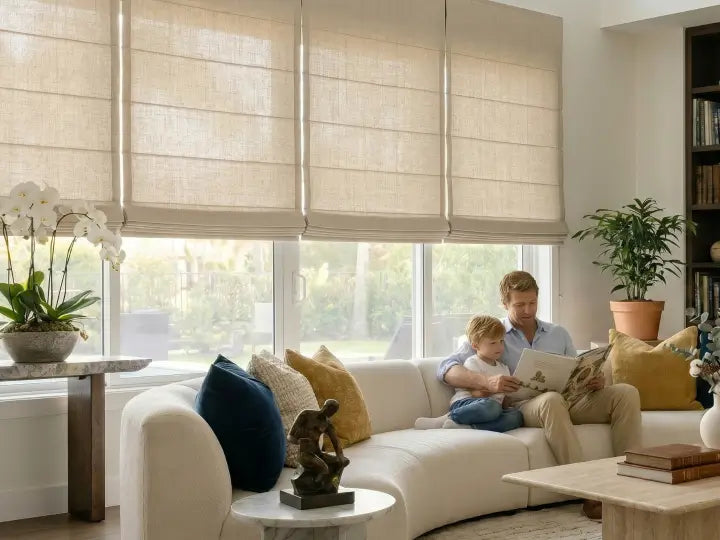

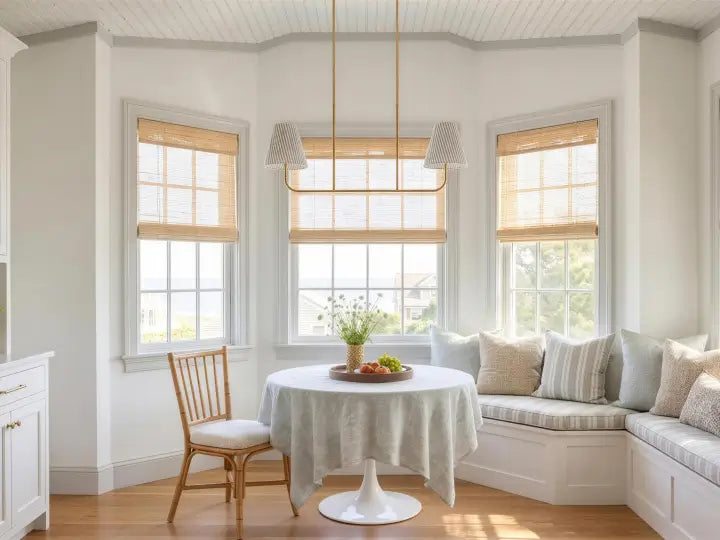

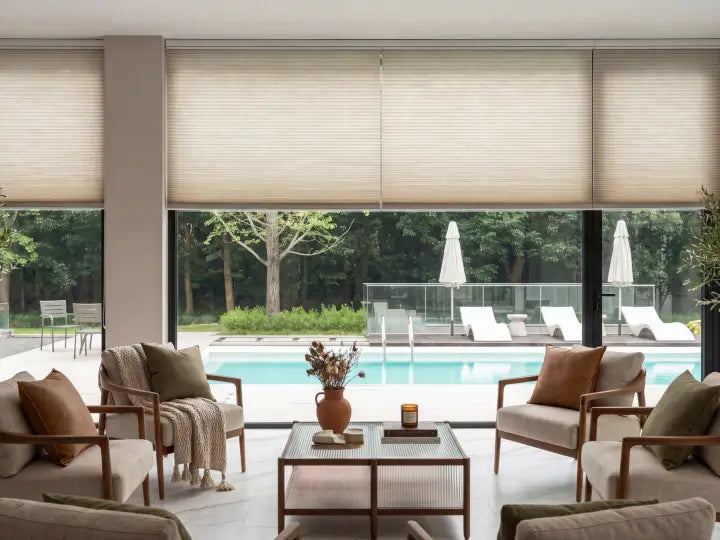

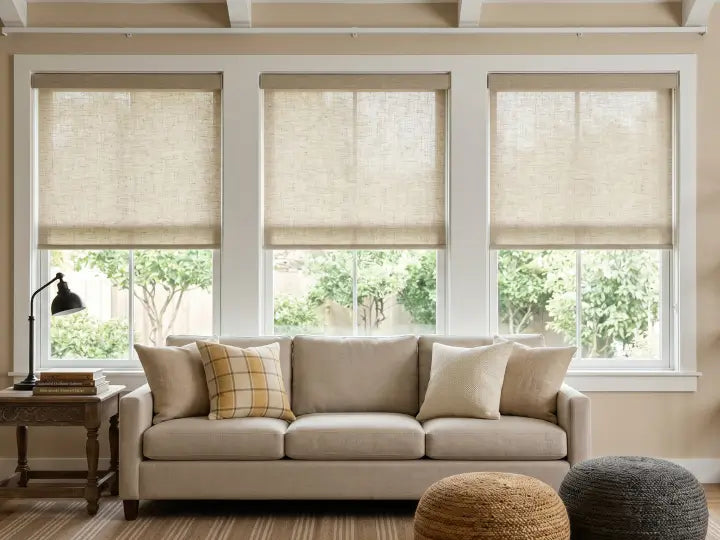












Light Filtering vs Room Darkening vs Blackout: 3 Levels Explained
Three labels sit on almost every curtain and shade you will shop for, and the percentages printed next to them disagree by 30 points or more. Here is what each level actually does, why the numbers don't line up, and how to get the darkness you want.
The short answer
Light filtering softens daylight and keeps a room bright. Room darkening dims it enough for a nap or a movie, but light still glows through the fabric. Blackout fabric stops light passing through the cloth itself. Room darkening is not blackout, and no US standard defines either label, so brands quote anywhere from about 60% to 99% for "room darkening."
What decides how dark your room really gets: the face fabric, the lining, the color, and above all the gaps around the edges. A blackout panel hung tight to the frame usually leaves a room brighter than you expect, because light leaks around the edges.
In this guide
- The three levels at a glance
- Is room darkening the same as blackout?
- Why every brand quotes a different percentage
- Curtains vs shades at each level
- How lining sets the level
- Where the light really gets in
- Which level for which room
- What the extra darkness costs
- Five myths to drop
- The honest part
- How to check before you buy
- Glossary
- FAQ
The three levels at a glance
Think of the labels as points on a dimmer, not separate products: the same curtain can land at any of them depending on what is sewn behind it.
| Light filtering | Room darkening | Blackout | |
|---|---|---|---|
| What it does | Softens and spreads daylight; glare drops, the room stays bright | Dims the room enough for a nap or a movie; you can still see the fabric glow | Stops light passing through the fabric itself |
| Typical claims | Varies most: "under 50%" (Blindsgalore), 30–60% (Allure) | From about 60–80% to 95–99%, depending on the brand | From 80–100% to 100%; The Shade Store says "up to 99%" |
| Daytime privacy | Good: shapes, not detail | Very good | Complete |
| Night privacy | Weak once lamps are on: silhouettes show | Good | Complete |
| Fabric clue | Unlined or lightly lined; you can see the weave against the light | Dense weave, darker color or a lining | Coated, foam-backed or blackout-lined; a flashlight barely shows through |
| Best for | Living rooms, kitchens, dining rooms, offices | Most bedrooms, guest rooms, TV corners | Nurseries, day sleepers, media rooms, streetlit bedrooms |
Some brands add a lighter fourth level, sheer; Hunter Douglas uses five opacities. Before choosing light filtering for a street-facing room, read can you see through sheer curtains at night.

Is room darkening the same as blackout?
No, and the difference is easy to see in your hand. Hold a room-darkening fabric up to a window and it glows; hold a blackout fabric up and it looks like a solid shape. Hunter Douglas puts it plainly: room-darkening fabrics don't entirely eliminate light, so they are not considered blackout (Hunter Douglas).
Lutron defines blackout fabrics as having zero openness and blocking 100 percent of daylight (Lutron), while retailers such as Blindster and Janovic put room darkening at 95 to 99 percent. That last 1 to 5 percent sounds small. On a bright morning it is the difference between "dim" and "is it still night?"
Shoppers rarely meet that definition in practice. Marketplace titles often combine both words, and Wirecutter reported in 2019, after testing curtains sold as blackout, that very few blocked all light (Wirecutter).
Why every brand quotes a different percentage
Because nobody has to use the same one. In the US there is no federal or industry-mandated threshold for "light filtering," "room darkening" or "blackout" (Allure Window Treatments). There are lab methods for measuring how much light a textile blocks, such as AATCC Test Method 148 (AATCC), but they measure; they don't award a label (Specialty Fabrics Review).
Europe is stricter on paper. EN 14501 sorts blinds and shutters into darkening classes 0 to 4, measured to EN 14500, and the standard itself acknowledges that a whole installed product lets in more light than its fabric alone because of side gaps (Louvolite on EN 14501). The UK also uses "dim-out" for fabrics that dim without going fully dark (Nooteboom); its closest US equivalent is room darkening.
So the percentages you see are each brand's own. Here is how widely they spread:
| Source | Room darkening | Blackout | Type of source |
|---|---|---|---|
| Lutron | no room-darkening tier; dim-out/privacy fabrics = 0–1% openness | 100%, 0% openness | Shade fabric maker |
| Blindster | 95–99% | 99–100% | Retailer |
| Blinds.com | about 95% | "blocks all incoming light" | Retailer |
| Janovic | 95–99% | nearly 100% | Retailer |
| Blindsgalore | about 85–99% | nearly 100% | Retailer |
| Allure Window Treatments | 95–99% | 99–100% | Dealer |
| Stein Mart | 70–90% | 95–100% "when properly installed" | Retailer |
| Curtarra | about 60–80% | 80–100% | Curtain maker |
| Hunter Douglas | no percentage: "block almost all light" | no percentage | Shade maker |
Read it as a range: "room darkening" means somewhere between noticeably dim and almost dark, and only the stated percentage, a swatch and the installation tell you where.
Color moves the number too. Consumer Reports shone a 5,000-lumen flashlight through 18 curtains from 9 brands and found that, for most brands, darker colors blocked more light; only two brands blocked light well across their colors (Consumer Reports). IKEA's ROSENMANDEL line has been sold as room darkening in yellow-beige and as blackout in dark green and gray (Hunker).
Curtains vs shades at each level
Most guides cover either curtains or shades. Both reach all three levels, but they do it differently and leak in different places:
| Window treatment | How you get each level | Where light gets in |
|---|---|---|
| Curtains and drapes | Face fabric plus lining: unlined or lightly lined = filtering; dense fabric or room-darkening lining = darkening; blackout lining or coated fabric = blackout | Over the rod, at both sides, and where two panels meet |
| Roman shades | The same fabric-plus-lining logic as curtains, in a flat folding panel | At the sides when mounted inside the frame, and between the folds |
| Roller shades | Choice of fabric: light-filtering, solar screen or blackout | A side gap of roughly 3/16 to 3/4 inch per side when inside-mounted |
| Solar or screen shades | Rated by openness (1%, 3%, 5%, 10%), not darkness; they cut glare and keep the view, but they are not room darkening | Through the weave by design |
| Cellular shades | Usually offered in light-filtering and blackout versions; the honeycomb also insulates | At the sides; side channels are an add-on on some systems |
Solar shades deserve a warning. Their rating is openness, the share of open space in the weave, which controls glare and view rather than darkness. Openness is not the same as light let through, either: Lutron's SheerLite screen fabrics at 3 to 5 percent openness transmit roughly 7 to 20 percent of visible light depending on color (dealer listing of Lutron specs). A 1 percent screen is not a 99 percent blackout. Lutron itself defines blackout as zero openness (Lutron).
If you are still deciding between the categories themselves, our curtains vs blinds vs shades guide compares them on cost, insulation and look.
How lining sets the level
For curtains and Roman shades, the level is mostly a choice you make at checkout, not a fixed property of the fabric. Here are the lining options on Freshine custom curtains and Roman shades, with the light block each one is rated for:
| Freshine lining option | Stated light block | What it is called | Where it usually lands |
|---|---|---|---|
| Unlined | Face fabric only | — | Light filtering (sheer to semi-sheer fabrics) or room darkening (dense, dark fabrics) |
| White 30% | Blocks 30% of sunlight | Privacy lining | Light filtering with a cleaner, fuller look |
| White or beige 50% | Blocks 50% of sunlight | Privacy lining | Light filtering to light room darkening |
| White or black 80% | Blocks 80% of sunlight | Room-darkening lining | Room darkening |
| Black or white 100% | Blocks 100% of sunlight | Blackout lining | Blackout at the fabric (gaps still matter) |
All four lining tiers are 100% polyester microfiber. Our own product pages add an important caveat: the final light-blocking ratio depends on the face fabric you put in front of the lining. Two examples from our range:
- Amara, a polyester-linen blend (20% linen), is rated 30–40% light blocking on its own. Unlined, it is a classic light-filtering curtain.
- Celina, a polyester-linen blend (30% linen) at 350 gsm, is rated 40–50% on its own. With an 80% lining it moves into room darkening; with a 100% lining it becomes a blackout-lined panel. The same fabric comes as a Celina Roman shade with the same lining choices.
Some fabrics are blackout without a separate lining: Isadora (100% polyester) is rated 100% light blocking, and Arlise chenille is made with a built-in blackout lining.
Why does a white blackout curtain sometimes glow while a white blackout lining doesn't? It comes down to how the dark layer is built. A "3-pass" coating sandwiches a black layer between two white ones, so even a white 3-pass back blocks light fully (Hotel Drapery & Bedding). Triple-weave "blackout" fabrics weave dark yarn between two face layers instead, and pale versions can still glow in strong sun (Nicetown); a quick tell is a back that looks the same as the front (The Hues). For how linings are sewn and when interlining makes sense, see curtain lining explained, and for how blackout fabric itself works, how blackout curtains work.
Where the light really gets in
Once a fabric is rated near 100 percent, almost all the remaining light comes in around it, not through it. Hunter Douglas makes the same point about "dark" rooms (Hunter Douglas), and Lutron says a side channel is required for total blackout on a shade (Lutron).

The numbers that matter:
- Inside-mount shades always leave a side gap, quoted at about 3/16 to 3/4 inch per side (Blindster) or 1/4 to 1/2 inch (World Wide Shades). Our own inside-mount Roman shades are made slightly narrower than the opening so they raise and lower cleanly, and our blackout lining notes warn that minor light gaps can occur between the folds.
- Outside-mount shades cover the gap by overlapping the frame. For our Roman shades we recommend 1 to 3 inches past each side and mounting 4 to 6 inches above the opening; one blackout-shade retailer suggests 2 to 3 inches per side (Blindster).
- Curtains leak over the rod, at the sides and in the middle. One common rule is a rod 4 to 6 inches above the frame and 3 to 6 inches past each side (uBlockout), with panels that overlap where they meet. Return or wraparound rods bring the fabric back to the wall and close the side gap; a ceiling-mounted track removes the gap above. Our rods vs tracks guide covers the trade-offs.
Doubling up often helps more than upgrading one layer: a room-darkening shade inside the frame behind blackout-lined drapes hung wide and high can leave a room darker than a single "100%" product mounted tight; our layering guide and curtains over blinds guide show the clearances.
Which level for which room
How dark is dark enough? Some reference points. A full moon delivers about 0.1 to 0.3 lux (Kyba et al.). A 2022 expert consensus in PLOS Biology recommends a sleep environment at or below about 1 lux of melanopic light at the eye (Brown et al., PLOS Biology). In a small Northwestern University study of 20 healthy young adults, one night of sleeping with overhead lights on (100 lux), compared with under 3 lux, raised heart rate during sleep and next-morning insulin resistance (Mason et al., PNAS 2022)(Northwestern summary). The Sleep Foundation suggests blackout curtains or blinds when your current coverings don't block enough outside light, and reminds you that chargers and clocks count too (Sleep Foundation).
That is why the right level depends on when you sleep and what is outside, not just on the room's name:
| Room or need | Usual pick | Why | Layered alternative |
|---|---|---|---|
| Nursery, toddler room | Blackout | Daytime naps; room darkening is usually not enough for infants | Blackout curtains plus a light-filtering shade for daytime play |
| Shift worker, day sleeper | Blackout | Sleeping through full daylight | Blackout curtains with return rods, plus an eye mask for edge light |
| Bedroom facing a streetlight | Blackout or strong room darkening | Light at night is the problem, not the morning | Room-darkening shade behind blackout-lined drapes |
| Bedroom, regular hours | Room darkening | Dark enough to sleep, still wakes you with morning light | Light-filtering shade plus room-darkening curtains |
| Media or TV room | Blackout or room darkening | Glare on screens; contrast for movies | Blackout curtains over a solar shade |
| Home office | Light filtering or solar shade | Cuts screen glare without making the room gloomy | Solar shade plus unlined curtains |
| Living or dining room | Light filtering | Rooms you use by day; blackout reads heavy and flat | Lined curtains for evening privacy |
| Kitchen, bathroom | Light filtering | Privacy without losing daylight | Top-down/bottom-up shade or a café curtain |
Sources do disagree on ordinary bedrooms. Installers such as Lone Star Shutter reserve blackout for shift workers, light sleepers and toddlers and suggest room darkening for most people (Lone Star Shutter). In daytime rooms the advice runs the other way: designers interviewed by Livingetc argue against blackout in kitchens and rooms used for hosting (Livingetc).
For room-specific ideas, see the best curtains for a bedroom, kids' room curtain ideas and home theater curtains.
What the extra darkness costs
Less than most people assume. Listed starting prices from US retailers on November 1, 2026 (they change often):
- West Elm's European Flax Linen tie-top curtain starts at $169 light-filtering and $189 blackout (light filtering)(blackout).
- Blinds.com's MyBlinds roller shade starts at $77.17 light-filtering and $80.49 blackout (light filtering)(blackout).
- The Shade Store charges a small surcharge for blackout lining on drapery and includes privacy or blackout lining on Roman shades (The Shade Store).
The bigger cost can be a wider rod or a ceiling track to stop edge leaks. For custom pricing, including lining, see how much custom curtains cost.
Five myths to drop
- "Room darkening is just a softer word for blackout." It isn't. The fabric still transmits some light, and depending on the brand that can be anywhere from about 1% to 30% or more.
- "Black fabric blocks all light." Color helps in single-layer fabrics, but construction decides: a white fabric with a coated back can block more than an unlined black one.
- "A 1% solar shade is 99% blackout." Openness measures the holes in the weave, not darkness. Screens are for glare and view.
- "100% blackout means a pitch-black room." It describes the fabric. The gaps around it are where most of the remaining light comes from.
- "Blackout curtains are thermal curtains." Blackout is about visible light. Heat depends on insulation, backing and how tightly the treatment seals against the window. Department of Energy research found cellular shades outperformed other common window attachments (DOE fact sheet); for curtains, see what thermal curtains really do.
The honest part
Each level has a real downside, and choosing well means accepting one of them.
- Blackout can look heavy. Coated and foam-backed linings are stiffer, and budget panels can flare at the hem instead of falling in soft folds; foam backings can also degrade with heat and humidity over time (Curtain-fabric.com). A well-draped face fabric and a sewn-in lining can hide much of this.
- Blackout makes daytime rooms gloomy. If you leave the curtains closed by day, you lose the light that made the room pleasant. That is why designers steer kitchens and living rooms away from it.
- Room darkening disappoints people who wanted blackout. If you need full darkness, buy for it; a "very dark" fabric will still glow at 6 a.m. in June.
- Light filtering gives up night privacy. With lamps on, shapes show through. A lining or a second layer fixes it.
- Labels are only as good as the seller. With no standard, a percentage is a claim, not a certification. Ask how it was measured, and check a swatch yourself.
We sell all three levels, and the cheapest fix for a bright bedroom can be a wider, higher rod rather than a new fabric.

How to check before you buy
- Do the flashlight test. Hold a phone flashlight or a bright lamp behind the fabric in a dim room. A glow means filtering or room darkening; a dark shape means blackout. Consumer Reports used the same idea with a 5,000-lumen light (Consumer Reports).
- Look at the back. A smooth, coated or separately lined back points to blackout; a back that matches the front in a pale color may glow.
- Read the lining line, not just the title. A product name that says "blackout" may describe one lining option, not every version.
- Test in your own window. Order free swatches and hold them against the glass at the time of day you care about, morning sun for a bedroom, late afternoon for a west-facing office.
- Plan the gaps. Decide on inside or outside mount, rod height and width before you order lengths; see how to measure for curtains.
Glossary
Light filtering: fabric that diffuses daylight and keeps a room bright while giving daytime privacy.
Room darkening: fabric or lining that dims a room substantially but still lets some light glow through the cloth.
Blackout: fabric, coating or lining intended to stop light passing through the cloth itself.
Dim-out: a mostly UK and European term for fabric that dims without full darkness; closest US equivalent is room darkening.
Openness factor: the share of open space in a solar or screen shade weave, typically 1% to 10%; it governs glare and view, not darkness.
3-pass coating: a blackout backing with a black layer between two white layers, so a pale back still blocks light.
Return rod: a curtain rod whose ends curve back to the wall so the fabric closes the side gap.
FAQ
Is room darkening the same as blackout?
No. Room darkening fabric dims a room a lot but still lets some light glow through the cloth; blackout fabric is meant to stop light at the fabric itself. No US standard defines either label, and some products sold as room darkening block much less, so check the stated percentage and do a flashlight test.
What are the 3 levels of light blocking?
Light filtering, room darkening and blackout. Light filtering softens daylight and keeps a room bright, room darkening makes it dim enough for a nap but not pitch black, and blackout fabric stops light passing through the cloth. Sheer is sometimes counted as a fourth, lighter level.
Can people see through light filtering curtains at night?
Often, yes, at least as silhouettes. At night the lit room is brighter than the street, so light-filtering fabric that hides you by day can show shapes after dark. Lining the curtain or adding a second, opaque layer fixes it.
Is room darkening or blackout better for a bedroom?
It depends on who sleeps there. Blackout suits day sleepers, shift workers, light-sensitive sleepers and rooms facing streetlights; room darkening suits most people who sleep at night and like some morning light. Either way, gaps at the sides and top matter as much as the fabric.
Should a nursery have blackout or room darkening curtains?
Many guides, including installers such as Lone Star Shutter, recommend blackout for nurseries and toddler rooms, because babies nap in daylight and room-darkening fabric usually is not dark enough. Pair it with a wide, high rod or side coverage so light does not leak around the edges.
Why do my blackout curtains still let light in?
Almost always through gaps, not the fabric: at the sides, over the rod and where the panels meet. Mount the rod higher and wider than the frame, overlap the panels and consider return rods. A pale fabric without a coated or lined back can also glow.
Are blackout curtains also thermal curtains?
Not necessarily. Blackout describes how much visible light a fabric stops; thermal performance depends on insulation, backing and how well the curtain seals against the window frame. Many thermal curtains are blackout; not every blackout curtain is thermal.
Ready to choose? Browse room darkening curtains for bedrooms and TV rooms, blackout curtains for nurseries and day sleepers, semi-sheer curtains for living spaces, and Roman shades with the same lining choices. Every custom panel is made to your width, length and lining, so you can pick the level per room instead of per product.
